
What to say in Court
Original price was: $297.00.$197.00Current price is: $197.00.
Class Schedule
December 6- Evidence Objections and Preservation of the Record
December 9- Jurisdictional Challenges, the Sixth Amendment & the Verification Doctrine
December 16- Negative Averments & the Verification Doctrine
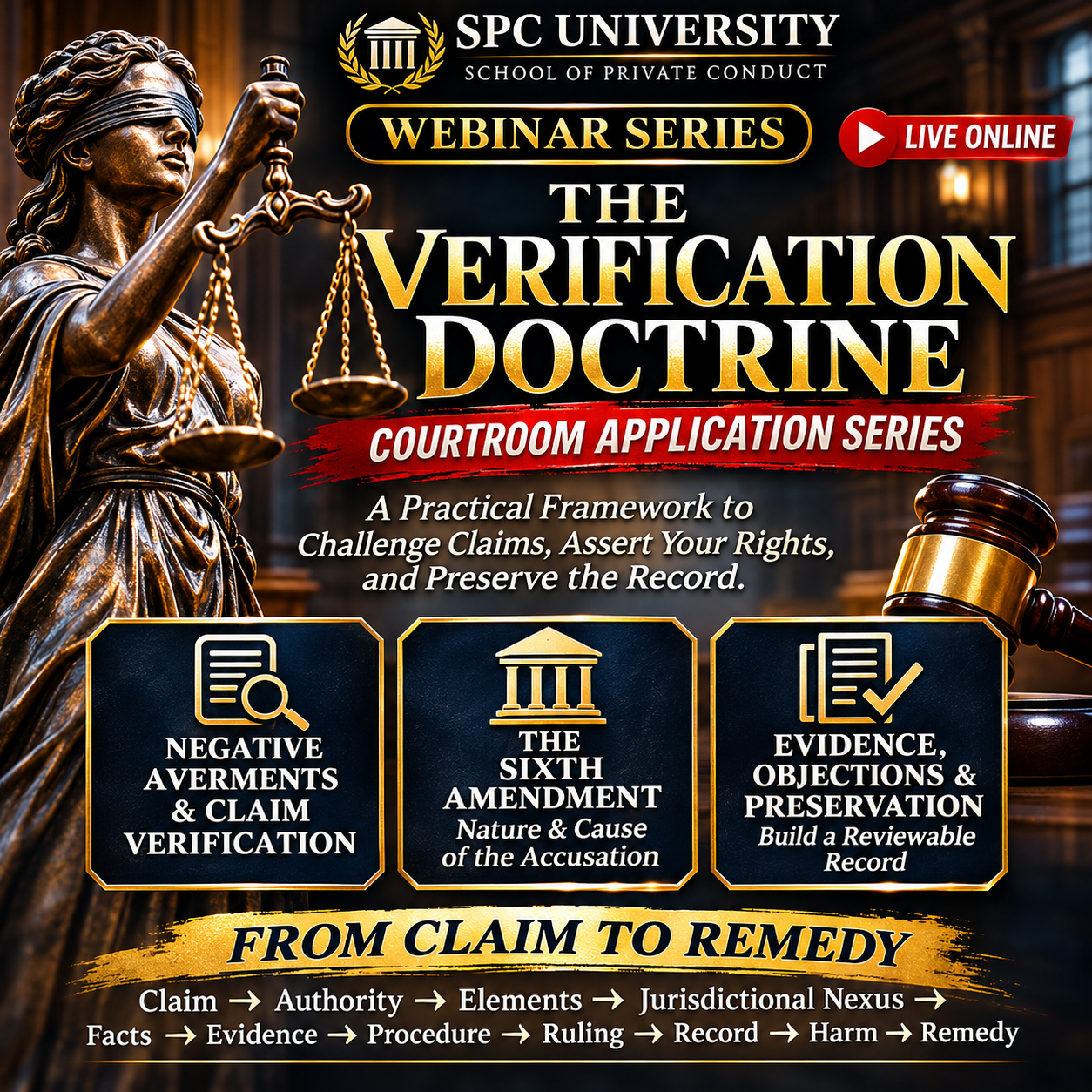
Master the courtroom application of the Verification Doctrine with this practical webinar series covering negative averments, Sixth Amendment nature-and-cause challenges, jurisdictional elements, evidentiary objections, offers of proof, and preservation of error.
Learn how to move beyond general denials and “prove jurisdiction” arguments by identifying the correct authority, elements, facts, evidence, procedural requirements, and remedies.
Claim → Authority → Elements → Evidence → Ruling → Record → Remedy
Designed for students who want a more disciplined, courtroom-ready approach to legal verification and preservation.
Description
VERIFICATION DOCTRINE: COURTROOM APPLICATION SERIES
Knowing the law is not enough.
You must also know how to:
identify the claim,
identify the authority,
identify the elements,
challenge the accusation,
preserve the issue,
and build a record that can actually be reviewed.
This webinar series is designed to move students beyond slogans, blanket denials, and generic “jurisdiction challenges” and into a more disciplined method of courtroom analysis.
We will focus on three core areas:
1. NEGATIVE AVERMENTS & CLAIM VERIFICATION
Learn the difference between simply saying:
“I did nothing wrong.”
and forcing the claimant to establish:
What law?
What authority?
What elements?
What facts?
What evidence?
What remedy?
Students will learn how to challenge conclusions without merely arguing against them.
The goal is to move from:
Denial
to
Verification.
2. THE SIXTH AMENDMENT — NATURE & CAUSE OF THE ACCUSATION
In a criminal prosecution, the accused has a constitutional right to understand the nature and cause of the accusation.
We will examine how to ask better questions concerning:
• the classification of the proceeding
• the specific statute charged
• the essential elements of the offense
• jurisdictional elements and statutory nexus requirements
• factual allegations
• subject-matter jurisdiction
• charging documents
• notice sufficient to prepare a defense
Students will also learn the critical difference between:
subject-matter jurisdiction
and
a jurisdictional element of the offense.
Instead of merely saying:
“Prove jurisdiction,”
you will learn how to identify exactly which jurisdictional issue is actually being challenged.
3. EVIDENCE, OBJECTIONS & PRESERVATION
A correct argument can still become useless if it is not properly preserved.
This portion of the series will examine:
• timely objections
• specific grounds for objections
• obtaining a ruling from the court
• offers of proof
• excluded evidence
• unsworn attorney statements
• hearsay versus lack of personal knowledge
• authentication
• affidavits and documentary evidence
• formal bills of exception
• appellate preservation
• building a reviewable record
Students will learn one of the most important courtroom principles:
Filed does not necessarily mean admitted.
Argument is not necessarily evidence.
An objection without a ruling may not preserve the issue.
Excluded evidence that never enters the record may be impossible to review.
THE VERIFICATION DOCTRINE FRAMEWORK
Throughout the webinar, we will work from this sequence:
Claim → Authority → Applicability → Elements → Jurisdictional Nexus → Facts → Evidence → Procedure → Ruling → Record → Harm → Remedy
This is not about arguing with judges.
It is not about magic words.
It is not about repeating “I challenge jurisdiction.”
It is about learning how to ask the correct legal question at the correct procedural stage.
The purpose of this series is to help students understand how to transform:
belief into analysis,
analysis into objection,
objection into preservation,
and preservation into a record.
THIS SERIES IS FOR STUDENTS WHO WANT TO LEARN:
• how to challenge claims precisely
• how to identify jurisdiction correctly
• how to understand the accusation
• how to distinguish legal conclusions from evidence
• how to preserve objections
• how to create an appellate record
• how to avoid common procedural mistakes
• how to apply the Verification Doctrine in an actual courtroom setting
CORE PRINCIPLE
Do not answer a conclusion with another conclusion.
Ask:
What is the claim?
What is the authority?
What must be proven?
What facts allegedly satisfy the elements?
What evidence supports those facts?
What ruling did the court make?
Was the issue preserved?
What remedy is authorized?
That is courtroom verification.
Verified Information First.
Preserved Information Second.
Everything Else Follows.

Reviews
There are no reviews yet.