Description
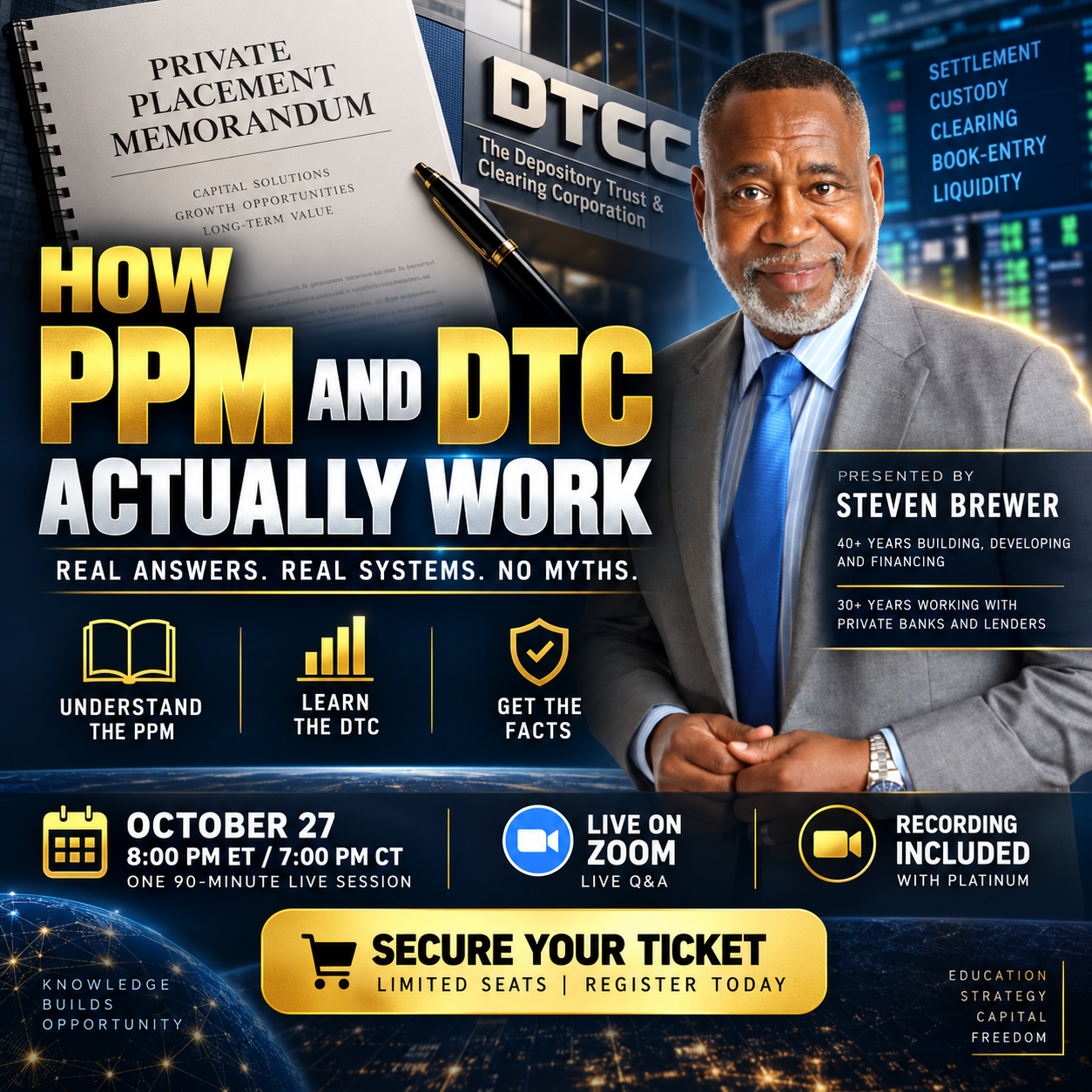
How PPM and DTC Actually Work
October 27 at 8:00 PM ET / 7:00 PM CT. One 90-minute live session.
Who This Session Is For
This session teaches what the DTC actually is and how it works, and what a Private
Placement Memorandum actually is and how it is used. No myths, no shortcuts,
just the real system explained from the inside.
Founders and issuers planning a private raise under Regulation D who want to
understand what investors expect to see in a Private Placement Memorandum.
Small-cap and emerging public companies exploring how restricted securities can
become DTC eligible and what that means for liquidity and trading.
Transfer agents, brokers, and market makers who support issuers through the
deposit and eligibility process and want a clearer view of how the PPM and DTC fit
together.
Securities attorneys, accountants, and advisors who guide clients through private
placements and want a practical refresher on documentation and compliance
considerations.
Investors and fund managers evaluating private placements who want to
understand how holding form, resale restrictions, and DTC eligibility affect
liquidity.
Anyone who has been told the DTC or a PPM can be used to access funds in their
name and wants the truth about what both really do.
Secure Your Ticket. Live session. The recording is included with Platinum.
About the Presenter
40+ Years building, developing, and financing.
30+ Years working with private banks and lenders.
90 Minutes live, with teaching and real-time questions in the same session.
Session Agenda
Three modules covering what a PPM is and how it is used, what the DTC is and
how it actually works, and the path from restricted securities to DTC eligibility.
Module 01. Private Placements and the PPM
Learning objectives. By the end of this module, attendees will be able to:
Explain why issuers choose private placements over registered offerings.
Distinguish between Rule 506(b) and Rule 506(c) of Regulation D.
Identify the core sections of a Private Placement Memorandum and what each is
for.
Topics covered
Why private placements: speed, lower cost, flexibility, and fewer disclosure
burdens than a registered public offering.
Regulation D essentials: Rule 506(b) versus Rule 506(c), accredited investor
verification under 506(c), general solicitation rules, the Form D notice filing, and
state blue sky notice filings.
Anatomy of a PPM: business overview and strategy, offering terms (security type,
price, minimum investment), use of proceeds, management and key personnel,
financial information, risk factors, conflicts of interest, transfer restrictions, and
subscription procedures.
Liability and anti-fraud: why Rule 10b-5 still applies to exempt offerings and why
vague or overly optimistic disclosure is risky.
Common drafting mistakes: incomplete risk factors, unsupported projections, and
inaccurate statements about liquidity.
Key takeaways
A PPM is both a marketing-adjacent document and a legal shield, so accuracy
matters more than persuasion.
Exempt does not mean unregulated.
Activity. Attendees review a short sample use of proceeds paragraph and flag what
is vague, unsupported, or potentially misleading.
Module 02. Understanding DTC and How Securities Are Held
Learning objectives. By the end of this module, attendees will be able to:
Describe the role of The Depository Trust Company within DTCC.
Explain book-entry ownership and what street name means.
Compare DTC-held securities with certificated and direct registration securities.
Topics covered
What DTC is: a U.S. central securities depository and subsidiary of The Depository
Trust and Clearing Corporation, supporting clearing and settlement for equities,
corporate and municipal bonds, and money market instruments.
Immobilization and book-entry: why electronic records replaced physical
certificates.
Key players: DTC participants (broker-dealers and banks), Cede and Co. as DTC’s
nominee, transfer agents, and the National Securities Clearing Corporation.
How a trade settles: a simplified walkthrough from order to settlement.
Ways to hold securities: street name through a broker at DTC, direct registration
(DRS) on the issuer’s books at the transfer agent, and physical certificates.
Key takeaways
DTC eligibility is what lets shares move through brokerage accounts in book-entry
form.
How a security is held affects how easily an investor can sell it.
Activity. A quick poll asks attendees to match scenarios, such as shares in a
brokerage account or shares held directly with the transfer agent, to the correct
holding method.
Module 03. Bridging the Two: Restricted Securities and DTC Eligibility
Learning objectives. By the end of this module, attendees will be able to:
Explain why most private placement securities start out restricted and are not DTC
eligible.
Outline the general path to DTC eligibility.
Describe how a PPM should disclose liquidity limits and holding form.
Topics covered
Restricted securities: what they are, restrictive legends, and Rule 144 holding
periods.
What DTC eligibility requires: a sponsoring DTC participant (often an underwriter
or market maker), the transfer agent’s role, and the eligibility application process.
Why eligibility is not automatic: issuer compliance history, availability of current
public information, and the possibility of deposit chills or global locks.
Legend removal and deposit: how and when restricted shares can enter the DTC
system, generally with an opinion of counsel and transfer agent processing.
Aligning the PPM with reality: stating clearly whether DTC eligibility is planned,
possible, or unavailable; disclosing holding periods and resale restrictions; and
avoiding any suggestion that investors can quickly sell.
Pitfalls to avoid: overpromising liquidity, ignoring bad actor disqualification under
Rule 506(d), and treating DTC eligibility as a guaranteed outcome.
Key takeaways
Liquidity is a disclosure issue as much as a mechanical one.
Set investor expectations early and in writing.
Activity. Attendees receive a short case study of a company completing a
Regulation D raise and later seeking DTC eligibility.
Registration Tiers
Select your registration package below. Confirmation and access details are sent
at checkout.
Webinar Ticket. $97
One-time admission. Live Zoom session.
Live Zoom admission.
Real-time Q&A participation.
Full walkthrough of what a PPM and the DTC actually are and do.
Automated confirmation and calendar invite.
Register for $97.
Live session access only. The replay recording is not included in this tier.
Platinum Ticket. $297. Most Popular
Complete session and toolkit.
Live Zoom admission with priority Q&A queue.
Full HD replay recording access.
Physical and digital copies of The PPM Playbook.
Capital Execution Model and Worksheets.
Post-webinar implementation checklist.
Claim Platinum for $297.
Replay access and physical book shipment included.
PPM Playbook. $29
Digital edition. Self-paced guide.
Complete PPM Playbook digital ebook (PDF and ePub).
Private Placement Memorandum structuring guide.
Immediate delivery through the Whop portal and automated email.
Essential capital raising clauses and terms reference.
Download the Book for $29.
Standalone digital reference manual. Does not include webinar admission.
Secure SSL encryption. Payments are processed through Stripe and GoHighLevel.
Visa, MasterCard, American Express, Discover, and Apple Pay are accepted.
Registration Details
Straight answers before you buy. Everything about tickets, delivery, and what
comes after is here. For anything else, reply to your confirmation email and a
person answers.
When the confirmation arrives.
When Platinum receives the recording.
How the ebook and worksheets are delivered.
Whether the session is recorded for the webinar ticket.
Whether a ticket can be transferred or an email changed.
Contact Support.
Important Educational Notice
How PPM and DTC Actually Work, its materials, and The PPM Playbook are produced for
educational purposes only. Steven Brewer is not acting as your securities attorney, brokerdealer, investment adviser, transfer agent, or placement agent. Nothing presented is legal,
tax, or investment advice, and nothing is a recommendation regarding any specific
investment or offering. No introductions to investors or capital are provided. This session
does not teach, endorse, or provide any method of accessing funds through a birth
certificate, Social Security number, UCC filing, bond, or any account claimed to exist at the
DTC, the Treasury, or the Federal Reserve. No such method exists. Whether any securities
exemption is available for a particular offering depends on its facts, and every actual
offering requires review by qualified securities counsel licensed in the relevant jurisdiction.
DTC eligibility is determined by DTC and is never assured. No representation is made
about funding, debt relief, liquidity, or any outcome.
Privacy Policy. Terms of Service. Regulatory Disclosures. Institutional Terms.
Copyright 2026 Raise Mastery. All Rights Reserved
Reviews
There are no reviews yet.