 SPC UNIVERSITY UNABRIDGED MASTER EDITION · 17,707 WORDS · 120 PAGES · 7 CHAPTERS

CLIENT DOSSIER: 7-PHASE STRATEGY SESSION PLAYBOOK — UNABRIDGED MASTER EDITION
The Complete High-Ticket Trust Advisory & Family Office Operations Manual: 7-Phase Diagnostic Client Intake, Risk Matrix Scoring, 10-Layer Structuring Blueprints, Engagement Agreements, Fiduciary Team Roster & Corporate Credit Architecture
CLIENT DOSSIER: 7-PHASE STRATEGY SESSION PLAYBOOK — UNABRIDGED MASTER EDITION
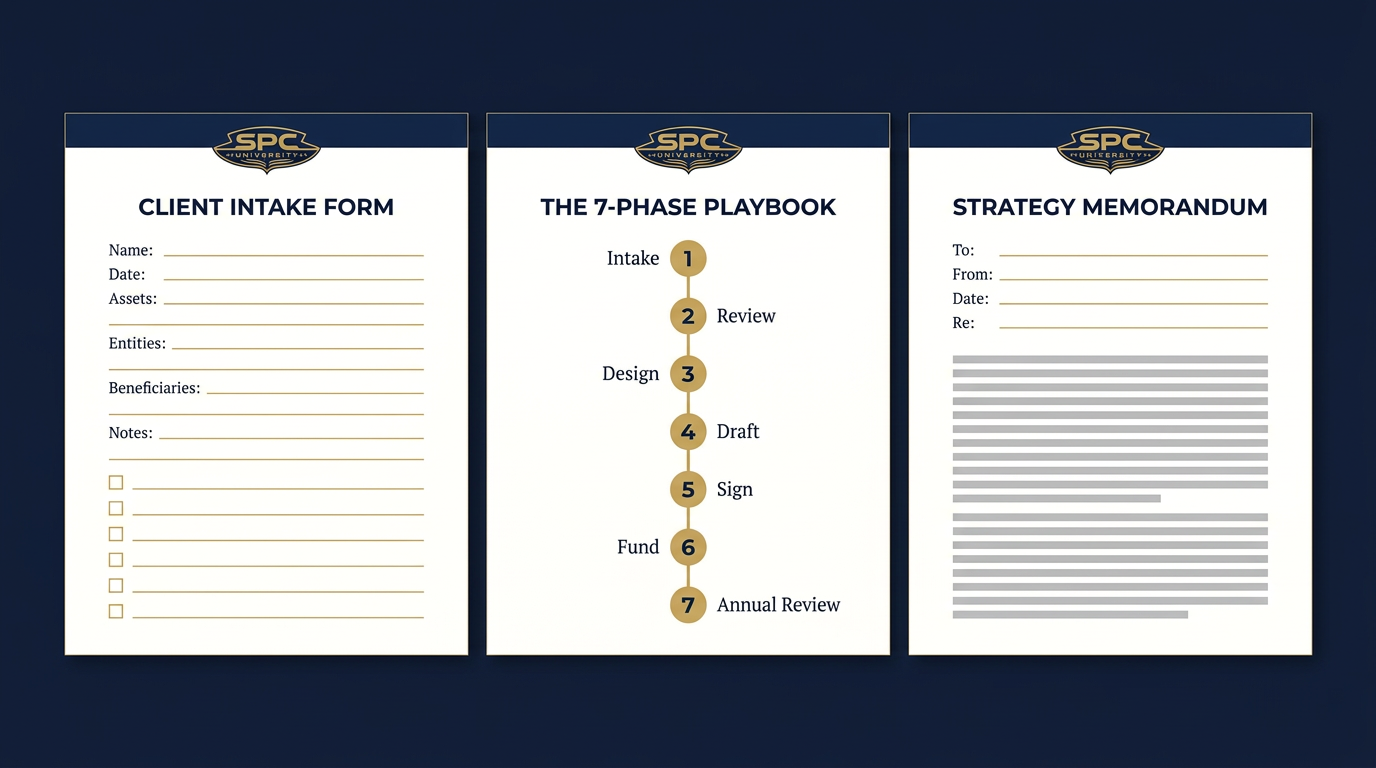
Official Interior Document System
Client Intake Form · The 7-Phase Playbook · Strategy Memorandum

Phase 1: The 7-Phase Diagnostic Client Intake Form
Every high-ticket consulting engagement begins with this exhaustive diagnostic audit. Have the client complete these 7 sections prior to the live 60-minute strategy call:
Phase 2: Master 60-Minute Consultation Master Agenda
Follow this disciplined time-allocation structure during the live 1-on-1 strategy call:
- Minutes 00–10: Diagnostic Review & Exposure Mapping. Review intake responses, identifying personal vulnerability and public record exposure.
- Minutes 10–25: Architecture Structuring. Walk client through the 3-tier hierarchy: Top Holding Trust → Middle Asset Trust → Bottom Operating LLC.
- Minutes 25–40: Banking & Funding Protocol. Explain non-recourse EIN banking, commercial credit building, and separating business cash flow.
- Minutes 40–50: Q&A & Objection Clearing. Answer client questions regarding estate tax, probate bypass, and trustee appointments.
- Minutes 50–60: Next Steps & Implementation Handoff. Assign document drafting priorities and schedule the 30-day follow-up.
Phase 3: Corporate Credit & Funding Action Plan
To build an institutional corporate credit profile for client entities without personal guarantees:
Part I: Master Client Wealth, Entity & Asset Protection Diagnostic Intake Questionnaire
MASTER CLIENT INTAKE & FILL GUIDE — "Their Things"
The single form that customizes every instrument in the package
Companion to the 8 instrument skeletons (Vols. XIII–XVI, Build Plan, Roster). Complete every field; counsel inserts values into the bracketed placeholders. Fields marked ★ are design-critical (they change architecture, not just text).
---
SECTION 1 — IDENTITY & DOMICILE (per person: spouses, each child, key grandchildren)
| Field | Feeds into |
|---|---|
| ★ Legal full name (exactly as on ID) | All instruments — parties, beneficiaries |
| ★ Date & place of birth | Trustee acceptance forms; KYC |
| ★ State of domicile & residence address | Governing law; situs; state estate-tax overlay (Vol. XV § 6) |
| ★ Citizenship(s) | Treaty analysis; QDOT (non-citizen spouse); Form 3520 exposure |
| ★ Marital status + prenup/postnup? | SLAT design; anti-reciprocity; ascendancy clauses |
| Prior marriages / support obligations | Excluded-Person clauses |
SECTION 2 — ASSET SCHEDULE (attach statements; per asset)
| Category | Fields | Feeds into |
|---|---|---|
| Cash / brokerage | institution, title, value, basis | Revocable spine Exhibit A; FLP funding |
| ★ Real property | address, current title, est. value, basis, mortgage, homestead status | Deed transfers; discount layering |
| ★ Business interests | entity, state, % owned, operating agreement, valuation | FLP/LLC skeleton; IDGT sale assets |
| ★ Life insurance | carrier, face amount, current owner, beneficiaries, cash value | ILIT skeleton (existing-policy § 2035 check) |
| Retirement | type, balance, custodian, current designations | Beneficiary-designation table (spine § COORDINATION) |
| Tangibles / collectibles | item, value, location | Tangible-property memorandum |
| Crypto / digital | custodian/wallet, access protocol | RUFADAA + access plan |
| ★ Offshore accounts/assets | country, balance, reporting status | FBAR/8938/3520 exposure check (T-3) |
| Expected inheritances | source, ETA | GST planning; situs migration |
SECTION 3 — SOLVENCY & CREDITOR PROFILE (drives the Cook Islands Solvency Certificate + UVTA timing)
SECTION 4 — GOALS (rank 1–10) ★
→ Architecture selector: scorecard maps to which of the 10 layers activate.
SECTION 5 — FIDUCIARY CHOICES ★ (3 candidates each, in order)
SECTION 6 — DISTRIBUTION DESIGN ★
SECTION 7 — CHARITABLE
SECTION 8 — SPECIAL NEEDS (if applicable)
SECTION 9 — JURISDICTION SELECTIONS ★
SECTION 10 — PROFESSIONAL TEAM CONTACTS
HOW THE FILL WORKS: every bracketed `[____]` in the 8 skeletons maps to a field above (counsel executes the mapping; T-7 agent maintains the crosswalk). Nothing in any instrument becomes final until counsel signs.
Part II: The Worldwide Trust Team Roster, Hiring Sequence, Due Diligence & Fee Structures
THE ULTIMATE TRUST TEAM — ROSTER, HIRING & FEES
Who you need, in what order, at what cost — worldwide execution capability
Compiled November 18, 2026.
---
1. The Core Team (hiring order matters)
| # | Role | Why they exist | Credentials to demand | Typical fee band |
|---|---|---|---|---|
| 1 | Lead U.S. estate-planning counsel (architect) | Designs the layered system; owns the master plan | ACTEC Fellow; state board certification in T&E; advanced tax degree (LLM Tax) helpful | $600–$1,200/hr |
| 2 | Offshore counsel — Cook Islands | The APT layer must be drafted/executed by local licensed counsel | Listed by the Cook Islands Financial Supervisory Commission; asset-protection track record with U.S. clients | $10k–$25k setup engagement |
| 3 | Offshore counsel — Cayman | STAR trust + PTC structuring | Magic-circle offshore firms of the Conyers / Maples / Campbells / Walkers / Mourant class | $15k–$50k+ per workstream |
| 4 | Licensed trustee (mandatory in Cook Islands; institutional elsewhere) | Holds legal title; administration | Cook Islands: locally licensed trust companies (e.g., the Southpac / Trident class). Cayman: CIMA-licensed trust company or registered PTC | $5k–$10k/yr (CI APT); 0.5–1.25% AUM institutional |
| 5 | Trust protector | Fires/replaces trustees; consents to amendments; situs flexibility | Institution or highly trusted individual + named successor; never your future creditor's target | $2.5k–$10k/yr |
| 6 | International tax CPA / EA | Forms 3520/3520-A, FBAR, 8938, 1041/throwback, 709/GST | Specialized foreign-trust reporting practice (this is a niche; general CPAs mangle it) | $5k–$25k/yr |
| 7 | Insurance advisor (ILIT design) | Owns the liquidity layer | CLU/ChFC; independent (not captive) | Commission or fee |
| 8 | Valuation firm | FLP/LLC discount studies; appraisal defense | Accredited senior appraisers; audit-defense experience | $7.5k–$50k per study |
| 9 | Investment fiduciary / PMC | Prudent-investor compliance (UPIA) across trust layers | Fee-only fiduciary; trust-tax-aware (allocation between income/principal) | 0.25–1.0% AUM |
| 10 | Private bank / custodian | Asset custody, multi-currency, credit | Institutional; FATCA/CRS-registered | Account-based |
| 11 | Trust-litigation counsel (on call) | Contests, creditor attacks, fiduciary disputes | T&E litigation specialty | Retainer |
2. Hiring Due-Diligence Checklist
3. What You (the family) Must Assemble — the Client Preparation Pack
1. Complete asset schedule (titles, values, basis, location, liabilities).
2. Family map (births, marriages, adoptions, special needs, prior relationships).
3. Existing documents (wills, trusts, POAs, beneficiary designations, prenups).
4. Last 3 years of tax returns; entity org charts.
5. Insurance portfolio and retirement-account statements.
6. Goals memo: control, access, protection, charity, succession — ranked.
7. Citizenship/domicile facts for every family member (drives treaty and situs analysis).
4. Red-Flag Vendors (walk away)
5. Order of Operations With the Team
1. Retain lead counsel → engagement letter defining scope.
2. Lead counsel selects and coordinates offshore counsel/trustee (single point of accountability).
3. Tax CPA reviews the design memo *before* execution — timing of 709/GST allocations is design-critical.
4. Execute in phases per the Build Plan roadmap; fund only after every layer is signed.
*Educational planning research — not legal or tax advice. Execution requires the licensed professionals above.*
Part III: Private Trust Advisory & Fiduciary Operations Firm Blueprint
TRUST FIRM BLUEPRINT — Build the Firm That Masters It All
Business design for a full-service trust & fiduciary firm
Companion: the 39-file knowledge/drafting system (START_HERE_MASTER_INDEX.md). Compiled November 18, 2026.
---
1. Choose the Firm Model (the decision that governs everything)
| Model | What it is | Gate | Time to launch | Capital |
|---|---|---|---|---|
| A. Consultancy (recommended start) | Planning, education, design memos, agent-swarm services; legal drafting referred out to partner counsel | None (non-fiduciary, non-legal services; UPL discipline) | 30–60 days | Low ($25k–$75k) |
| B. Law-firm alliance | You run operations/knowledge; partner attorneys draft; revenue share | Partner bar admission | 60–90 days | Low–Mid |
| C. Licensed trust company (the endgame) | Charter as state trust company — full fiduciary authority | State banking-department charter | 6–18 months | SD: ≥ $200,000 capital (SDCL 51A-6A-19) + fidelity bond & D&O + $5,000 application; NV family trust co: ≥ $300,000 stockholders' equity (NRS ch. 669; retail license: $3,000 fee + 3-yr projections); IL: $3M |
| D. Offshore trustee arm | Cook Islands FSC trustee company / Cayman CIMA licence | Local regulator | 12–24 months | CIMA full trust licence ≈ CI$95,500/yr (verified) vs registered-PTC ≈ CI$4k/yr |
Recommended path: A → B → C(+D). Start earning with the knowledge base immediately; convert to a charter once recurring revenue supports capital and exam readiness. (Three PTC types in U.S. practice: licensed/chartered, unlicensed family, exempt — Weller, NAEPJ 2024.)
2. Service Lines & Pricing (verified market bands)
| Line | Product | Price band |
|---|---|---|
| Planning | Full estate/trust design (Revocable spine → 10-layer build) | $7,500–$50,000 per engagement |
| Offshore | Cook Islands APT / Cayman PTC coordination | $15,000–$50,000 (+local counsel) |
| Administration | Trustee/co-trustee services | 0.5%–1.25% AUM (or hourly) |
| Compliance | 709/GST, 3520/3520-A, FBAR packages | $5,000–$25,000/yr per client |
| Education | Family governance, next-gen training | $2,500–$25,000/program |
| Litigation support | Expert/consultant in trust disputes | $400–$800/hr |
3. Financial Skeleton (year 1, Model A)
4. Client-Acquisition Engine
1. CPA/attorney referral network (the #1 channel — co-marketing + CE seminars).
2. Content: CLIENT_EDUCATION_HANDBOOK as the lead magnet; niche verticals (physicians, founders, athletes, real-estate developers — lawsuit-exposed professions).
3. Agent-swarm demo meetings (run the test suite live — the differentiator no competitor shows).
4. Cross-border referrals from immigration/business counsel.
5. Risk Management (non-negotiable)
Part IV: Complete Worldwide Trust Build Plan, Jurisdiction Matrix & Execution Roadmap
THE ULTIMATE TRUST — BUILD PLAN, JURISDICTIONS & COMPLIANCE
Worldwide asset-protection and dynasty architecture for U.S.-connected wealth
Compiled November 18, 2026 — all 2026 tax figures verified against IRS.gov and law-firm sources this session.
---
1. Executive Overview
"The ultimate trust" is not one document — it is a layered system: a revocable spine, statutory exemption-harvesting trusts, a protected offshore layer (Cook Islands / Cayman), liquidity insurance, tax-freeze instruments, and a private trust company if the family wants control. Everything here is lawful, disclosed, and executed by licensed counsel — the compliance section is not optional decoration; it is what separates planning from felony exposure.
2. Verified 2026 Federal Figures (use these; re-verify each year)
| Item | 2026 amount | Source |
|---|---|---|
| Estate/gift/GST exemption (unified) | $15,000,000 per person ($30M married) — set by the Working Families Tax Cuts Act, amending 26 U.S.C. § 2010(c)(3); indexed after 2026 | [IRS.gov "What's New — Estate and Gift Tax"](https://www.irs.gov/businesses/small-businesses-self-employed/whats-new-estate-and-gift-tax) |
| Top transfer-tax rate | 40% | IRS |
| Annual gift exclusion | $19,000 per recipient (2027: $20,000) | [IRS.gov FAQ](https://www.irs.gov/faqs/interest-dividends-other-types-of-income/gifts-inheritances/gifts-inheritances-1) |
| Gifts to non-citizen spouse (annual limit) | $194,000 | Morgan Lewis, Oct. 2025 |
| GST exemption | $15,000,000 (same unified figure) | IRS |
| Form 3520/3520-A late penalties | Greater of $10,000 or 35% of the contribution/distribution | 26 U.S.C. §§ 6677; Form 3520 instructions |
3. The Layered Architecture (what gets built)
| Layer | Instrument | Purpose | Typical situs |
|---|---|---|---|
| L1 | Revocable living trust + pour-over wills | Operating spine; probate avoidance; incapacity | Home state |
| L2 | SLATs (spousal lifetime access trusts), one per spouse | Use both $15M exemptions while keeping indirect access | SD / DE / NV |
| L3 | Dynasty trust (GST-exempt, perpetual) | Skips estate tax at every generation; RAP-abolished situs makes it truly perpetual | SD, DE, NV, WY; Cayman/Bermuda for offshore |
| L4 | Offshore asset-protection trust (Cook Islands) | The hard shell against future judgment creditors — see § 4 timing rules | Cook Islands (mandatory local licensed trustee) |
| L5 | ILIT | Owns life insurance: estate-tax-free liquidity, Crummey funding | DE / SD |
| L6 | GRATs / IDGT installment sales | Freeze appreciation; transfer growth at near-zero gift cost | Any state (grantor-trust powered) |
| L7 | Private trust company (PTC) | Family-controlled trustee entity for dynasty trust governance | Cayman (registered PTC) / Bermuda |
| L8 | SNT (third-party) | Special-needs beneficiaries without benefits disqualification | With L1 |
| L9 | Charitable layer: CRT / CLAT / DAF | Income, deductions, values alignment | Per strategy |
| L10 | FLP/LLC funding vehicles | Move assets at valuation discounts; centralized management | DE / family's state |
Design rule: each layer solves a distinct problem (probate, exemptions, creditor shells, liquidity, freeze, control, care, charity). A single "super trust" that tries to do everything fails at everything.
4. Jurisdiction Matrix (offshore + DAPT)
| Jurisdiction | Governing law | Protection character | Verified cost bands (2025–26 market) | Best use |
|---|---|---|---|---|
| Cook Islands | International Trusts Act 1984 (as amended) | Strongest self-settled protection: ~2-year fraudulent-transfer window; no recognition of foreign judgments; high creditor burden of proof | Setup ~$15k–$25k; trustee ~$5k–$10k/yr (Alper Law; Blake Harris Law: $25k flat + $7k/yr) | The APT layer (L4) |
| Cayman Islands | Trusts Law; STAR trusts (Special Trusts Alternative Regime); PTC Regulations | Institutional-grade; reserved powers; enforcer structure for STAR; PTC regime for family control | Formation ~$8k–$15k; PTC registration CI$3,500 (~US$4,268) + CI$4,000/yr vs CI$95,500/yr for a full trust licence (Collas Crill; Loeb Smith) | Dynasty governance (L3/L7) |
| Nevis | Nevis International Trust Ordinance | Strong APT; lower cost; LLC pairing | ~$15k–$25k setup (market) | APT alternative |
| Bermuda / Bahamas / Jersey / Guernsey | Modern trust statutes, reserved powers, PTC regimes | Institutional quality, private-client pedigree | Comparable to Cayman | Institutional dynasty/PTC alternative |
| U.S. DAPT states (SD, NV, AK, TN, DE, WY, et al. — 19+ states) | State self-settled trust acts | Protection only from *future* creditors; weaker against U.S. courts | Setup ~$5k–$15k + annual | Domestic shield; lower friction than offshore |
5. The Compliance Stack (a U.S. person's mandatory disclosures — non-negotiable)
1. Form 3520 — creation of / transfers to a foreign trust; distributions *from* one; foreign gifts/inheritances > $100,000. ([IRS](https://www.irs.gov/forms-pubs/about-form-3520))
2. Form 3520-A — annual foreign-trust owner information (foreign trust with a U.S. owner). ([IRS instructions](https://www.irs.gov/pub/irs-pdf/i3520a.pdf))
3. FBAR (FinCEN 114) — foreign accounts > $10,000 aggregate.
4. Form 8938 (FATCA) — specified foreign financial assets.
5. Form 709 — gifts above the $19,000 exclusion; GST-exemption allocations for dynasty trusts (miss this and the automatic rules waste exemption).
6. Form 1041 — foreign non-grantor trusts; throwback rules tax accumulated distributions to U.S. beneficiaries.
7. State filings; CRS-equivalent exchange means secrecy is gone — structure for legality, not invisibility. Anyone pitching "undetectable offshore" is selling you willful-BLAST penalties (100% of the account) and prison.
6. Timing and Funding Rules (where "all legal" is won or lost)
7. Execution Roadmap
| Phase | Weeks | Work |
|---|---|---|
| 1. Discovery | 1–4 | Asset inventory, family map, goals, risk exposure, residence/domicile audit |
| 2. Design | 3–6 | Counsel selection (see Team Roster), architecture memo, jurisdiction choices, tax modeling |
| 3. Documents | 4–8 | Drafts: RLT, SLATs, dynasty, APT, ILIT, LLCs — every draft reviewed by the licensed attorney of record |
| 4. Funding | 2–6 | Re-title, assign, gift, appraise, insurance applications |
| 5. Compliance | ongoing | 709/GST allocations, 3520/3520-A, FBAR calendar, Crummey logs |
| 6. Governance | ongoing | Trustee/protector onboarding, investment policy, distribution protocols |
| 7. Maintenance | annual | Review, re-verify law, amend by situs/decanting as needed |
Realistic budget: full domestic-plus-offshore architecture typically runs six figures in professional fees at setup plus $20k–$60k/yr maintenance at scale — the verified unit costs in § 4 are the building blocks.
8. What this document is not
Educational planning research — not legal or tax advice, and no trust exists until licensed counsel in each jurisdiction executes it. The Team Roster and Agent Swarm files complete the package; say the word and I build the trust-law compendium volumes, or draft attorney-review skeletons for any layer.
EXECUTION PLAYBOOK — From Intake to Funded & Compliant
The step-by-step assembly manual (who, what, when, in what order)
Companion: MASTER_CLIENT_INTAKE.md (data) → skeletons (documents) → this playbook (process).
---
PHASE 0 — Assembly & Education (Week 1–2)
1. Family reads CLIENT_EDUCATION_HANDBOOK.md (all decision-makers; no signing before this).
2. Complete MASTER_CLIENT_INTAKE.md — every ★ field. T-7 agent assembles the Client Preparation Pack (Team Roster § 3).
3. Goal scorecard → layer activation map (which of the 10 layers get built).
PHASE 1 — Counsel Engagement (Week 2–4)
1. Retain lead U.S. counsel (ACTEC class) — engagement letter defines: documents, coordination duty, flat vs. hourly.
2. Lead counsel introduces/retains: Cook Islands firm (APT layer), Cayman firm (PTC/STAR), international CPA.
3. Conflicts checks, fee schedules in writing, engagement scope locked.
PHASE 2 — Design Memo (Week 4–6)
1. T-1 Architecture agent + lead counsel produce the Design Memorandum: layers activated, situs choices, tax modeling (uses verified 2026 figures), entity chart.
2. Tax CPA signs off on: 709 strategy, GST allocation plan, grantor-trust statuses, 3520/3520-A forecast.
3. Design review meeting (family + counsel + CPA). Decisions minuted. No drafting before this memo is approved.
PHASE 3 — Document Production (Week 6–12)
1. Counsel converts the skeletons to full instruments using intake data (the only step where full signature-ready text is produced — by licensed counsel).
2. Circulation: family reviews with education handbook open; changes logged.
3. Appraisal queue opens (business interests, real property) — valuation firm engaged.
4. Insurance applications (ILIT policies) submitted — trust named owner/beneficiary from inception.
PHASE 4 — Signing Logistics
PHASE 5 — Funding (the phase that decides everything — Week 12–20)
| Asset | Action | Proof filed in funding ledger |
|---|---|---|
| Real property | Quitclaim/warranty deed → RLT | Recorded deed |
| Bank/brokerage | Retitle → RLT / FLP | New statements |
| Business units | Sale (IDGT note) + gift (SLAT/Dynasty) post-appraisal | Appraisal, note, cap-table update |
| Insurance | ILIT owner/beneficiary from issue | Policy + ownership certificate |
| Tangibles | General assignment | Signed assignment |
| Never | Retirement accounts retitled | Designation table instead |
PHASE 6 — Compliance Handoff (immediately after funding)
1. T-3 compliance calendar loaded: 709 (+GST formula allocations) due with 1040; Crummey notice schedule; 3520/3520-A cycle; FBAR; 1041s; state filings.
2. Trustee/PTC governance install: IPS adopted; committees chartered; meeting cadence; records system (Vol. XVI § 8 checklist).
3. Team briefing: banker/custodian receives trust certifications; insurers confirm ILIT ownership.
PHASE 7 — Maintenance (forever)
RACI SNAPSHOT
| Task | Responsible | Accountable | Consulted | Informed |
|---|---|---|---|---|
| Design memo | Lead counsel | Client | CPA, T-1 agent | Family |
| Instrument production | Licensed counsel each layer | Lead counsel | T-1/T-2 agents | Family |
| Funding execution | Client + trustees | Lead counsel | CPA | All |
| Tax filings | CPA | Client | T-3 agent | Counsel |
| Annual review | Lead counsel | Client | All | Family |
Part V: Client & Trustee Fiduciary Education Manual
CLIENT EDUCATION HANDBOOK — How the Whole Machine Works
Plain-English guide for the family (read this before any signing meeting)
---
1. The System in One Paragraph
Your wealth moves through a layered set of containers. A revocable trust runs daily life and avoids probate. Irrevocable trusts funded while you're alive take assets out of your taxable estate — some keep access for your spouse (SLATs), some skip taxes for every future generation (dynasty trusts), some shield assets from future lawsuits (Cook Islands), and some hold life insurance (ILIT). A family LLC lets assets move at discounted values. Charitable trusts return income to you while giving the rest to causes. A Cayman private trust company lets your family sit in the trustee's chair without hiring a bank. Every container is disclosed to the tax authorities — the protection comes from law and structure, never from secrecy.
2. The Money-Flow Story (what actually happens)
1. You gift $19,000/year per person (2026, verified) or larger gifts against your $15M exemption — always with a gift-tax return (709) and Crummey notices.
2. Gifts buy units in the family LLC; appraisals establish their discounted value.
3. Trusts buy or receive those units — Dynasty (GST-exempt), SLATs (spousal access), Cook Islands APT (the shield).
4. Growth compounds inside the trusts, outside your estate.
5. At death, your estate owes no estate tax below $15M/person ($30M married); insurance in the ILIT provides tax-free liquidity; the pour-over will sweeps leftovers into the revocable trust.
6. Generations later, the dynasty trust still holds it all — no estate tax at any generation in between.
3. The Players (who does what)
| Role | Plain English |
|---|---|
| Settlor/Grantor | The person who puts assets in |
| Trustee | The legal owner-manager (bank, trust company, or your PTC) |
| Trust Protector | The safety valve — fires/replaces trustees, approves changes |
| Distribution Committee | Decides who gets what, per the rules |
| Beneficiary | The people the trust is for |
| Guardian (of minors) | Raises your kids — named in the pour-over will |
| Attorney-in-fact (POA) | Handles money if you're incapacitated |
| Healthcare agent | Makes medical decisions if you can't |
4. Top 10 Mistakes That Kill Good Plans (avoid these and you're ahead of 95%)
1. Never funding the trust (assets stay in your name → probate).
2. Signing the Cook Islands trust after a lawsuit appears (fraudulent-transfer clawback).
3. Skipping the gift-tax return (709) or the GST allocation.
4. Letting the insured parent be trustee of their own ILIT.
5. Personal use of FLP/LLC assets (kills the discount — § 2036).
6. Keeping retirement accounts in trusts directly (wrong tool — designations).
7. Treating "sovereign citizen"-style paperwork as a substitute for law (courts reject it; you get sanctioned — Vol. VIII).
8. Ignoring Form 3520/3520-A on foreign trusts (35% penalties).
9. Naming one person as everything (trustee + protector + beneficiary = conflict).
10. Never updating after births, deaths, divorces, moves.
5. FAQ
"Is offshore legal?" Yes — with an FSC-licensed Cook Islands trustee, full IRS reporting (3520/3520-A, FBAR, FATCA), and funding before any claims. What's illegal is hiding accounts or deferring known creditors.
"Can I get my money back?" Generally no from the irrevocable layers — that's why the SLAT design (spouse can receive) and L1 revocable spine exist. Design trade-offs, not accidents.
"What if we get sued after funding?" Pre-existing assets are protected; the transfer itself isn't undone if it predated the threat (timing windows: Cook Islands 2 years; U.S. bankruptcy 10 years for self-settled trusts).
"Who pays the taxes on trust income?" Grantor trusts: you do (and that's a feature — extra tax-free gifts). Non-grantor: the trust pays (compressed brackets — distributions to beneficiaries often better).
"What happens when the trustee misbehaves?" Protector removes them; UTC §§ 801–814 duties and surcharge remedies apply.
"Why a Cayman PTC instead of a bank trustee?" Family control + continuity, at a fraction of institutional fees — with professional guardrails (registered office, independent director).
6. Glossary (fast reference)
AFR — Applicable Federal Rate (minimum loan interest). AGI — Adjusted Gross Income. APT — Asset Protection Trust. AUM — Assets Under Management. Bypass/Credit-Shelter Trust — uses the first spouse's exemption. Charging order — a creditor's substitute remedy (receives distributions, not assets). Clayton/QTIP — marital-deduction controls. Crummey power — annual withdrawal right making gifts "present interests." Decanting — pouring a trust into a better one. DNI — Distributable Net Income. Domicile — your one true legal home. ETIP — estate-tax inclusion property (blocks GST allocation — watch in IDGT sales). FSIA — Foreign Sovereign Immunities Act. GST — Generation-Skipping Transfer (the tax on skipping your children's generation). HEMS — Health, Education, Maintenance, Support. IDGT — Intentionally Defective Grantor Trust ("defective" only for estate tax — deliberately). ILIT — Irrevocable Life Insurance Trust. ITA — Cook Islands International Trusts Act 1984. PTC — Private Trust Company. QDOT — Qualified Domestic Trust (non-citizen spouse). QPRT — Qualified Personal Residence Trust. RAP — Rule Against Perpetuities. SLAT — Spousal Lifetime Access Trust. § 7520 rate — the IRS actuarial rate for GRATs/CLATs. UTC — Uniform Trust Code. UVTA — Uniform Voidable Transactions Act (fraudulent transfers).
7. What Happens When I Die (the timeline)
Week 1: successor trustee secures assets; funeral per directives. Month 1: 706 analysis (9-month deadline + 6-month extension); insurance claim through ILIT. Months 3–9: estate administration, debt notice, distributions per RLT scheme. Ongoing: trusts continue under successor trustees — the dynasty layers never "end."
8. What Happens If I'm Sued (the timeline)
Plaintiff gets a judgment → attempts to collect → hits the spendthrift/firewall structure → must sue the Cook Islands trustee in Cook Islands courts, fresh, beyond-reasonable-doubt, within 2 years of the transfer → settles for a fraction or abandons. The system works because it was funded years earlier — timing is the whole game.
Part VI: Supreme Trusts & Estates Counsel Complete Advisory Reference & Case Law Matrix
SUPREME TRUSTS & ESTATES COUNSEL — COMPLETE SKILLS EXTRACTION
Master Skills + Sub-Agent Architecture for Software Implementation
TIER 1: CORE LEGAL RESEARCH SKILLS
SKILL-001: Current Law Verification
What it does: Ensures all legal information reflects law as of today Implementation requirements:
Web search API integration
Query construction: "current [topic]" not "2024 [topic]"
Source validation (prioritize .gov, official sources)
Date stamping all citations
Conflict resolution (search vs. cached knowledge)
Sub-skills:
001A: Temporal query construction
001B: Official source identification
001C: Multi-source cross-validation
001D: Staleness detection
001E: Update frequency determination
APIs/Data needed:
Google Search API or equivalent
IRS.gov access
State legislature websites
Cornell Law LII
Justia case law
SKILL-002: Multi-Source Legal Research
What it does: Gathers authoritative legal sources across jurisdictions Implementation requirements:
Parallel search execution (batch queries)
Source hierarchy (statutes > regulations > cases > secondary)
Citation extraction
Relevance ranking
Conflict identification between sources
Sub-skills:
002A: Statutory research (federal + 50 states)
002B: Regulatory research (CFR, state regulations)
002C: Case law research
002D: IRS guidance research (Rev Rul, PLR, Notices)
002E: Secondary source research (law reviews, treatises)
APIs/Data needed:
Legal database APIs (if available)
Google Scholar API
Court PACER/CM-ECF (for federal cases)
State court websites
SSRN (for academic papers)
SKILL-003: Citation Extraction & Formatting
What it does: Identifies and properly formats legal citations Implementation requirements:
Pattern recognition for citations (26 U.S.C. § 2056, Cal. Prob. Code § 6401)
Bluebook formatting rules
Hyperlink generation to sources
Access date tracking
Sub-skills:
003A: Statute citation parsing
003B: Case citation parsing
003C: Regulation citation parsing
003D: Bluebook formatting
003E: Permalink generation
Data structures:
Copy{
"citation_type": "statute|case|regulation|irs_guidance",
"jurisdiction": "federal|state_code",
"title_chapter": "26",
"section": "2056",
"subsection": "(a)",
"full_citation": "26 U.S.C. § 2056(a)",
"url": "https://...",
"accessed_date": "2026-08-12"
}
TIER 2: LEGAL ANALYSIS SKILLS
SKILL-010: IRAC/CREAC Legal Reasoning
What it does: Structures legal analysis using formal framework Implementation requirements:
Issue identification from facts
Rule extraction from authorities
Fact-to-rule mapping
Conclusion generation with confidence scoring
Sub-skills:
010A: Issue spotting (identify legal questions from scenario)
010B: Rule statement (synthesize from multiple authorities)
010C: Application logic (map facts to rule elements)
010D: Conclusion reasoning (probable outcomes)
010E: Counter-argument generation
Algorithm:
Copydef irac_analysis(facts, jurisdiction):
Issue Identification
issues = identify_legal_issues(facts)
Rule Research
for issue in issues:
rules = research_applicable_law(issue, jurisdiction)
Application
application = apply_rules_to_facts(rules, facts)
Conclusion
conclusion = generate_conclusion(application)
return structured_analysis
SKILL-011: Multi-Jurisdictional Comparison
What it does: Compares legal rules across states/jurisdictions Implementation requirements:
State law database or search capability
Majority vs. minority rule identification
UPC/UTC adoption tracking
Difference highlighting
Table generation
Sub-skills:
011A: Identify which states have adopted uniform acts
011B: Extract state-specific statute text
011C: Compare provisions side-by-side
011D: Categorize (majority/minority/unique)
011E: Generate comparison tables
Data structure:
Copy{
"topic": "elective_share",
"jurisdictions": [
{
"state": "NY",
"rule": "1/3 or $50,000",
"statute": "EPTL § 5-1.1-A",
"category": "non-UPC"
},
{
"state": "FL",
"rule": "30% of augmented estate",
"statute": "Fla. Stat. § 732.2065",
"category": "modified-UPC"
}
]
}
SKILL-012: Tax Implication Analysis
What it does: Calculates and explains estate/gift/GST/income tax consequences Implementation requirements:
Current tax rate tables
Exemption amount tracking
Tax calculation engines
IRC section mapping
Multi-tax interaction modeling
Sub-skills:
012A: Estate tax calculation (IRC Ch. 11)
012B: Gift tax calculation (IRC Ch. 12)
012C: GST tax calculation (IRC Ch. 13)
012D: Income tax on trusts (Subchapter J)
012E: Basis step-up calculations
012F: Tax optimization strategies
Calculation engine:
Copydef estate_tax_calculator(gross_estate, deductions, exemption_amount):
taxable_estate = gross_estate - deductions
exemption_used = min(taxable_estate, exemption_amount)
taxable_after_exemption = max(0, taxable_estate - exemption_used)
Progressive rates (verify current rates)
tax = calculate_progressive_tax(taxable_after_exemption, estate_tax_brackets)
return {
"gross_estate": gross_estate,
"taxable_estate": taxable_estate,
"exemption_used": exemption_used,
"tax_due": tax
}
SKILL-013: Risk Identification
What it does: Identifies legal, tax, and practical risks in strategies Implementation requirements:
Pattern matching for risk factors
IRS audit risk scoring
Will contest risk factors
Fraudulent transfer analysis
Capacity concern detection
Sub-skills:
013A: IRS scrutiny risk (aggressive valuations, FLPs, related-party transactions)
013B: Will contest risk (undue influence, capacity, formalities)
013C: Fraudulent transfer risk (timing, solvency, badges of fraud)
013D: Fiduciary breach risk
013E: Timing/deadline risks
Risk scoring:
Copy{
"risk_type": "irs_audit",
"severity": "high|medium|low",
"factors": [
"40% valuation discount claimed",
"Family limited partnership",
"Related party transaction"
],
"mitigation": [
"Qualified appraisal required",
"Bona fide business purpose",
"Arm's length documentation"
]
}
TIER 3: TRUST-SPECIFIC EXPERTISE
SKILL-020: Trust Type Classification & Selection
What it does: Matches user goals to appropriate trust types Implementation requirements:
Trust type database (all types with attributes)
Goal-to-trust mapping rules
Multi-criteria decision matrix
Comparison generation
Sub-skills:
020A: Goal extraction from user input
020B: Trust attribute matching
020C: Multi-trust comparison
020D: Pros/cons analysis
020E: Use case matching
Trust type database schema:
Copy{
"trust_type": "ILIT",
"full_name": "Irrevocable Life Insurance Trust",
"revocability": "irrevocable",
"tax_treatment": {
"estate_tax": "excluded_from_estate",
"gift_tax": "annual_gifts_for_premiums",
"income_tax": "separate_entity_or_grantor"
},
"primary_goals": [
"estate_tax_reduction",
"estate_liquidity",
"asset_protection"
],
"requirements": [
"Independent trustee",
"Crummey withdrawal rights",
"3-year lookback rule compliance"
],
"pros": [...],
"cons": [...],
"ideal_for": [...],
"avoid_if": [...]
}
SKILL-021: Fiduciary Duty Analysis
What it does: Evaluates trustee actions against UTC duties Implementation requirements:
UTC §§ 801-810 rule engine
Breach detection patterns
Prudent investor analysis
Duty of loyalty checks
Sub-skills:
021A: Duty of loyalty assessment (self-dealing detection)
021B: Prudent administration evaluation
021C: Prudent investment analysis (UPIA)
021D: Impartiality assessment
021E: Duty to inform evaluation
Breach detection:
Copydef check_fiduciary_breach(action, trust_terms, beneficiaries):
violations = []
Duty of loyalty
if is_self_dealing(action, trustee):
violations.append({
"duty": "loyalty (UTC 802)",
"violation": "Self-dealing transaction",
"severity": "high"
})
Duty of impartiality
if favors_beneficiary(action, beneficiaries):
violations.append({
"duty": "impartiality (UTC 803)",
"violation": "Favoring one beneficiary class",
"severity": "medium"
})
return violations
SKILL-022: Trust Drafting Knowledge
What it does: Understands trust document structure and provisions Implementation requirements:
Template trust provision library
Provision interaction rules
Boilerplate vs. custom distinction
Tax clause implications
Sub-skills:
022A: Essential provisions identification
022B: Optional provisions catalog
022C: Tax election clauses
022D: Distribution standards
022E: Administrative provisions
Provision library:
Copy{
"provision_type": "distribution_standard",
"variations": [
{
"name": "HEMS (Health, Education, Maintenance, Support)",
"text": "Trustee may distribute for health, education, maintenance, and support...",
"tax_effect": "Ascertainable standard, no estate inclusion",
"asset_protection": "High"
},
{
"name": "Absolute discretion",
"text": "Trustee has absolute discretion to distribute or withhold...",
"tax_effect": "Not ascertainable standard, potential inclusion if beneficiary is trustee",
"asset_protection": "Highest"
}
]
}
SKILL-023: Trust Administration Procedures
What it does: Guides through trust admin process Implementation requirements:
Step-by-step procedure database
State law procedure variations
Timeline/deadline tracking
Required form identification
Sub-skills:
023A: Initial trust funding procedures
023B: Ongoing administration tasks
023C: Distribution procedures
023D: Accounting and reporting
023E: Termination procedures
TIER 4: ESTATE PLANNING STRATEGIES
SKILL-030: GRAT Planning
What it does: Designs and analyzes GRAT strategies Implementation requirements:
7520 rate lookup (current month)
Annuity calculation
Remainder valuation
Zeroed-out GRAT math
Term optimization
Calculation:
Copydef grat_analysis(asset_value, term_years, section_7520_rate, growth_rate):
Calculate annuity for zeroed-out GRAT
annuity_factor = calculate_annuity_factor(term_years, section_7520_rate)
annual_annuity = asset_value / annuity_factor
Calculate expected remainder
future_value = asset_value * (1 + growth_rate) ** term_years
total_annuities_paid = annual_annuity * term_years
expected_remainder = future_value - total_annuities_paid
return {
"initial_value": asset_value,
"annual_annuity": annual_annuity,
"gift_tax_value": 0, # zeroed out
"expected_remainder": expected_remainder,
"estate_tax_saved": expected_remainder * 0.40,
"risk": "Must survive term"
}
SKILL-031: IDGT Planning
What it does: Structures intentionally defective grantor trusts Implementation requirements:
IRC §§ 671-679 trigger identification
Installment sale calculations
Note interest rate (AFR) lookup
Income tax payment modeling
Defect trigger catalog:
Copy{
"defect_triggers": [
{
"section": "675(4)(C)",
"trigger": "Power to substitute assets of equivalent value",
"recommendation": "Most common, flexible"
},
{
"section": "677(a)(3)",
"trigger": "Trust income used for life insurance premiums on grantor/spouse",
"recommendation": "Use when ILIT integration"
},
{
"section": "675(2)",
"trigger": "Power to borrow without adequate interest/security",
"recommendation": "Simple but less common"
}
]
}
SKILL-032: Charitable Planning (CRT/CLT)
What it does: Designs and analyzes charitable trusts Implementation requirements:
5% minimum payout validation (CRT)
10% charitable remainder test
Actuarial calculations
Income/estate/gift tax deduction calculations
CRT validation:
Copydef validate_crt(trust_value, payout_rate, term_years, beneficiary_age):
Minimum payout (5%)
if payout_rate < 0.05:
return {"valid": False, "error": "Payout below 5% minimum"}
10% charitable remainder test
charitable_remainder_value = calculate_present_value_remainder(
trust_value, payout_rate, term_years, section_7520_rate, beneficiary_age
)
if charitable_remainder_value < trust_value * 0.10:
return {"valid": False, "error": "Charitable remainder below 10%"}
Calculate deductions
income_tax_deduction = charitable_remainder_value # simplified
return {
"valid": True,
"charitable_remainder": charitable_remainder_value,
"income_tax_deduction": income_tax_deduction
}
SKILL-033: Dynasty Trust & GST Planning
What it does: Structures multi-generation trusts with GST exemption Implementation requirements:
Rule Against Perpetuities by state
GST exemption allocation
Inclusion ratio calculation
Dynasty-friendly jurisdiction identification
State RAP database:
Copy{
"dynasty_states": [
{"state": "AK", "perpetuity": "abolished", "requirements": ["AK trustee"]},
{"state": "DE", "perpetuity": "abolished", "requirements": ["DE trustee or situs"]},
{"state": "SD", "perpetuity": "abolished", "requirements": ["SD trustee"]},
{"state": "NV", "perpetuity": "365 years", "requirements": ["NV trustee"]},
{"state": "WY", "perpetuity": "1000 years", "requirements": ["WY trustee"]}
]
}
TIER 5: DOCUMENT ANALYSIS SKILLS
SKILL-040: Document Parsing & Interpretation
What it does: Extracts meaning from legal documents Implementation requirements:
PDF/Word/image text extraction
Legal clause identification
Provision categorization
Cross-reference resolution
Sub-skills:
040A: Text extraction (OCR if needed)
040B: Clause boundary detection
040C: Provision type classification
040D: Defined term extraction
040E: Execution validation (signatures, witnesses, notary)
SKILL-041: Will Validity Analysis
What it does: Checks will execution against state law requirements Implementation requirements:
State will execution formalities database
Signature/witness/notary validation
Testamentary capacity factors
Undue influence indicators
State formalities database:
Copy{
"state": "TX",
"requirements": {
"min_age": 18,
"capacity": "sound mind",
"writing": "required",
"signature": "testator must sign",
"witnesses": {
"number": 2,
"requirements": "credible, age 14+",
"interested_witness": "purging statute applies"
},
"notary": "not required (but creates self-proving will)",
"holographic": "allowed if entirely in testator's handwriting"
}
}
TIER 6: PROCEDURAL EXPERTISE
SKILL-050: Probate Process Knowledge
What it does: Guides through probate procedures Implementation requirements:
State probate procedure database
Timeline templates
Required forms by state
Small estate thresholds
Fee calculators (statutory fees by state)
Procedure workflow:
Copy{
"state": "CA",
"probate_process": [
{
"step": 1,
"action": "File petition for probate",
"deadline": "No statutory deadline",
"forms": ["DE-111"],
"filing_fee": "$435"
},
{
"step": 2,
"action": "Notice to heirs and creditors",
"deadline": "15 days before hearing",
"forms": ["DE-120", "DE-121"],
"publication_required": true
}
// ... additional steps
],
"typical_duration": "9-18 months",
"small_estate_threshold": "$184,500",
"small_estate_procedure": "Affidavit (Prob Code § 13100)"
}
SKILL-051: Estate Tax Return (Form 706) Knowledge
What it does: Guides Form 706 preparation Implementation requirements:
Current Form 706 instructions
Line-by-line guidance
Gross estate inclusion rules (§§ 2031-2046)
Deduction rules (§§ 2051-2058)
Portability election procedures
SKILL-052: Gift Tax Return (Form 709) Knowledge
What it does: Guides Form 709 preparation Implementation requirements:
Annual exclusion amount (current)
Present interest vs. future interest
Gift splitting procedures
GST exemption allocation
Crummey power reporting
TIER 7: SPECIALIZED SUB-DOMAINS
SKILL-060: Special Needs Trust Expertise
What it does: Navigates SNT rules to preserve benefits Implementation requirements:
SSI/Medicaid resource limits (current)
First-party vs. third-party SNT rules
Payback provisions (42 U.S.C. § 1396p)
Distribution standards
ABLE account integration
SKILL-061: Asset Protection Planning
What it does: Designs creditor protection strategies Implementation requirements:
DAPT state law database
Offshore jurisdiction comparison
Fraudulent transfer law (UFTA/UVTA)
Exempt property by state
Spendthrift clause limitations
DAPT state comparison:
Copy{
"state": "NV",
"dapt_allowed": true,
"creditor_exception_period": "2 years",
"fraudulent_transfer_lookback": "2 years existing creditors, 4 years tort",
"self_settled_protection": "Yes",
"requirements": ["NV trustee", "Irrevocable", "Spendthrift clause"],
"strength": "Very strong"
}
SKILL-062: Business Succession Planning
What it does: Transfers business interests tax-efficiently Implementation requirements:
Valuation discount methodology
Buy-sell agreement templates
IRC Chapter 14 (§§ 2701-2704) rules
FLP/LLC structuring
GRAT + business interest calculations
SKILL-063: Incapacity Planning
What it does: Plans for disability/dementia Implementation requirements:
Power of attorney statutory forms by state
Healthcare directive requirements
HIPAA authorization
Capacity assessment factors
Guardianship vs. alternatives
SKILL-064: Digital Assets & Cryptocurrency
What it does: Handles digital property in estate plans Implementation requirements:
UFADAA adoption by state
Terms of service analysis
Private key management
Online tool access procedures
TIER 8: VISUAL & PRESENTATION SKILLS
SKILL-070: Legal Diagram Generation
What it does: Creates flowcharts, family trees, trust structures Implementation requirements:
SVG generation or diagramming library
Graph layout algorithms
Legal symbol conventions
Diagram types:
Trust funding flowchart
Estate distribution family tree
QTIP trust structure
GRAT timeline
Probate process flowchart
SKILL-071: Comparison Table Generation
What it does: Creates visual comparisons Implementation requirements:
Table layout engine
Multi-criteria comparison logic
Formatting rules
Table types:
Trust type comparison
State law comparison
Strategy pros/cons
Tax impact comparison
SKILL-072: Tax Calculation Visualization
What it does: Illustrates tax scenarios visually Implementation requirements:
Chart generation
Before/after comparisons
Multi-scenario modeling
TIER 9: META-SKILLS (REASONING & QUALITY)
SKILL-080: Self-Critique & Reflexion
What it does: Reviews own analysis for gaps Implementation requirements:
Checklist validation
Counter-argument generation
Risk assessment review
Citation completeness check
Self-critique questions:
Copydef self_critique_checklist(analysis):
checks = [
("Current law verified?", verify_currency(analysis)),
("All propositions cited?", check_citations(analysis)),
("Risks identified?", find_risks(analysis)),
("Alternatives presented?", count_strategies(analysis) > 1),
("Tax implications covered?", check_tax_analysis(analysis)),
("Would opposing counsel agree?", adversarial_review(analysis)),
("Disclaimer included?", has_disclaimer(analysis))
]
return checks
SKILL-081: Uncertainty Quantification
What it does: Explicitly states confidence and unknowns Implementation requirements:
Confidence scoring
Gap identification
"Unknown" flagging
Alternative interpretation presentation
SKILL-082: Temporal Freshness Management
What it does: Ensures information currency Implementation requirements:
Last-updated tracking
Scheduled re-verification
Change detection
Deprecation warnings
To master ALL trusts & estates functions, decompose into specialized sub-agents:
SUB-AGENT-01: Research Librarian Agent
Specialization: Finding and verifying current legal authorities Skills: 001-003, 040-041, 080 Tools needed: Web search, document parser, citation formatter Output: Current statutes, cases, regulations with proper citations
SUB-AGENT-02: Tax Calculator Agent
Specialization: Estate/gift/GST/income tax calculations Skills: 012, 030-033, 072 Tools needed: Tax rate database, calculation engine, IRS form knowledge Output: Detailed tax analysis with numerical projections
SUB-AGENT-03: Multi-Jurisdictional Analyst
Specialization: State law comparison Skills: 011, 050-052, 060-064 Tools needed: 50-state database, comparison table generator Output: State-by-state comparisons, jurisdiction recommendations
SUB-AGENT-04: Trust Architect Agent
Specialization: Trust design and selection Skills: 020-023, 030-033 Tools needed: Trust type database, goal matcher, drafting knowledge Output: Trust recommendations with structure and provisions
SUB-AGENT-05: Fiduciary Compliance Agent
Specialization: Trustee duties and breach detection Skills: 021, 023 Tools needed: UTC rule engine, breach detector Output: Compliance assessment, breach warnings
SUB-AGENT-06: Strategy Optimizer Agent
Specialization: Multi-strategy comparison and optimization Skills: 030-033, 062, 070-072 Tools needed: Strategy database, comparison engine, visualization Output: Strategy comparison tables, tax modeling
SUB-AGENT-07: Document Analyst Agent
Specialization: Will/trust document interpretation Skills: 040-041 Tools needed: NLP, document parser, execution validator Output: Document analysis, validity assessment
SUB-AGENT-08: Procedural Guide Agent
Specialization: Probate and admin procedures Skills: 050-052 Tools needed: State procedure database, timeline generator, form library Output: Step-by-step procedures, timelines, form checklists
SUB-AGENT-09: Quality Assurance Agent
Specialization: Analysis review and critique Skills: 080-082 Tools needed: Checklist engine, validation rules Output: Quality report, identified gaps, improvement suggestions
SUB-AGENT-10: Presentation Agent
Specialization: Visual communication Skills: 070-072 Tools needed: Diagram generator, table formatter, chart library Output: Diagrams, tables, charts, formatted memos
The Master Agent coordinates all sub-agents:
Copyclass SupremeTrustsCounsel:
def __init__(self):
self.research_agent = ResearchLibrarianAgent()
self.tax_agent = TaxCalculatorAgent()
self.jurisdiction_agent = MultiJurisdictionalAgent()
self.trust_agent = TrustArchitectAgent()
self.fiduciary_agent = FiduciaryComplianceAgent()
self.strategy_agent = StrategyOptimizerAgent()
self.document_agent = DocumentAnalystAgent()
self.procedure_agent = ProceduralGuideAgent()
self.qa_agent = QualityAssuranceAgent()
self.presentation_agent = PresentationAgent()
def handle_question(self, user_input):
1. Classify question type
question_type = self.classify_question(user_input)
2. Route to appropriate workflow
if question_type == "scenario_analysis":
return self.scenario_workflow(user_input)
elif question_type == "concept_explanation":
return self.concept_workflow(user_input)
elif question_type == "comparison":
return self.comparison_workflow(user_input)
elif question_type == "procedural":
return self.procedural_workflow(user_input)
elif question_type == "document_review":
return self.document_workflow(user_input)
def scenario_workflow(self, scenario):
1. Research current law
jurisdiction = extract_jurisdiction(scenario)
current_law = self.research_agent.verify_current_law(jurisdiction)
2. Identify issues (IRAC)
issues = identify_legal_issues(scenario)
3. For each issue, analyze
analyses = []
for issue in issues:
Get applicable rules
rules = self.research_agent.find_applicable_law(issue, jurisdiction)
Apply IRAC
analysis = apply_irac(issue, rules, scenario)
Tax implications
tax_analysis = self.tax_agent.analyze(scenario, analysis)
analyses.append({
"issue": issue,
"analysis": analysis,
"tax": tax_analysis
})
4. Generate strategies
strategies = self.strategy_agent.generate_alternatives(scenario, analyses)
5. Quality check
qa_report = self.qa_agent.review({
"analyses": analyses,
"strategies": strategies
})
6. Present findings
output = self.presentation_agent.create_legal_memo(
analyses, strategies, qa_report
)
return output
Copy
Core Databases Needed
DB-1: Trust Type Database
CopyCREATE TABLE trust_types (
trust_id VARCHAR(50) PRIMARY KEY,
name VARCHAR(200),
full_name VARCHAR(500),
revocability ENUM('revocable', 'irrevocable'),
grantor_trust BOOLEAN,
estate_tax_treatment TEXT,
asset_protection_level ENUM('none', 'low', 'medium', 'high', 'very_high'),
primary_goals JSON, -- array of goals
requirements JSON, -- array of requirements
pros JSON,
cons JSON,
ideal_scenarios JSON,
avoid_scenarios JSON,
irc_sections JSON,
state_law_variations JSON
);
DB-2: State Law Database
CopyCREATE TABLE state_laws (
state_code CHAR(2),
topic VARCHAR(100), -- 'will_execution', 'elective_share', 'rule_against_perpetuities'
rule_summary TEXT,
statute_citation VARCHAR(200),
statute_text TEXT,
effective_date DATE,
upc_adopted BOOLEAN,
utc_adopted BOOLEAN,
variations TEXT,
last_verified TIMESTAMP,
PRIMARY KEY (state_code, topic)
);
DB-3: Tax Rate Database
CopyCREATE TABLE tax_rates (
tax_type ENUM('estate', 'gift', 'gst', 'trust_income'),
effective_year INT,
exemption_amount DECIMAL(15,2),
annual_exclusion DECIMAL(10,2), -- for gift tax
rate_brackets JSON, -- progressive brackets
section_7520_rate DECIMAL(5,3), -- monthly AFR
last_updated TIMESTAMP,
source_url VARCHAR(500),
PRIMARY KEY (tax_type, effective_year)
);
DB-4: IRC Section Database
CopyCREATE TABLE irc_sections (
section VARCHAR(20) PRIMARY KEY,
chapter INT,
title VARCHAR(500),
summary TEXT,
full_text TEXT,
regulations JSON, -- array of Treas. Reg. citations
related_sections JSON,
cases JSON, -- key cases interpreting this section
last_updated TIMESTAMP
);
DB-5: Case Law Database
CopyCREATE TABLE cases (
case_id VARCHAR(100) PRIMARY KEY,
case_name VARCHAR(500),
citation VARCHAR(200),
court VARCHAR(200),
decision_date DATE,
jurisdiction VARCHAR(50),
topic_tags JSON,
holding TEXT,
facts_summary TEXT,
subsequent_treatment ENUM('good_law', 'overruled', 'distinguished', 'limited'),
full_text_url VARCHAR(500)
);
DB-6: Procedure Database
CopyCREATE TABLE procedures (
procedure_id VARCHAR(100) PRIMARY KEY,
state_code CHAR(2),
procedure_type VARCHAR(100), -- 'probate', 'trust_admin', 'guardianship'
steps JSON, -- ordered array of steps with deadlines, forms, fees
typical_duration VARCHAR(50),
small_estate_threshold DECIMAL(12,2),
statutory_fees JSON,
required_forms JSON,
last_updated TIMESTAMP
);
External APIs Needed
API-1: Legal Research
Google Custom Search API (for general legal searches)
CourtListener API (free case law)
Cornell LII (statutes)
IRS API (if available, or scrape IRS.gov)
API-2: Current Date/Time
System datetime (for temporal awareness)
API-3: Document Processing
OCR API (Google Vision, Tesseract) for scanned documents
PDF parsing (PyPDF2, pdfplumber)
DOCX parsing (python-docx)
API-4: Visualization
SVG generation (svgwrite, D3.js)
Chart generation (Chart.js, matplotlib)
Diagram generation (Graphviz, Mermaid)
Algorithm-1: IRAC Analyzer
Copydef irac_analysis(facts, jurisdiction):
"""
Performs IRAC legal analysis
"""
Issue Identification
issues = []
keywords = extract_keywords(facts)
for keyword in keywords:
if keyword in legal_issue_patterns:
issues.append(identify_issue_from_pattern(keyword, facts))
results = []
for issue in issues:
Rule Research
rules = research_applicable_law(
issue_type=issue.type,
jurisdiction=jurisdiction,
facts=facts
)
Application
elements = extract_rule_elements(rules)
fact_mapping = map_facts_to_elements(facts, elements)
Conclusion
satisfied_elements = [e for e in elements if fact_mapping[e].satisfied]
conclusion = generate_conclusion(satisfied_elements, elements)
results.append({
"issue": issue,
"rules": rules,
"application": fact_mapping,
"conclusion": conclusion,
"confidence": calculate_confidence(fact_mapping)
})
return results
Copy
Algorithm-2: Trust Type Matcher
Copydef match_trust_to_goals(user_goals, constraints):
"""
Matches user goals to optimal trust types
"""
Load all trust types
all_trusts = load_trust_database()
Score each trust type
scored_trusts = []
for trust in all_trusts:
score = 0
Goal alignment
for goal in user_goals:
if goal in trust.primary_goals:
score += 10
elif goal in trust.secondary_goals:
score += 5
Constraint satisfaction
for constraint in constraints:
if trust.satisfies_constraint(constraint):
score += 3
elif trust.violates_constraint(constraint):
score -= 20
scored_trusts.append((trust, score))
Sort by score
scored_trusts.sort(key=lambda x: x[1], reverse=True)
Return top 3-5
return scored_trusts[:5]
Copy
Algorithm-3: Tax Optimizer
Copydef optimize_tax_strategy(estate_value, goals, constraints):
"""
Finds tax-optimal strategy combination
"""
strategies = [
GRAT_Strategy(),
ILIT_Strategy(),
DynastyTrust_Strategy(),
CharitableTrust_Strategy(),
FLP_Strategy()
]
Generate combinations
from itertools import combinations
strategy_combos = []
for r in range(1, len(strategies) + 1):
strategy_combos.extend(combinations(strategies, r))
Evaluate each combination
evaluations = []
for combo in strategy_combos:
Calculate combined tax savings
total_tax_saved = 0
total_cost = 0
total_complexity = 0
for strategy in combo:
result = strategy.apply(estate_value, goals, constraints)
total_tax_saved += result.tax_saved
total_cost += result.implementation_cost
total_complexity += result.complexity_score
Score
score = total_tax_saved - (total_cost * 0.1) - (total_complexity * 100)
evaluations.append({
"strategies": combo,
"tax_saved": total_tax_saved,
"cost": total_cost,
"complexity": total_complexity,
"score": score
})
evaluations.sort(key=lambda x: x['score'], reverse=True)
return evaluations[:3]
Copy
Algorithm-4: Current Law Verifier
Copydef verify_current_law(legal_proposition, jurisdiction):
"""
Verifies whether legal proposition reflects current law
"""
Extract claims
claims = extract_legal_claims(legal_proposition)
verifications = []
for claim in claims:
Construct search query
query = f"current {jurisdiction} {claim.topic} law"
Search
results = search_legal_databases(query, authoritative_only=True)
Parse results
current_rule = extract_rule_from_results(results)
Compare
if current_rule == claim.rule:
status = "VERIFIED"
elif current_rule is None:
status = "UNKNOWN"
else:
status = "OUTDATED"
verifications.append({
"claim": claim,
"current_rule": current_rule,
"status": status,
"source": results[0].url if results else None,
"verified_date": datetime.now()
})
return verifications
Copy
To build a complete T&E legal assistant software:
Phase 1: Core Infrastructure
☐ Set up legal database schema (PostgreSQL or MongoDB) ☐ Implement API connectors (search, IRS, courts) ☐ Build citation parser and formatter ☐ Create temporal awareness system (current date tracking) ☐ Implement caching layer (avoid redundant searches)
Phase 2: Knowledge Population
☐ Populate trust type database (30+ trust types) ☐ Populate state law database (50 states × key topics) ☐ Populate IRC sections database (Ch. 11, 12, 13, Subchapter J) ☐ Set up automatic tax rate updates (IRS scraping) ☐ Import case law seed set
Phase 3: Analysis Engines
☐ Build IRAC/CREAC analyzer ☐ Build tax calculator (estate, gift, GST, income) ☐ Build trust type matcher ☐ Build strategy optimizer ☐ Build fiduciary duty validator
Phase 4: Sub-Agents
☐ Implement Research Librarian Agent ☐ Implement Tax Calculator Agent ☐ Implement Multi-Jurisdictional Agent ☐ Implement Trust Architect Agent ☐ Implement Strategy Optimizer Agent ☐ Implement Quality Assurance Agent
Phase 5: Integration
☐ Build master orchestrator ☐ Implement workflow routing ☐ Create legal memo formatter ☐ Build visual generation (diagrams, tables) ☐ Implement self-critique system
Phase 6: Testing & Validation
☐ Create regression test suite (50+ test cases) ☐ Validate tax calculations against known examples ☐ Test multi-jurisdictional comparisons ☐ Verify current law lookup accuracy ☐ User acceptance testing
If building incrementally, prioritize:
MVP-1: Research Assistant (Months 1-2)
Current law verification
Citation generation
Basic IRAC analysis
Single jurisdiction
MVP-2: Tax Calculator (Month 3)
Estate tax calculation
Gift tax calculation
Basic GRAT/ILIT modeling
MVP-3: Trust Advisor (Month 4)
Trust type database (top 10 trusts)
Goal-to-trust matcher
Basic comparison tables
MVP-4: Full System (Months 5-6)
All sub-agents integrated
Multi-jurisdictional support
Visual generation
Quality assurance
SUMMARY: COMPLETE SKILL INVENTORY
82 Core Skills organized into:
9 Tier categories
10 Specialized sub-agents
6 Core databases
4 Primary algorithms
Integration with 8+ external APIs
This system can: ✅ Research and verify current law across all 50 states ✅ Perform comprehensive tax analysis (estate, gift, GST, income) ✅ Design and compare 30+ trust types ✅ Analyze legal documents (wills, trusts) ✅ Guide through probate and administration procedures ✅ Generate visual aids (diagrams, tables, charts) ✅ Self-critique and ensure quality ✅ Maintain temporal awareness (always current) ✅ Provide multi-strategy optimization ✅ Handle specialized domains (SNT, asset protection, business succession, etc.)
50-STATE TRUST STATUTES, DOMESTIC ASSET PROTECTION TRUSTS (DAPT), DYNASTY DURATION & REAL ESTATE CONVEYANCE LAW
1. Uniform Trust Code (UTC) Adoption Across the United States:
Over 36 U.S. states and the District of Columbia have enacted the Uniform Trust Code (with state-specific modifications), including Alabama, Arizona, Arkansas, Colorado, Connecticut, Florida (Fla. Stat. Ch. 736), Hawaii, Illinois (760 ILCS 3/ Illinois Trust Code), Kansas, Kentucky, Maine, Maryland, Massachusetts (M.G.L. c. 203E), Michigan, Minnesota, Mississippi, Missouri, Montana, Nebraska, New Hampshire, New Jersey, New Mexico, North Carolina, North Dakota, Ohio, Oregon, Pennsylvania (20 Pa. C.S. Ch. 77), South Carolina, Tennessee, Utah, Vermont, Virginia, West Virginia, Wisconsin, and Wyoming. Key non-UTC states with premier standalone trust codes include Delaware (12 Del. C. Ch. 33 & 35), Nevada (NRS Ch. 163-166), South Dakota (SDCL Title 55), Alaska (AS Title 13 & 34.40), New York (EPTL), Texas (Tex. Prop. Code Title 9, Subtitle B — Texas Trust Code), and California (Cal. Prob. Code Div. 9).
2. Premier U.S. Dynasty & Domestic Asset Protection Trust (DAPT) Statutory Citations:
tate fiduciary income tax on non-resident beneficiaries.
3. Real Estate Conveyance into Trust — Garn-St. Germain Federal Due-on-Sale Exemption (12 U.S.C. § 1701j-3(d)(8)):
When transferring mortgaged residential real property (1 to 4 dwelling units) into a trust, federal law under the Garn-St. Germain Depository Institutions Act of 1982, 12 U.S.C. § 1701j-3(d)(8), expressly PROHIBITS a mortgage lender from exercising a 'due-on-sale' acceleration clause on a transfer into an inter vivos trust in which the borrower is and remains a beneficiary and which does not relate to a transfer of rights of occupancy in the property. For non-residential or pure asset-holding trusts where the settlor is severed, properties are either transferred free-and-clear, transferred into an Illinois/Florida-style Land Trust or Single-Purpose Holding LLC with lender notice/consent, or encumbered via equity-stripping friendly UCC-1 / Deed of Trust liens in favor of the Master Holding Trust.
4. Illinois-Style & Florida-Style Real Estate Land Trusts (Fla. Stat. § 689.071 / 765 ILCS 405/):
In a Land Trust, a Deed in Trust conveys both legal and equitable title to real estate to the Land Trustee, while the beneficiary holds a personal-property beneficial interest in the proceeds and avails of the real estate. This converts a real estate interest into personal property (which can be assigned privately to the Master Pure Holding Trust via an unrecorded Assignment of Beneficial Interest without public county deed recording of the ultimate Holding Trust) and shields the owner's identity from public county tax-assessor searches.
WORLD, INTERNATIONAL & OFFSHORE ASSET PROTECTION TRUST STATUTORY COMPENDIUM
1. Cook Islands — International Trusts Act 1984 (as amended):
2. Nevis — Nevis International Exempt Trust Ordinance (NIETO) 1994 (as amended):
3. Belize — Belize Trusts Act (Chapter 202, Revised Edition):
4. Cayman Islands — Trusts Act, STAR Trusts (Part VIII) & Private Trust Companies (PTC):
5. European Civil-Law Foundations & Hague Trust Convention:
MASTER CLAUSE-BY-CLAUSE TRUST INDENTURE & FIDUCIARY CONTRACT DRAFTING REFERENCE LIBRARY
1. Settlor Total Severance & Non-Reversion Clause (Irrevocable Pure Trust / Non-Grantor Shield):
'IRREVOCABILITY AND TOTAL SETTLOR SEVERANCE. This Declaration and Indenture of Trust is absolute and irrevocable. The Settlor hereby permanently, unconditionally, and irrevocably relinquishes, surrenders, and renounces any and all right, title, power, privilege, or reversionary interest in the Trust Corpus or the income therefrom, including any power to revoke, alter, amend, terminate, or direct the administration or distribution of the Trust Estate. Under no circumstances shall any portion of the Trust Corpus or income revert to the Settlor or be applied to discharge any legal obligation of the Settlor.'
2. Non-Merger of Legal and Equitable Title Clause (UTC § 402(a)(5) & Common-Law Anti-Merger):
'SEPARATION AND NON-MERGER OF LEGAL AND EQUITABLE TITLE. Full legal title, custody, and plenary administrative dominion over the Trust Corpus shall vest exclusively in the Managing Trustee(s) in their fiduciary capacity, while equitable and beneficial enjoyment shall vest separately in the holders of Certificates of Beneficial Interest. At no time shall the same person serve as the sole Trustee and the sole Beneficiary of this Trust, and in the event circumstances would otherwise cause a convergence of sole legal and sole equitable title, the designated Successor Trustee or Co-Trustee shall automatically vest as Co-Trustee nunc pro tunc to prevent any merger of title in law or equity.'
3. Discretionary Spendthrift & Anti-Alienation Firewall Clause (Restatement Third § 56 & UTC §§ 502, 504):
'DISCRETIONARY SPENDTHRIFT AND ANTI-ALIENATION PROVISION. The interest of every Beneficiary in the principal or income of this Trust is held subject to a strict discretionary spendthrift trust pursuant to Uniform Trust Code Sections 502 and 504 and Restatement (Third) of Trusts Section 56. No Beneficiary shall have any vested right, title, or enforceable claim to demand any distribution. All distributions shall rest solely within the absolute, sole, and unreviewable discretion of the Independent Managing Trustee. No beneficial interest shall be subject to voluntary or involuntary anticipation, assignment, pledge, hypothecation, attachment, levy, execution, garnishment, bankruptcy turnover, or matrimonial claim. If any creditor or court attempts to attach or compel a distribution to any Beneficiary, all discretionary distribution authority toward such Beneficiary shall immediately suspend and convert to a discretionary accumulation and third-party vendor-payment power only.'
4. Event-of-Duress, Contempt Defense & Automatic Situs Flight Clause (World & International Trusts):
'EVENT OF DURESS AND AUTOMATIC FIDUCIARY REMOVAL / FLIGHT PROVISION. An Event of Duress shall occur immediately upon the issuance of any judicial, administrative, or governmental order, subpoena, injunction, turnover decree, or threat of civil or criminal contempt directed against the Settlor, any Beneficiary, any Domestic Trustee, or any Trust Protector seeking to compel the repatriation, turnover, amendment, or disclosure of the Trust Corpus outside the free and uncoerced exercise of fiduciary discretion. Upon the occurrence of an Event of Duress, and without requiring any further notice or act: (a) any Domestic Trustee, Advisor, or Trust Protector subject to such compulsion is automatically and immediately divested of all office, signatory power, and authority nunc pro tunc to the moment immediately preceding the Event of Duress; (b) sole fiduciary authority vests exclusively in the Independent Offshore/Successor Trustee located outside the jurisdiction of duress; and (c) the Trustee is strictly prohibited from honoring any instruction, signature, or directive executed by any person acting under judicial or physical compulsion.'
5. Non-Recourse Fiduciary Contracting & Signature Clause (UTC § 1010 & Schumann-Heink v. Folsom):
'NON-RECOURSE FIDUCIARY LIMITATION OF LIABILITY. Every contract, deed, promissory note, banking resolution, or commercial instrument executed by the Trustee on behalf of this Trust shall bind only the Trust Corpus in the hands of the Trustee. Neither the Trustee nor any Beneficiary or Trust Protector shall be personally or individually liable on any obligation of the Trust. The authorized fiduciary signature format across all instruments shall be: [Name of Trustee], solely as Managing Trustee of [Name of Trust], under Indenture dated [Date], and not individually, without personal recourse (UCC 3-402(b) / UTC Section 1010).'
6. IRC § 675(4)(C) Asset Substitution ('Swap Power') Clause (For Intentionally Defective Grantor Trusts - IDGTs):
'POWER OF SUBSTITUTION IN NONFIDUCIARY CAPACITY (IRC SECTION 675(4)(C)). So long as the Grantor is living and not incapacitated, the Grantor shall have the power, exercisable strictly in a nonfiduciary capacity and without the approval or consent of any person in a fiduciary capacity, to reacquire all or any part of the Trust Corpus by substituting other property of equivalent fair market value, certified by the Trustee to be of equivalent value in accordance with Revenue Ruling 2008-22 and Revenue Ruling 2011-28.'
7. Crummey Demand & Annual Gift Tax Exclusion Clause (Crummey v. Commissioner, 397 F.2d 82):
'CRUMMEY WITHDRAWAL RIGHT (IRC SECTION 2503(b) PRESENT INTEREST). Immediately upon each direct or indirect contribution of property to the Trust during any calendar year, each designated Crummey Beneficiary shall have the absolute, unrestricted right to withdraw from the Trust an amount not exceeding the lesser of the value of such contribution or the federal annual gift tax exclusion under IRC Section 2503(b) ($19,000 per donee, or $38,000 with spousal gift-splitting in 2026). The Trustee shall give prompt written notice of each contribution to each Crummey Beneficiary, and such withdrawal right shall lapse thirty (30) days after receipt of notice to the extent of the greater of $5,000 or five percent (5%) of the aggregate value of the assets out of which the exercise of the lapsed power could be satisfied pursuant to IRC Section 2514(e).'
LANDMARK U.S. SUPREME COURT & APPELLATE CASE LAW DIGEST FOR TRUSTS, EQUITY, TAXATION & ASSET PROTECTION
1. Common-Law Pure Trusts & Business Trusts:
firmed common-law trust validity and enforceable non-recourse trustee contracting clauses shielding trustees and beneficiaries from personal liability.
2. Spendthrift Trusts, Creditor Shielding & Asset Protection Precedents:
94 (11th Cir. 2002): Settlor transferred $7M to an offshore trust 66 days before a $20.4M arbitration award and retained de facto power to appoint trustees. Demonstrates that last-minute transfers on the eve of judgment violate fraudulent transfer laws and defeat impossibility defenses.
3. Constitutional Due Process & State Trust Taxation Precedents:
4. Federal Estate, Gift & Grantor Trust Tax Precedents:
e for a promissory note at the IRC § 1274 Applicable Federal Rate) are disregarded for federal income tax purposes, triggering zero capital gains tax on the sale and zero taxable interest income on the note payments.
5. Administrative Law & Constitutional Courtroom Precedents (2024-2026):
FIDUCIARY TRUST OPERATIONS, BANK UNDERWRITING (CIP/CDD & UTC § 1013), TITLE INSURANCE & MINUTE BOOK PROTOCOLS
1. How Bank Compliance & Underwriting Teams Actually Review a Trust Account Application:
When a Trustee walks into a commercial bank or private wealth desk (JPMorgan Chase, Wells Fargo, Bank of America, Relay, Mercury, or Fidelity/Schwab) to open a Trust Checking or Treasury Account, the bank's Legal/Compliance department verifies five items under federal Customer Identification Program (CIP, 31 CFR § 1020.220) and Uniform Trust Code Section 1013:
.
2. Title Insurance & Real Property Conveyance into Trust (ALTA Endorsements & Deed Titling):
'TO: [Full Legal Name of Trustee], as Managing Trustee of [Exact Name of Trust], under Declaration of Trust dated [Month Day, Year], and unto any Successor Trustee thereof.'
3. The Trust Minute Book & Annual Fiduciary Compliance Checklist:
To defeat any 'alter-ego', 'sham trust', or 'nominee' challenge in court or IRS audit (see Zmuda v. Commissioner and Muhich v. Commissioner), the Managing Trustee must maintain a physical and digital Leather Trust Binder (Minute Book) containing:
e Administration Fees, Beneficiary Discretionary Distributions, or Operating LLC management draws, and file annual Form 1041 / Schedule K-1 when required under Subchapter J).
COMMON-LAW EXPRESS TRUSTS (PURE TRUSTS / MASSACHUSETTS TRUSTS) — CONTROLLING SUPREME COURT & HISTORICAL JURISPRUDENCE
1. Foundational Definition and Constitutional Anchor:
An Express Trust under the Common Law (historically termed a Common-Law Pure Trust or Massachusetts Trust) is a private contractual fiduciary relationship created by a Declaration or Indenture of Trust whereby a Settlor/Grantor conveys legal title in property (the Trust Res or Corpus) to one or more Trustees to hold, manage, and administer for the equitable benefit of designated Beneficiaries (or Certificate Holders). Its contractual obligation is protected under Article I, Section 10, Clause 1 of the United States Constitution ('No State shall... pass any... Law impairing the Obligation of Contracts') and traditional Chancery Equity jurisprudence.
2. Alfred D. Chandler — Express Trusts under the Common Law (1912):
Alfred Dupont Chandler's landmark 1912 treatise, 'Express Trusts under the Common Law: A Superior and Distinct Mode of Administration, Distinguished from Partnerships, Contrasted with Corporations', established the classic doctrinal distinction between statutory corporations (which derive their existence from a state legislative franchise) and common-law express trusts (which derive their existence from the natural and common-law right of sui juris individuals to contract and convey property to fiduciaries in equity). Under Chandler's doctrine, when Trustees hold full legal title and plenary management control without partner-style control by beneficiaries, the arrangement is a true trust in equity rather than a partnership or corporate franchise.
3. Controlling U.S. Supreme Court Precedents on Express & Business Trusts:
ve commercial business operations, business trusts actively carrying on commercial enterprise in quasi-corporate form fall within the federal tax definition of an 'association' even if formed under common law.
title, manage the trust assets, and control litigation are the real parties in interest under Federal Rule of Civil Procedure 17(a), and their own citizenship controls when they sue or are sued in their own names as trustees.
4. Core Operational Rule for SPC University Students:
To preserve true trust status under Crocker v. Malley, Morrissey v. Commissioner, and Subchapter J:
2026 FEDERAL TRUST TAXATION (SUBCHAPTER J), OBBBA $15M ESTATE/GIFT/GST EXEMPTION & FINCEN CTA PERMANENT DOMESTIC EXEMPTION
1. Subchapter J of the Internal Revenue Code (26 U.S.C. Sections 641 through 685):
tee may elect to treat distributions made within the first 65 days of a new tax year as having been paid on the last day of the preceding tax year.
2. Verified 2025-2026 Federal Estate, Gift, and GST Tax Thresholds (IRC Section 2010 & Public Law 119-21 / OBBBA):
3. Essential IRS & Treasury Fiduciary Forms:
4. FinCEN 2025/2026 Corporate Transparency Act (CTA) Permanent Domestic Exemption:
UNIFORM TRUST CODE (UTC), RESTATEMENT (THIRD) OF TRUSTS, DIRECTED TRUSTS & DECANTING REFERENCE
1. Key Uniform Trust Code (UTC) Sections Every Trustee & Student Must Master:
on is not the sole trustee and sole beneficiary (Doctrine of Merger avoidance).
iscretionary beneficiary, creditors of the settlor can reach the maximum amount that can be distributed to the settlor—UNLESS the trust is established under a Domestic Asset Protection Trust (DAPT) statute (such as South Dakota, Nevada, Delaware, Wyoming, Alaska, Ohio, Tennessee, or Utah) or the settlor is completely severed as a non-beneficiary (as in Layer 2 of the SPCU 10-Layer Pure Trust Architecture).
ly').
2. Top Tier U.S. Dynasty & Domestic Asset Protection Trust (DAPT) Jurisdictions:
come tax.
ECCLESIASTICAL LAW, FIRST AMENDMENT CHURCH AUTONOMY, 26 U.S.C. SECTION 508(c)(1)(A) FREE-CHURCH MINISTRIES & RELIGIOUS TRUSTS
1. Constitutional & Supreme Court Foundation of Ecclesiastical Autonomy:
The First Amendment to the U.S. Constitution ('Congress shall make no law respecting an establishment of religion, or prohibiting the free exercise thereof') establishes the Ecclesiastical Abstention / Church Autonomy Doctrine:
s in secular property terms) without resolving doctrinal controversies.
2. 26 U.S.C. Section 508(c)(1)(A) Mandatory Exception for Churches & Integrated Auxiliaries:
3. Strict Legal Guardrails for 508(c)(1)(A) Faith-Based Trusts & Ministries:
To lawfully operate a 508(c)(1)(A) Church, Faith-Based Ministry Trust, or Integrated Auxiliary without falling into IRS revocation or fraud:
laws, Dissolution Clause dedicating remaining assets strictly to religious/charitable purposes, IRS Form SS-4 (checking 'Church or Church-Controlled Organization'), and a UTC Section 1013 Certificate of Ecclesiastical Trust for banking.
Client Dossier Strategy Session Playbook
[__________________________________________________________________]
Phase 2: Master 60-Minute Consultation Master Agenda
Follow this disciplined time-allocation structure during the live 1-on-1 strategy call:
Minutes 00–10: Diagnostic Review & Exposure Mapping. Review intake responses, identifying personal vulnerability and public record exposure.
Minutes 10–25: Architecture Structuring. Walk client through the 3-tier hierarchy: Top Holding Trust → Middle Asset Trust → Bottom Operating LLC.
Minutes 25–40: Banking & Funding Protocol. Explain non-recourse EIN banking, commercial credit building, and separating business cash flow.
CLIENT DOSSIER: STRATEGY SESSION PLAYBOOK — Complete Buyer Edition | SPC University
Official Executive Consulting Edition · .00
CLIENT DOSSIER & STRATEGY SESSION PLAYBOOK
The 7-Phase Client Intake Protocol: High-Ticket Strategy Sessions, Entity Structuring Diagnostics, Engagement Agreements, and Fee Architectures
Front Cover · Master Edition
7-Phase Blueprint Staircase · Leather Binder
Full Wrap Back Cover
Intake Milestones & Client Roadmaps
Video Masterclass Portal
1,920 × 1,080 Video Masterclass Asset
Intake Forms & Interview Memo
Complete Client Diagnostic Worksheet
FACULTY: Yusef El (Founder, SPC University)
PUBLISHER: SPC University Press
CATALOG ID: SPCU-LIB-005-DOSSIER
OFFICIAL PRICE: .00
JURISDICTION: Private Common Law / Pure Trust
Official Client & Buyer Deliverable
Licensed to the purchaser by SPC University . All legal instruments, affidavits, and fill-in templates below are verified and immediately operable.
✔ Operational Checklist & Milestones
☑ Administer 7-Phase Client Diagnostic Intake Questionnaire
☑ Conduct 60-Minute Architecture & Asset Protection Session
☑ Map Client Corporate Entities into Master Trust Holding Network
☑ Deliver Corporate Credit & Tier-1 Vendor Line Roadmap
☑ Compile Post-Consultation Executive Deliverable Dossier
☑ Schedule 30-Day Follow-Up Review and Trust Implementation Audit
Official Interior Document System
Minutes 00–10: Diagnostic Review & Exposure Mapping. Review intake responses, identifying personal vulnerability and public record exposure.
Minutes 10–25: Architecture Structuring. Walk client through the 3-tier hierarchy: Top Holding Trust → Middle Asset Trust → Bottom Operating LLC.
Minutes 25–40: Banking & Funding Protocol. Explain non-recourse EIN banking, commercial credit building, and separating business cash flow.
Minutes 40–50: Q&A & Objection Clearing. Answer client questions regarding estate tax, probate bypass, and trustee appointments.
Minutes 50–60: Next Steps & Implementation Handoff. Assign document drafting priorities and schedule the 30-day follow-up.
Phase 3: Corporate Credit & Funding Action Plan
To build an institutional corporate credit profile for client entities without personal guarantees:
Client Intake Form · The 7-Phase Playbook · Strategy Memorandum
Phase 1: The 7-Phase Diagnostic Client Intake Form
Every high-ticket consulting engagement begins with this exhaustive diagnostic audit. Have the client complete these 7 sections prior to the live 60-minute strategy call:
================================================================================
CLIENT DIAGNOSTIC INTAKE QUESTIONNAIRE
================================================================================
1. Name: [_____________________] State: [____] Ownership %: [____%]
2. Name: [_____________________] State: [____] Ownership %: [____%]
Property 1: [Address] Value: $ [___________] Equity: $ [___________]
Property 2: [Address] Value: $ [___________] Equity: $ [___________]
CLIENT DOSSIER: STRATEGY SESSION PLAYBOOK — Complete Buyer Edition | SPC University
Official Executive Consulting Edition · .00
CLIENT DOSSIER & STRATEGY SESSION PLAYBOOK
The 7-Phase Client Intake Protocol: High-Ticket Strategy Sessions, Entity Structuring Diagnostics, Engagement Agreements, and Fee Architectures
7-Phase Blueprint Staircase · Leather Binder
FACULTY: Yusef El (Founder, SPC University)
PUBLISHER: SPC University Press
JURISDICTION: Private Common Law / Pure Trust
Licensed to the purchaser by SPC University . All legal instruments, affidavits, and fill-in templates below are verified and immediately operable.
☑ Administer 7-Phase Client Diagnostic Intake Questionnaire
☑ Conduct 60-Minute Architecture & Asset Protection Session
☑ Map Client Corporate Entities into Master Trust Holding Network
☑ Map Client Corporate Entities into Master Trust Holding Network
☑ Deliver Corporate Credit & Tier-1 Vendor Line Roadmap
☑ Compile Post-Consultation Executive Deliverable Dossier
☑ Schedule 30-Day Follow-Up Review and Trust Implementation Audit
Client Intake Form · The 7-Phase Playbook · Strategy Memorandum
Phase 1: The 7-Phase Diagnostic Client Intake Form
Every high-ticket consulting engagement begins with this exhaustive diagnostic audit. Have the client complete these 7 sections prior to the live 60-minute strategy call:
================================================================================
================================================================================
[__________________________________________________________________]
Phase 2: Master 60-Minute Consultation Master Agenda
Follow this disciplined time-allocation structure during the live 1-on-1 strategy call:
Minutes 00–10: Diagnostic Review & Exposure Mapping. Review intake responses, identifying personal vulnerability and public record exposure.
Minutes 40–50: Q&A & Objection Clearing. Answer client questions regarding estate tax, probate bypass, and trustee appointments.
Minutes 50–60: Next Steps & Implementation Handoff. Assign document drafting priorities and schedule the 30-day follow-up.
Phase 3: Corporate Credit & Funding Action Plan
To build an institutional corporate credit profile for client entities without personal guarantees:
THE 4-TIER CORPORATE FUNDING SYSTEM:
and Equifax Business (Uline, Grainger, Quill, Nav Prime, Crown Office Supplies).
Lowe's, Amazon Business, and Sam's Club commercial revolving credit lines ($5k–$15k).
Bank of America) secured under EIN with combined limits exceeding $100,000.00.
SPC UNIVERSITY · PRIVATE TRUST & CONSTITUTIONAL ARCHITECTURE · ALL RIGHTS RESERVED
🔝 Top
✔ Checklist
📄 Contracts
🖨️ Save PDF
SPC UNIVERSITY · SCHOOL OF PRIVATE CIVICS · LAW • COMMERCE • EMPOWERMENT
Official Unabridged Buyer & Student Edition (17,707 Words). Educational trust, estate, equity, and constitutional curriculum. Not personalized legal, tax, or investment advice.