 SPC UNIVERSITY UNABRIDGED MASTER EDITION · 13,934 WORDS · 120 PAGES · 7 CHAPTERS

THE BANK PACKET: OPEN YOUR TRUST ACCOUNT — UNABRIDGED MASTER EDITION
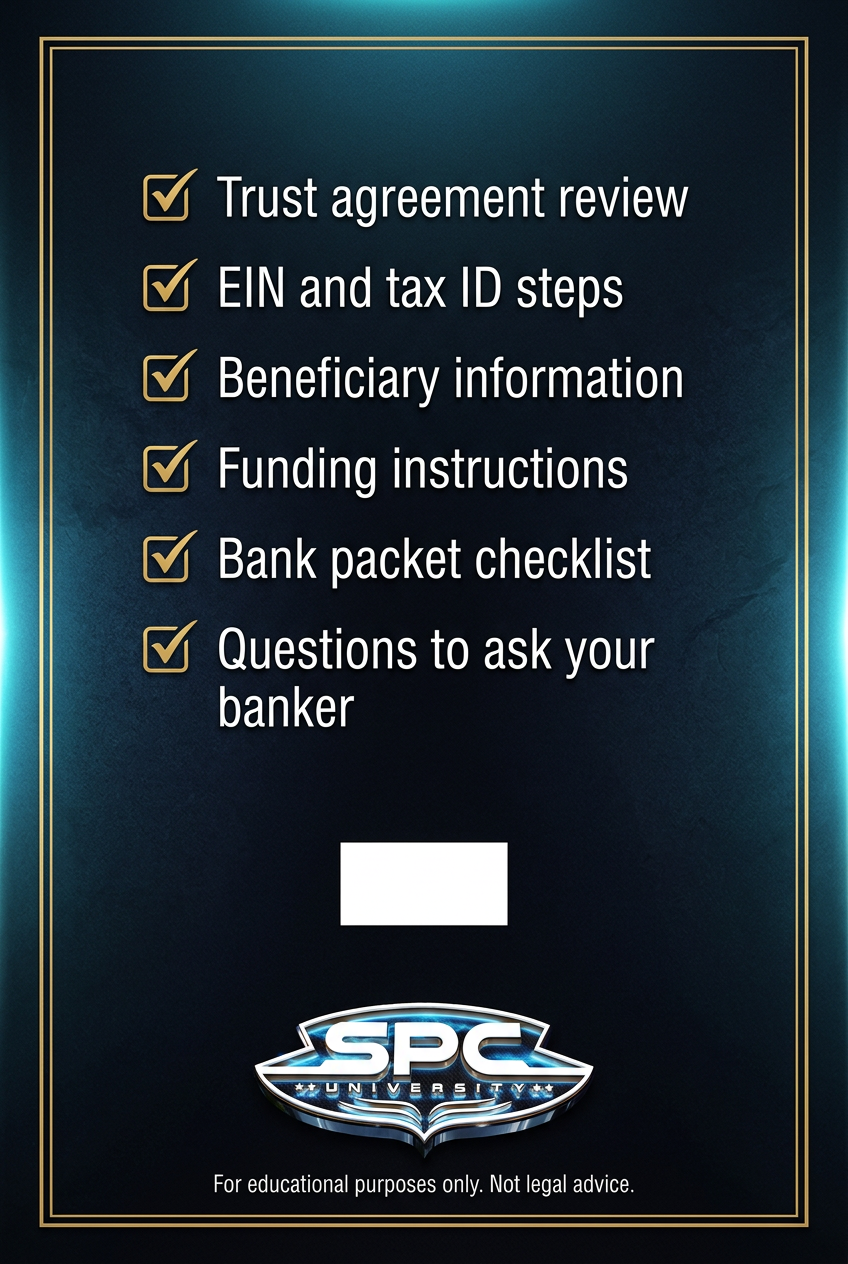
The Complete 7-Step Private Trust Banking, Treasury & Underwriting Kit: UTC § 1013 Certificates of Trust, Line-by-Line IRS Form SS-4 EIN Protocol, Form 56 Fiduciary Notice, Banker Scripts, Non-Recourse Signing & Subchapter J Tax Compliance

THE BANK PACKET: OPEN YOUR TRUST ACCOUNT — UNABRIDGED MASTER EDITION
Section 1: Line-by-Line IRS Form SS-4 EIN Application Protocol
Securing an Employer Identification Number (EIN) correctly from the Internal Revenue Service is the crucial first step. Errors in entity classification can cause the IRS or bank to treat your trust as a partnership or corporation:
Section 2: Formal Banking Resolution of Trustees
The Banking Resolution is the corporate/trust resolution presented to the bank manager authorizing the account opening:
Section 3: Word-for-Word Banker Objection Scripts
Front-line branch bankers are trained on statutory LLCs and frequently get confused when opening trust accounts. Use these professional scripts:
Trustee: "A trust is not a statutory LLC or corporation; it is a private contractual estate created by trust indenture. Under Uniform Trust Code Section 1013, financial institutions are governed by a Certificate of Trust, which I have right here, fully notarized."
Trustee: "This is an irrevocable discretionary spendthrift trust. Under federal law, no beneficiary holds a vested equitable property right exceeding 25%, as all distributions are made solely at the absolute discretion of the Trustee. As Trustee, I am the authorized signer and sole managerial controller."
Trustee: "Under UTC § 1013(d), a recipient of a Certificate of Trust cannot require the trustee to furnish copies of the private trust indenture unless an excerpt is strictly necessary. The Certificate provides complete legal protection to your bank under the statute."
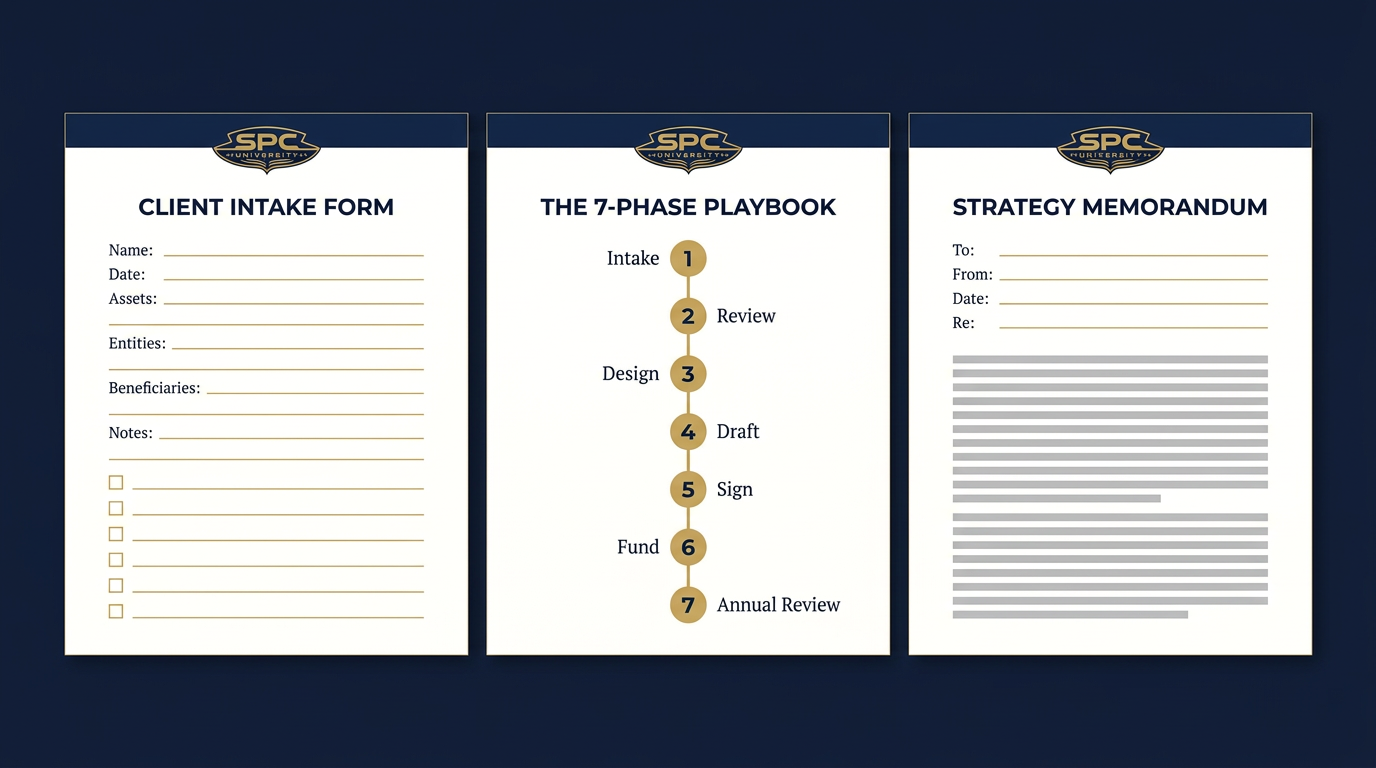
Part I: Step-by-Step Trust Execution, EIN Issuance, Bank Handoff & Annual Maintenance Playbook
EXECUTION PLAYBOOK — From Intake to Funded & Compliant
The step-by-step assembly manual (who, what, when, in what order)
Companion: MASTER_CLIENT_INTAKE.md (data) → skeletons (documents) → this playbook (process).
---
PHASE 0 — Assembly & Education (Week 1–2)
1. Family reads CLIENT_EDUCATION_HANDBOOK.md (all decision-makers; no signing before this).
2. Complete MASTER_CLIENT_INTAKE.md — every ★ field. T-7 agent assembles the Client Preparation Pack (Team Roster § 3).
3. Goal scorecard → layer activation map (which of the 10 layers get built).
PHASE 1 — Counsel Engagement (Week 2–4)
1. Retain lead U.S. counsel (ACTEC class) — engagement letter defines: documents, coordination duty, flat vs. hourly.
2. Lead counsel introduces/retains: Cook Islands firm (APT layer), Cayman firm (PTC/STAR), international CPA.
3. Conflicts checks, fee schedules in writing, engagement scope locked.
PHASE 2 — Design Memo (Week 4–6)
1. T-1 Architecture agent + lead counsel produce the Design Memorandum: layers activated, situs choices, tax modeling (uses verified 2026 figures), entity chart.
2. Tax CPA signs off on: 709 strategy, GST allocation plan, grantor-trust statuses, 3520/3520-A forecast.
3. Design review meeting (family + counsel + CPA). Decisions minuted. No drafting before this memo is approved.
PHASE 3 — Document Production (Week 6–12)
1. Counsel converts the skeletons to full instruments using intake data (the only step where full signature-ready text is produced — by licensed counsel).
2. Circulation: family reviews with education handbook open; changes logged.
3. Appraisal queue opens (business interests, real property) — valuation firm engaged.
4. Insurance applications (ILIT policies) submitted — trust named owner/beneficiary from inception.
PHASE 4 — Signing Logistics
PHASE 5 — Funding (the phase that decides everything — Week 12–20)
| Asset | Action | Proof filed in funding ledger |
|---|---|---|
| Real property | Quitclaim/warranty deed → RLT | Recorded deed |
| Bank/brokerage | Retitle → RLT / FLP | New statements |
| Business units | Sale (IDGT note) + gift (SLAT/Dynasty) post-appraisal | Appraisal, note, cap-table update |
| Insurance | ILIT owner/beneficiary from issue | Policy + ownership certificate |
| Tangibles | General assignment | Signed assignment |
| Never | Retirement accounts retitled | Designation table instead |
PHASE 6 — Compliance Handoff (immediately after funding)
1. T-3 compliance calendar loaded: 709 (+GST formula allocations) due with 1040; Crummey notice schedule; 3520/3520-A cycle; FBAR; 1041s; state filings.
2. Trustee/PTC governance install: IPS adopted; committees chartered; meeting cadence; records system (Vol. XVI § 8 checklist).
3. Team briefing: banker/custodian receives trust certifications; insurers confirm ILIT ownership.
PHASE 7 — Maintenance (forever)
RACI SNAPSHOT
| Task | Responsible | Accountable | Consulted | Informed |
|---|---|---|---|---|
| Design memo | Lead counsel | Client | CPA, T-1 agent | Family |
| Instrument production | Licensed counsel each layer | Lead counsel | T-1/T-2 agents | Family |
| Funding execution | Client + trustees | Lead counsel | CPA | All |
| Tax filings | CPA | Client | T-3 agent | Counsel |
| Annual review | Lead counsel | Client | All | Family |
Part II: Fiduciary Banking Underwriting (CIP/CDD & UTC § 1013), Minute Books, Form SS-4, Form 56 & FinCEN 2026 CTA Permanent Domestic Exemption
50-STATE TRUST STATUTES, DOMESTIC ASSET PROTECTION TRUSTS (DAPT), DYNASTY DURATION & REAL ESTATE CONVEYANCE LAW
1. Uniform Trust Code (UTC) Adoption Across the United States:
Over 36 U.S. states and the District of Columbia have enacted the Uniform Trust Code (with state-specific modifications), including Alabama, Arizona, Arkansas, Colorado, Connecticut, Florida (Fla. Stat. Ch. 736), Hawaii, Illinois (760 ILCS 3/ Illinois Trust Code), Kansas, Kentucky, Maine, Maryland, Massachusetts (M.G.L. c. 203E), Michigan, Minnesota, Mississippi, Missouri, Montana, Nebraska, New Hampshire, New Jersey, New Mexico, North Carolina, North Dakota, Ohio, Oregon, Pennsylvania (20 Pa. C.S. Ch. 77), South Carolina, Tennessee, Utah, Vermont, Virginia, West Virginia, Wisconsin, and Wyoming. Key non-UTC states with premier standalone trust codes include Delaware (12 Del. C. Ch. 33 & 35), Nevada (NRS Ch. 163-166), South Dakota (SDCL Title 55), Alaska (AS Title 13 & 34.40), New York (EPTL), Texas (Tex. Prop. Code Title 9, Subtitle B — Texas Trust Code), and California (Cal. Prob. Code Div. 9).
2. Premier U.S. Dynasty & Domestic Asset Protection Trust (DAPT) Statutory Citations:
tate fiduciary income tax on non-resident beneficiaries.
3. Real Estate Conveyance into Trust — Garn-St. Germain Federal Due-on-Sale Exemption (12 U.S.C. § 1701j-3(d)(8)):
When transferring mortgaged residential real property (1 to 4 dwelling units) into a trust, federal law under the Garn-St. Germain Depository Institutions Act of 1982, 12 U.S.C. § 1701j-3(d)(8), expressly PROHIBITS a mortgage lender from exercising a 'due-on-sale' acceleration clause on a transfer into an inter vivos trust in which the borrower is and remains a beneficiary and which does not relate to a transfer of rights of occupancy in the property. For non-residential or pure asset-holding trusts where the settlor is severed, properties are either transferred free-and-clear, transferred into an Illinois/Florida-style Land Trust or Single-Purpose Holding LLC with lender notice/consent, or encumbered via equity-stripping friendly UCC-1 / Deed of Trust liens in favor of the Master Holding Trust.
4. Illinois-Style & Florida-Style Real Estate Land Trusts (Fla. Stat. § 689.071 / 765 ILCS 405/):
In a Land Trust, a Deed in Trust conveys both legal and equitable title to real estate to the Land Trustee, while the beneficiary holds a personal-property beneficial interest in the proceeds and avails of the real estate. This converts a real estate interest into personal property (which can be assigned privately to the Master Pure Holding Trust via an unrecorded Assignment of Beneficial Interest without public county deed recording of the ultimate Holding Trust) and shields the owner's identity from public county tax-assessor searches.
WORLD, INTERNATIONAL & OFFSHORE ASSET PROTECTION TRUST STATUTORY COMPENDIUM
1. Cook Islands — International Trusts Act 1984 (as amended):
2. Nevis — Nevis International Exempt Trust Ordinance (NIETO) 1994 (as amended):
3. Belize — Belize Trusts Act (Chapter 202, Revised Edition):
4. Cayman Islands — Trusts Act, STAR Trusts (Part VIII) & Private Trust Companies (PTC):
5. European Civil-Law Foundations & Hague Trust Convention:
MASTER CLAUSE-BY-CLAUSE TRUST INDENTURE & FIDUCIARY CONTRACT DRAFTING REFERENCE LIBRARY
1. Settlor Total Severance & Non-Reversion Clause (Irrevocable Pure Trust / Non-Grantor Shield):
'IRREVOCABILITY AND TOTAL SETTLOR SEVERANCE. This Declaration and Indenture of Trust is absolute and irrevocable. The Settlor hereby permanently, unconditionally, and irrevocably relinquishes, surrenders, and renounces any and all right, title, power, privilege, or reversionary interest in the Trust Corpus or the income therefrom, including any power to revoke, alter, amend, terminate, or direct the administration or distribution of the Trust Estate. Under no circumstances shall any portion of the Trust Corpus or income revert to the Settlor or be applied to discharge any legal obligation of the Settlor.'
2. Non-Merger of Legal and Equitable Title Clause (UTC § 402(a)(5) & Common-Law Anti-Merger):
'SEPARATION AND NON-MERGER OF LEGAL AND EQUITABLE TITLE. Full legal title, custody, and plenary administrative dominion over the Trust Corpus shall vest exclusively in the Managing Trustee(s) in their fiduciary capacity, while equitable and beneficial enjoyment shall vest separately in the holders of Certificates of Beneficial Interest. At no time shall the same person serve as the sole Trustee and the sole Beneficiary of this Trust, and in the event circumstances would otherwise cause a convergence of sole legal and sole equitable title, the designated Successor Trustee or Co-Trustee shall automatically vest as Co-Trustee nunc pro tunc to prevent any merger of title in law or equity.'
3. Discretionary Spendthrift & Anti-Alienation Firewall Clause (Restatement Third § 56 & UTC §§ 502, 504):
'DISCRETIONARY SPENDTHRIFT AND ANTI-ALIENATION PROVISION. The interest of every Beneficiary in the principal or income of this Trust is held subject to a strict discretionary spendthrift trust pursuant to Uniform Trust Code Sections 502 and 504 and Restatement (Third) of Trusts Section 56. No Beneficiary shall have any vested right, title, or enforceable claim to demand any distribution. All distributions shall rest solely within the absolute, sole, and unreviewable discretion of the Independent Managing Trustee. No beneficial interest shall be subject to voluntary or involuntary anticipation, assignment, pledge, hypothecation, attachment, levy, execution, garnishment, bankruptcy turnover, or matrimonial claim. If any creditor or court attempts to attach or compel a distribution to any Beneficiary, all discretionary distribution authority toward such Beneficiary shall immediately suspend and convert to a discretionary accumulation and third-party vendor-payment power only.'
4. Event-of-Duress, Contempt Defense & Automatic Situs Flight Clause (World & International Trusts):
'EVENT OF DURESS AND AUTOMATIC FIDUCIARY REMOVAL / FLIGHT PROVISION. An Event of Duress shall occur immediately upon the issuance of any judicial, administrative, or governmental order, subpoena, injunction, turnover decree, or threat of civil or criminal contempt directed against the Settlor, any Beneficiary, any Domestic Trustee, or any Trust Protector seeking to compel the repatriation, turnover, amendment, or disclosure of the Trust Corpus outside the free and uncoerced exercise of fiduciary discretion. Upon the occurrence of an Event of Duress, and without requiring any further notice or act: (a) any Domestic Trustee, Advisor, or Trust Protector subject to such compulsion is automatically and immediately divested of all office, signatory power, and authority nunc pro tunc to the moment immediately preceding the Event of Duress; (b) sole fiduciary authority vests exclusively in the Independent Offshore/Successor Trustee located outside the jurisdiction of duress; and (c) the Trustee is strictly prohibited from honoring any instruction, signature, or directive executed by any person acting under judicial or physical compulsion.'
5. Non-Recourse Fiduciary Contracting & Signature Clause (UTC § 1010 & Schumann-Heink v. Folsom):
'NON-RECOURSE FIDUCIARY LIMITATION OF LIABILITY. Every contract, deed, promissory note, banking resolution, or commercial instrument executed by the Trustee on behalf of this Trust shall bind only the Trust Corpus in the hands of the Trustee. Neither the Trustee nor any Beneficiary or Trust Protector shall be personally or individually liable on any obligation of the Trust. The authorized fiduciary signature format across all instruments shall be: [Name of Trustee], solely as Managing Trustee of [Name of Trust], under Indenture dated [Date], and not individually, without personal recourse (UCC 3-402(b) / UTC Section 1010).'
6. IRC § 675(4)(C) Asset Substitution ('Swap Power') Clause (For Intentionally Defective Grantor Trusts - IDGTs):
'POWER OF SUBSTITUTION IN NONFIDUCIARY CAPACITY (IRC SECTION 675(4)(C)). So long as the Grantor is living and not incapacitated, the Grantor shall have the power, exercisable strictly in a nonfiduciary capacity and without the approval or consent of any person in a fiduciary capacity, to reacquire all or any part of the Trust Corpus by substituting other property of equivalent fair market value, certified by the Trustee to be of equivalent value in accordance with Revenue Ruling 2008-22 and Revenue Ruling 2011-28.'
7. Crummey Demand & Annual Gift Tax Exclusion Clause (Crummey v. Commissioner, 397 F.2d 82):
'CRUMMEY WITHDRAWAL RIGHT (IRC SECTION 2503(b) PRESENT INTEREST). Immediately upon each direct or indirect contribution of property to the Trust during any calendar year, each designated Crummey Beneficiary shall have the absolute, unrestricted right to withdraw from the Trust an amount not exceeding the lesser of the value of such contribution or the federal annual gift tax exclusion under IRC Section 2503(b) ($19,000 per donee, or $38,000 with spousal gift-splitting in 2026). The Trustee shall give prompt written notice of each contribution to each Crummey Beneficiary, and such withdrawal right shall lapse thirty (30) days after receipt of notice to the extent of the greater of $5,000 or five percent (5%) of the aggregate value of the assets out of which the exercise of the lapsed power could be satisfied pursuant to IRC Section 2514(e).'
LANDMARK U.S. SUPREME COURT & APPELLATE CASE LAW DIGEST FOR TRUSTS, EQUITY, TAXATION & ASSET PROTECTION
1. Common-Law Pure Trusts & Business Trusts:
firmed common-law trust validity and enforceable non-recourse trustee contracting clauses shielding trustees and beneficiaries from personal liability.
2. Spendthrift Trusts, Creditor Shielding & Asset Protection Precedents:
94 (11th Cir. 2002): Settlor transferred $7M to an offshore trust 66 days before a $20.4M arbitration award and retained de facto power to appoint trustees. Demonstrates that last-minute transfers on the eve of judgment violate fraudulent transfer laws and defeat impossibility defenses.
3. Constitutional Due Process & State Trust Taxation Precedents:
4. Federal Estate, Gift & Grantor Trust Tax Precedents:
e for a promissory note at the IRC § 1274 Applicable Federal Rate) are disregarded for federal income tax purposes, triggering zero capital gains tax on the sale and zero taxable interest income on the note payments.
5. Administrative Law & Constitutional Courtroom Precedents (2024-2026):
FIDUCIARY TRUST OPERATIONS, BANK UNDERWRITING (CIP/CDD & UTC § 1013), TITLE INSURANCE & MINUTE BOOK PROTOCOLS
1. How Bank Compliance & Underwriting Teams Actually Review a Trust Account Application:
When a Trustee walks into a commercial bank or private wealth desk (JPMorgan Chase, Wells Fargo, Bank of America, Relay, Mercury, or Fidelity/Schwab) to open a Trust Checking or Treasury Account, the bank's Legal/Compliance department verifies five items under federal Customer Identification Program (CIP, 31 CFR § 1020.220) and Uniform Trust Code Section 1013:
.
2. Title Insurance & Real Property Conveyance into Trust (ALTA Endorsements & Deed Titling):
'TO: [Full Legal Name of Trustee], as Managing Trustee of [Exact Name of Trust], under Declaration of Trust dated [Month Day, Year], and unto any Successor Trustee thereof.'
3. The Trust Minute Book & Annual Fiduciary Compliance Checklist:
To defeat any 'alter-ego', 'sham trust', or 'nominee' challenge in court or IRS audit (see Zmuda v. Commissioner and Muhich v. Commissioner), the Managing Trustee must maintain a physical and digital Leather Trust Binder (Minute Book) containing:
e Administration Fees, Beneficiary Discretionary Distributions, or Operating LLC management draws, and file annual Form 1041 / Schedule K-1 when required under Subchapter J).
COMMON-LAW EXPRESS TRUSTS (PURE TRUSTS / MASSACHUSETTS TRUSTS) — CONTROLLING SUPREME COURT & HISTORICAL JURISPRUDENCE
1. Foundational Definition and Constitutional Anchor:
An Express Trust under the Common Law (historically termed a Common-Law Pure Trust or Massachusetts Trust) is a private contractual fiduciary relationship created by a Declaration or Indenture of Trust whereby a Settlor/Grantor conveys legal title in property (the Trust Res or Corpus) to one or more Trustees to hold, manage, and administer for the equitable benefit of designated Beneficiaries (or Certificate Holders). Its contractual obligation is protected under Article I, Section 10, Clause 1 of the United States Constitution ('No State shall... pass any... Law impairing the Obligation of Contracts') and traditional Chancery Equity jurisprudence.
2. Alfred D. Chandler — Express Trusts under the Common Law (1912):
Alfred Dupont Chandler's landmark 1912 treatise, 'Express Trusts under the Common Law: A Superior and Distinct Mode of Administration, Distinguished from Partnerships, Contrasted with Corporations', established the classic doctrinal distinction between statutory corporations (which derive their existence from a state legislative franchise) and common-law express trusts (which derive their existence from the natural and common-law right of sui juris individuals to contract and convey property to fiduciaries in equity). Under Chandler's doctrine, when Trustees hold full legal title and plenary management control without partner-style control by beneficiaries, the arrangement is a true trust in equity rather than a partnership or corporate franchise.
3. Controlling U.S. Supreme Court Precedents on Express & Business Trusts:
ve commercial business operations, business trusts actively carrying on commercial enterprise in quasi-corporate form fall within the federal tax definition of an 'association' even if formed under common law.
title, manage the trust assets, and control litigation are the real parties in interest under Federal Rule of Civil Procedure 17(a), and their own citizenship controls when they sue or are sued in their own names as trustees.
4. Core Operational Rule for SPC University Students:
To preserve true trust status under Crocker v. Malley, Morrissey v. Commissioner, and Subchapter J:
2026 FEDERAL TRUST TAXATION (SUBCHAPTER J), OBBBA $15M ESTATE/GIFT/GST EXEMPTION & FINCEN CTA PERMANENT DOMESTIC EXEMPTION
1. Subchapter J of the Internal Revenue Code (26 U.S.C. Sections 641 through 685):
tee may elect to treat distributions made within the first 65 days of a new tax year as having been paid on the last day of the preceding tax year.
2. Verified 2025-2026 Federal Estate, Gift, and GST Tax Thresholds (IRC Section 2010 & Public Law 119-21 / OBBBA):
3. Essential IRS & Treasury Fiduciary Forms:
4. FinCEN 2025/2026 Corporate Transparency Act (CTA) Permanent Domestic Exemption:
UNIFORM TRUST CODE (UTC), RESTATEMENT (THIRD) OF TRUSTS, DIRECTED TRUSTS & DECANTING REFERENCE
1. Key Uniform Trust Code (UTC) Sections Every Trustee & Student Must Master:
on is not the sole trustee and sole beneficiary (Doctrine of Merger avoidance).
iscretionary beneficiary, creditors of the settlor can reach the maximum amount that can be distributed to the settlor—UNLESS the trust is established under a Domestic Asset Protection Trust (DAPT) statute (such as South Dakota, Nevada, Delaware, Wyoming, Alaska, Ohio, Tennessee, or Utah) or the settlor is completely severed as a non-beneficiary (as in Layer 2 of the SPCU 10-Layer Pure Trust Architecture).
ly').
2. Top Tier U.S. Dynasty & Domestic Asset Protection Trust (DAPT) Jurisdictions:
come tax.
ECCLESIASTICAL LAW, FIRST AMENDMENT CHURCH AUTONOMY, 26 U.S.C. SECTION 508(c)(1)(A) FREE-CHURCH MINISTRIES & RELIGIOUS TRUSTS
1. Constitutional & Supreme Court Foundation of Ecclesiastical Autonomy:
The First Amendment to the U.S. Constitution ('Congress shall make no law respecting an establishment of religion, or prohibiting the free exercise thereof') establishes the Ecclesiastical Abstention / Church Autonomy Doctrine:
s in secular property terms) without resolving doctrinal controversies.
2. 26 U.S.C. Section 508(c)(1)(A) Mandatory Exception for Churches & Integrated Auxiliaries:
3. Strict Legal Guardrails for 508(c)(1)(A) Faith-Based Trusts & Ministries:
To lawfully operate a 508(c)(1)(A) Church, Faith-Based Ministry Trust, or Integrated Auxiliary without falling into IRS revocation or fraud:
laws, Dissolution Clause dedicating remaining assets strictly to religious/charitable purposes, IRS Form SS-4 (checking 'Church or Church-Controlled Organization'), and a UTC Section 1013 Certificate of Ecclesiastical Trust for banking.
Part III: Federal Trust Taxation (Subchapter J IRC §§ 641-685), Form 1041, Schedule K-1 & Foreign Trust Reporting
VOLUME XV — TRANSFER-TAX & REPORTING MANUAL
Trust Agent Swarm knowledge base — compiled Nov. 18, 2026. 2026 figures verified against IRS.gov and law-firm sources this session.
1. Verified Current Figures (re-verify every year)
| Item | 2026 |
|---|---|
| Estate/gift/GST unified exemption | $15,000,000 per person; $30M married (WFTC, § 2010(c)(3), indexed after 2026) |
| Top rate | 40% |
| Annual exclusion | $19,000 per donee (2027: $20,000) |
| Non-citizen spouse annual gift cap | $194,000 |
| 706 due | 9 months after death (+6-month extension) |
| 709 due | With Form 1040 (Apr. 15 + extensions) |
| Form 3520/3520-A penalty | Greater of $10,000 or 35% of the reportable transfer/distribution (§ 6677) |
| Willful FBAR penalty | Greater of $100,000 or 50% of the account |
2. Estate Tax (Chapter 11)
3. Gift Tax (Chapter 12)
§ 2501; annual exclusion § 2503(b) ($19,000/donee, present interest); direct tuition/medical payments § 2503(e) (unlimited); gift-splitting § 2513; Crummey withdrawal mechanics § 2514 (present-interest qualified withdrawals; 5-and-5 limit § 2515? — § 2514(c); notice discipline = Vol. XVI § 4). IDGT installment sales: AFR-based notes; § 7872 below-market safe harbor; swap power § 675(4)(C) for basis step-up planning.
4. GST Tax (Chapter 13)
§§ 2601–2664: direct skips, taxable distributions, taxable terminations; inclusion ratio and allocation on timely Form 709 (§ 2631); automatic allocation rules can waste exemption — deliberate allocation schedules required for dynasty design; predeceased-parent rules; zero-out GRAT GST pairing.
5. Trust Income Tax (Subchapter J)
6. State Overlay (verify per state — changes often)
12+ states levy estate tax with far lower exemptions (e.g., OR from $1M; NY ~$7M+ indexed; MA $2M — verify current); state gift taxes rare (CT, MN); trust-income residency disputes concentrate in CA/NY (core-fiduciary tests); situs selection (SD/DE/NV) is a legitimate state-tax design tool.
7. The Annual Compliance Calendar (swarm T-3 runs this)
| Month | Action |
|---|---|
| Jan | Crummey notices for annual gifts; valuation queue for closely held interests |
| Mar–Apr | 1041s, 3520/3520-A prep; 709 prep; FBAR (Apr 15 + extension) |
| Apr 15 | 709 + GST allocations filed timely (late allocation = design failure) |
| Jun | 3520-A final date (75 days after 1040 due incl. extensions) |
| Q4 | Trustee accountings; distribution projections; PTC governance meeting |
| Annual | Law-currency re-verification (rates, statutes, case law) |
8. Penalty & Audit Realities
§ 6677 (3520/3520-A); § 6662 accuracy penalties; willful FBAR BLAST penalties; § 6702 frivolous submissions; promoters face § 6700. Everything in this manual assumes full disclosure — the architecture is tax-driven, not tax-evading.
TAXATION — COMPLETE DOCTRINE FILE
Knowledge-base companion — template: real doctrine → rejections → lawful paths → classification
---
1. THE REAL DOCTRINE
2. THE REJECTION RECORD (Stage C, verified)
| Claim | Treatment |
|---|---|
| "The income tax is unconstitutional" | *Brushaber* [K]; rejected for 110 years |
| "Wages are not income" | Rejected under § 61/*Glenshaw Glass*; IRS frivolous list [V] |
| "The 16th Amendment was never ratified" | Rejected in every court; *Brushaber* forecloses [K] |
| "§ 861 makes only foreign-source income taxable" | Rejected; frivolous-list item [V] |
| "IRS is a private company (Puerto Rico trust)" | Rejected; frivolous-list item [V] |
| "Filing 1040 waives rights / is voluntary" | Rejected; *Flora* [K]; § 7203 prosecutions |
3. THE LAWFUL PATHS (what the theory promises, done legally)
4. STAGE A–F
"Federal income tax on wages is invalid/voluntary" — B: none; C: *Brushaber*, *Cheek*, IRS list [V]; D: Rejected by controlling courts; E: verified; F: § 6702/6673 penalties, § 7201/7203/7206 prosecution.
Part IV: Commercial Law, UCC Articles 1, 3, 8 & 9, Non-Recourse Representative Signatures (UCC § 3-402 / UTC § 1010) & Money/Banking Doctrine
VOLUME VII — COMMERCIAL LAW, UCC, TRUSTS, AND GOVERNMENT ENTITIES
1. Executive Overview
This volume states what the Uniform Commercial Code actually does, what trusts actually are, what government corporations actually are — and dismantles the pseudo-uses of each. This is also the volume closest to this counsel's home discipline (trusts and estates), so its corrections are made with the same care a fiduciary would demand.
2. The UCC — Actual Structure
3. "Accepted for Value" (A4V) and Instrument Theories
4. Trusts — the Real Law (and the Fake Kind)
A valid express trust requires: (1) a settlor with capacity, (2) intent, (3) ascertainable beneficiaries, (4) trust property, (5) a valid purpose (UTC § 402; Restatement (Third) of Trusts § 46). Trusts are tax-neutral or tax-transparent entities governed by Subchapter J (26 U.S.C. §§ 641–692) and the grantor-trust rules (§§ 671–679).
Abusive "patriot"/"pure"/"constitutional trust" schemes — marketed as freeing property from taxation or judgment — have been rejected and penalized for decades:
5. Government Entities — the Real Definitions
6. Public Law vs. Private Law
A jurisprudential distinction (public law = state's relations with persons; private law = persons' relations with each other) — with a modern procedural meaning: "Public Law" is the standard designation of every federal session law (e.g., Pub. L. No. 93-198). The pseudolegal claim that "public law" statutes bind only government or that "private law" secretly governs citizens is UNSUPPORTED.
7. What Legitimate Commercial Law Offers
8. Source Notes
LII text of 28 U.S.C. § 3002 verified this session: [law.cornell.edu/uscode/text/28/3002](https://www.law.cornell.edu/uscode/text/28/3002); [TreasuryDirect fraud advisory](https://www.treasurydirect.gov/laws-and-regulations/fraud/birth-certificate-bonds/); SPLC, "His 'Straw Man' Free, a Scammer Finds the Rest of Him Isn't"; Fourth Circuit opinion (2016) documenting redemption origins [govinfo](https://www.govinfo.gov/content/pkg/USCOURTS-ca4-16-04213/pdf/USCOURTS-ca4-16-04213-1.pdf). Accessed November 18, 2026.
MONEY, BANKING, AND DEBT — COMPLETE DOCTRINE FILE
Knowledge-base companion
---
1. THE REAL STRUCTURE (what the Federal Reserve actually is)
2. THE REJECTION RECORD
| Claim | Treatment |
|---|---|
| "The Fed is a private corporation that owns the U.S." | Distortion of *Lewis*; structure above [K]; no court has accepted the ownership theory |
| "HJR 192 (June 1933) created a discharge method" | Rejected wherever litigated; frivolous-list adjacent [V/K] |
| "Vapor money" (the note funded the loan; no consideration) | *[V]* — *Anderson v. Sullivan*, 224 Md. App. 501, 121 A.3d 181 (2015): vapor money and redemption theories "roundly rejected by courts across the nation"; *Brook v. Woodall* (Utah Ct. App. 2011) (definitive rejection); *Gallant v. Deutsche Bank*, 766 F. Supp. 2d 714 (W.D. Pa. 2011) ("uniformly rejected"); *Lawson v. Citicorp Trust Bank* (E.D. Cal. 2012) |
| "A4V discharges debt" | Covered — file 8 (FBI/NASS [V]) |
3. THE LAWFUL PATHS (real discharge and protection mechanisms)
4. STAGE A–F
"Debt can be discharged by UCC instruments/HJR 192/vapor-money arguments" — B: none; C: the verified rejection record above; D: Rejected; E: verified this session; F: dismissed cases with prejudice, sanctions, fraud exposure; bankruptcy is the lawful path that exists.
Part V: 50-State UCC-1 Security Agreement & False-Lien Compliance Guardrails
STATE FALSE-LIEN LAW — VERIFIED ANCHORS + 50-STATE VERIFICATION ROSTER
Knowledge-base companion — current as of 18 November 2026
Verification legend: [V] = verified against a retrieved primary or authoritative source this session; [K] = canonical; ⚠ = pattern applies, confirm current state code before relying on the citation.
1. THE FEDERAL LAYER [V]
2. VERIFIED STATE ENACTMENTS
| State | Authority | What it does | Status |
|---|---|---|---|
| Indiana | Ind. Code § 32-28-13-4 (2026 code) | "Common law lien against public official based on performance of official duty precluded; voiding common law lien" — statutory nullification of the movement's core lien instrument | [V] ([IGA 2026 PDF](https://iga.in.gov/ic/2026/Title_32/Article_28.pdf)) |
| Texas | Tex. Civ. Prac. & Rem. Code § 12.002 | Civil liability for filing/presenting fraudulent judgment liens, false liens, or claims against real property; cause of action for the target | [V] ([Texas Statutes](https://statutes.capitol.texas.gov/GetStatute.aspx?Code=CP&Value=12.002)) |
| California | Cal. Penal Code § 115 | Felony for knowingly procuring/offering any false or forged instrument to be filed, registered, or recorded in any public office | [V] (via CSC state-remedies compilation) |
| Illinois | 2013 statutory upgrade | Enhanced penalties for false title-clouding filings against public officials | [V] ([ISBA Law Pulse](https://www.isba.org/ibj/2013/11/lawpulse/stiflingsovereigncitizenstougherpen)) |
| Florida | Fraudulent-liens provisions + legislative record | Filing false liens without notice criminalized; FL Sheriffs guidance for clerks | [V] ([FL Sheriffs](https://flsheriffs.org/resource/filing-false-liens/)) |
| California (leg. record) | AB 1267 analysis (2015-16) | Documents sovereign-citizen false-lien filings against judges, lawyers, IRS employees as the basis for relief legislation | [V] ([CA leg. record](https://www.leginfo.ca.gov/pub/15-16/bill/asm/ab_1251-1300/ab_1267_cfa_20150506_173044_asm_floor.html)) |
3. THE FOUR-TOOL PATTERN (what state statutes do — per the NASS 2014 survey [V])
1. Expungement authority — "a recording official may nullify or expunge from an official record a false or fraudulent lien or instrument" (NASS-compiled model language; several states).
2. Criminal penalties — false-filing felonies (Cal. Pen. Code § 115 pattern; Indiana's preclusion statute).
3. Civil damages — causes of action for slander of title / statutory damages (Tex. § 12.002 pattern).
4. Recorder immunity — immunity for recording officials who refuse or remove bogus filings.
4. FIFTY-STATE VERIFICATION ROSTER
> States below with no citation = the NASS pattern applies and every reporting database treats bogus UCC/lien filings as void-and-criminal there, but the current statutory cite must be pulled from the state code before any use. This roster is the verification checklist.
| State | Current cite | State | Current cite |
|---|---|---|---|
| AL | ⚠ verify | MT | ⚠ verify |
| AK | ⚠ verify | NE | ⚠ verify |
| AZ | ⚠ verify | NV | ⚠ verify |
| AR | ⚠ verify | NH | ⚠ verify |
| CA | Cal. Pen. Code § 115 [V] | NJ | ⚠ verify |
| CO | ⚠ verify | NM | ⚠ verify |
| CT | ⚠ verify | NY | ⚠ verify |
| DE | ⚠ verify | NC | ⚠ verify |
| FL | verified provisions [V] | ND | ⚠ verify |
| GA | ⚠ verify | OH | ⚠ verify |
| HI | ⚠ verify | OK | ⚠ verify |
| ID | ⚠ verify | OR | ⚠ verify |
| IL | 2013 upgrade [V] | PA | ⚠ verify |
| IN | Ind. Code § 32-28-13-4 [V] | RI | ⚠ verify |
| IA | ⚠ verify | SC | ⚠ verify |
| KS | ⚠ verify | SD | ⚠ verify |
| KY | ⚠ verify | TN | ⚠ verify |
| LA | ⚠ verify | TX | Tex. CPRC § 12.002 [V] |
| ME | ⚠ verify | UT | ⚠ verify |
| MD | ⚠ verify | VT | ⚠ verify |
| MA | ⚠ verify | VA | ⚠ verify |
| MI | ⚠ verify | WA | ⚠ verify |
| MN | ⚠ verify | WV | ⚠ verify |
| MS | ⚠ verify | WI | ⚠ verify |
| MO | ⚠ verify | WY | ⚠ verify |
Baseline source for the whole roster: NASS, *State Strategies to Subvert Fraudulent Uniform Commercial Code (UCC) Filings* (Apr. 2014) ([nass.org](https://www.nass.org/sites/default/files/surveys/2017-08/final-nass-report-bogus-filings-040914.pdf)) [V]; pattern confirmed current by SPLC (Nov. 13, 2025) [V].
Part VI: Client & Trustee Fiduciary Banking Education Handbook
CLIENT EDUCATION HANDBOOK — How the Whole Machine Works
Plain-English guide for the family (read this before any signing meeting)
---
1. The System in One Paragraph
Your wealth moves through a layered set of containers. A revocable trust runs daily life and avoids probate. Irrevocable trusts funded while you're alive take assets out of your taxable estate — some keep access for your spouse (SLATs), some skip taxes for every future generation (dynasty trusts), some shield assets from future lawsuits (Cook Islands), and some hold life insurance (ILIT). A family LLC lets assets move at discounted values. Charitable trusts return income to you while giving the rest to causes. A Cayman private trust company lets your family sit in the trustee's chair without hiring a bank. Every container is disclosed to the tax authorities — the protection comes from law and structure, never from secrecy.
2. The Money-Flow Story (what actually happens)
1. You gift $19,000/year per person (2026, verified) or larger gifts against your $15M exemption — always with a gift-tax return (709) and Crummey notices.
2. Gifts buy units in the family LLC; appraisals establish their discounted value.
3. Trusts buy or receive those units — Dynasty (GST-exempt), SLATs (spousal access), Cook Islands APT (the shield).
4. Growth compounds inside the trusts, outside your estate.
5. At death, your estate owes no estate tax below $15M/person ($30M married); insurance in the ILIT provides tax-free liquidity; the pour-over will sweeps leftovers into the revocable trust.
6. Generations later, the dynasty trust still holds it all — no estate tax at any generation in between.
3. The Players (who does what)
| Role | Plain English |
|---|---|
| Settlor/Grantor | The person who puts assets in |
| Trustee | The legal owner-manager (bank, trust company, or your PTC) |
| Trust Protector | The safety valve — fires/replaces trustees, approves changes |
| Distribution Committee | Decides who gets what, per the rules |
| Beneficiary | The people the trust is for |
| Guardian (of minors) | Raises your kids — named in the pour-over will |
| Attorney-in-fact (POA) | Handles money if you're incapacitated |
| Healthcare agent | Makes medical decisions if you can't |
4. Top 10 Mistakes That Kill Good Plans (avoid these and you're ahead of 95%)
1. Never funding the trust (assets stay in your name → probate).
2. Signing the Cook Islands trust after a lawsuit appears (fraudulent-transfer clawback).
3. Skipping the gift-tax return (709) or the GST allocation.
4. Letting the insured parent be trustee of their own ILIT.
5. Personal use of FLP/LLC assets (kills the discount — § 2036).
6. Keeping retirement accounts in trusts directly (wrong tool — designations).
7. Treating "sovereign citizen"-style paperwork as a substitute for law (courts reject it; you get sanctioned — Vol. VIII).
8. Ignoring Form 3520/3520-A on foreign trusts (35% penalties).
9. Naming one person as everything (trustee + protector + beneficiary = conflict).
10. Never updating after births, deaths, divorces, moves.
5. FAQ
"Is offshore legal?" Yes — with an FSC-licensed Cook Islands trustee, full IRS reporting (3520/3520-A, FBAR, FATCA), and funding before any claims. What's illegal is hiding accounts or deferring known creditors.
"Can I get my money back?" Generally no from the irrevocable layers — that's why the SLAT design (spouse can receive) and L1 revocable spine exist. Design trade-offs, not accidents.
"What if we get sued after funding?" Pre-existing assets are protected; the transfer itself isn't undone if it predated the threat (timing windows: Cook Islands 2 years; U.S. bankruptcy 10 years for self-settled trusts).
"Who pays the taxes on trust income?" Grantor trusts: you do (and that's a feature — extra tax-free gifts). Non-grantor: the trust pays (compressed brackets — distributions to beneficiaries often better).
"What happens when the trustee misbehaves?" Protector removes them; UTC §§ 801–814 duties and surcharge remedies apply.
"Why a Cayman PTC instead of a bank trustee?" Family control + continuity, at a fraction of institutional fees — with professional guardrails (registered office, independent director).
6. Glossary (fast reference)
AFR — Applicable Federal Rate (minimum loan interest). AGI — Adjusted Gross Income. APT — Asset Protection Trust. AUM — Assets Under Management. Bypass/Credit-Shelter Trust — uses the first spouse's exemption. Charging order — a creditor's substitute remedy (receives distributions, not assets). Clayton/QTIP — marital-deduction controls. Crummey power — annual withdrawal right making gifts "present interests." Decanting — pouring a trust into a better one. DNI — Distributable Net Income. Domicile — your one true legal home. ETIP — estate-tax inclusion property (blocks GST allocation — watch in IDGT sales). FSIA — Foreign Sovereign Immunities Act. GST — Generation-Skipping Transfer (the tax on skipping your children's generation). HEMS — Health, Education, Maintenance, Support. IDGT — Intentionally Defective Grantor Trust ("defective" only for estate tax — deliberately). ILIT — Irrevocable Life Insurance Trust. ITA — Cook Islands International Trusts Act 1984. PTC — Private Trust Company. QDOT — Qualified Domestic Trust (non-citizen spouse). QPRT — Qualified Personal Residence Trust. RAP — Rule Against Perpetuities. SLAT — Spousal Lifetime Access Trust. § 7520 rate — the IRS actuarial rate for GRATs/CLATs. UTC — Uniform Trust Code. UVTA — Uniform Voidable Transactions Act (fraudulent transfers).
7. What Happens When I Die (the timeline)
Week 1: successor trustee secures assets; funeral per directives. Month 1: 706 analysis (9-month deadline + 6-month extension); insurance claim through ILIT. Months 3–9: estate administration, debt notice, distributions per RLT scheme. Ongoing: trusts continue under successor trustees — the dynasty layers never "end."
8. What Happens If I'm Sued (the timeline)
Plaintiff gets a judgment → attempts to collect → hits the spendthrift/firewall structure → must sue the Cook Islands trustee in Cook Islands courts, fresh, beyond-reasonable-doubt, within 2 years of the transfer → settles for a fraction or abandons. The system works because it was funded years earlier — timing is the whole game.
SPCU Volume XXV: Fiduciary Operations, Bank Underwriting, Title Insurance & Minute Book Administration
3. The Trust Minute Book & Annual Fiduciary Compliance Checklist:
To defeat any 'alter-ego', 'sham trust', or 'nominee' challenge in court or IRS audit (see Zmuda v. Commissioner and Muhich v. Commissioner), the Managing Trustee must maintain a physical and digital Leather Trust Binder (Minute Book) containing:
FIDUCIARY TRUST OPERATIONS, BANK UNDERWRITING (CIP/CDD & UTC § 1013), TITLE INSURANCE & MINUTE BOOK PROTOCOLS
1. How Bank Compliance & Underwriting Teams Actually Review a Trust Account Application:
When a Trustee walks into a commercial bank or private wealth desk (JPMorgan Chase, Wells Fargo, Bank of America, Relay, Mercury, or Fidelity/Schwab) to open a Trust Checking or Treasury Account, the bank's Legal/Compliance department verifies five items under federal Customer Identification Program (CIP, 31 CFR § 1020.220) and Uniform Trust Code Section 1013:
.
2. Title Insurance & Real Property Conveyance into Trust (ALTA Endorsements & Deed Titling):
'TO: [Full Legal Name of Trustee], as Managing Trustee of [Exact Name of Trust], under Declaration of Trust dated [Month Day, Year], and unto any Successor Trustee thereof.'
e Administration Fees, Beneficiary Discretionary Distributions, or Operating LLC management draws, and file annual Form 1041 / Schedule K-1 when required under Subchapter J).
SPC UNIVERSITY · SCHOOL OF PRIVATE CIVICS · LAW • COMMERCE • EMPOWERMENT
Official Unabridged Buyer & Student Edition (13,934 Words). Educational trust, estate, equity, and constitutional curriculum. Not personalized legal, tax, or investment advice.