 SPC UNIVERSITY UNABRIDGED MASTER EDITION · 18,342 WORDS · 120 PAGES · 8 CHAPTERS

TRUST ARCHITECTURE: 10 LAYERS OF ASSET PROTECTION — UNABRIDGED MASTER EDITION
The Complete 10-Layer Private Wealth & Liability Firewall: Common-Law Pure Trusts, Holding Trusts, Operating LLCs, Real Estate Land Trusts, Domestic DAPTs & International Cook Islands / Nevis / Cayman Structures
TRUST ARCHITECTURE: 10 LAYERS OF ASSET PROTECTION — UNABRIDGED MASTER EDITION
Article I: Declaration of Irrevocable Pure Trust & Res
THIS INDENTURE OF TRUST is made and entered into this [DAY] day of [MONTH], 20[YEAR], by and between [SETTLOR FULL LEGAL NAME] (hereinafter referred to as the "Settlor"), and [INITIAL TRUSTEE NAME] (hereinafter referred to as the "Trustee").
Article II: Absolute Settlor Severance & Irrevocability
This Trust is irrevocable. The Settlor expressly, fully, and irrevocably relinquishes and renounces any and all right, power, title, interest, or reversionary privilege to alter, amend, revoke, terminate, or cancel this Indenture in whole or in part.
Article III: Discretionary Spendthrift Protections
This Trust incorporates the maximum asset protection permitted under equity and statutory spendthrift doctrine pursuant to Restatement (Third) of Trusts § 56 and Uniform Trust Code § 502:
Article IV: Comprehensive Powers of the Trustee
Article V: Trust Protector & Advisory Council Governance
Schedule B: Statutory Certificate of Trust (UTC § 1013)
The Certificate of Trust below is the official statutory instrument presented to banks, title companies, and government registries to verify the Trust without revealing private indenture terms or beneficiaries:
Subscribed and sworn to before me on this [DAY] day of [MONTH], 20[YEAR], by [TRUSTEE NAME], personally known to me or proved on satisfactory evidence.
Notary Public Signature & Expiration Date
Part I: The Official 10-Layer Trust Architecture & Worldwide Build Plan
THE ULTIMATE TRUST — BUILD PLAN, JURISDICTIONS & COMPLIANCE
Worldwide asset-protection and dynasty architecture for U.S.-connected wealth
Compiled November 18, 2026 — all 2026 tax figures verified against IRS.gov and law-firm sources this session.
---
1. Executive Overview
"The ultimate trust" is not one document — it is a layered system: a revocable spine, statutory exemption-harvesting trusts, a protected offshore layer (Cook Islands / Cayman), liquidity insurance, tax-freeze instruments, and a private trust company if the family wants control. Everything here is lawful, disclosed, and executed by licensed counsel — the compliance section is not optional decoration; it is what separates planning from felony exposure.
2. Verified 2026 Federal Figures (use these; re-verify each year)
| Item | 2026 amount | Source |
|---|---|---|
| Estate/gift/GST exemption (unified) | $15,000,000 per person ($30M married) — set by the Working Families Tax Cuts Act, amending 26 U.S.C. § 2010(c)(3); indexed after 2026 | [IRS.gov "What's New — Estate and Gift Tax"](https://www.irs.gov/businesses/small-businesses-self-employed/whats-new-estate-and-gift-tax) |
| Top transfer-tax rate | 40% | IRS |
| Annual gift exclusion | $19,000 per recipient (2027: $20,000) | [IRS.gov FAQ](https://www.irs.gov/faqs/interest-dividends-other-types-of-income/gifts-inheritances/gifts-inheritances-1) |
| Gifts to non-citizen spouse (annual limit) | $194,000 | Morgan Lewis, Oct. 2025 |
| GST exemption | $15,000,000 (same unified figure) | IRS |
| Form 3520/3520-A late penalties | Greater of $10,000 or 35% of the contribution/distribution | 26 U.S.C. §§ 6677; Form 3520 instructions |
3. The Layered Architecture (what gets built)
| Layer | Instrument | Purpose | Typical situs |
|---|---|---|---|
| L1 | Revocable living trust + pour-over wills | Operating spine; probate avoidance; incapacity | Home state |
| L2 | SLATs (spousal lifetime access trusts), one per spouse | Use both $15M exemptions while keeping indirect access | SD / DE / NV |
| L3 | Dynasty trust (GST-exempt, perpetual) | Skips estate tax at every generation; RAP-abolished situs makes it truly perpetual | SD, DE, NV, WY; Cayman/Bermuda for offshore |
| L4 | Offshore asset-protection trust (Cook Islands) | The hard shell against future judgment creditors — see § 4 timing rules | Cook Islands (mandatory local licensed trustee) |
| L5 | ILIT | Owns life insurance: estate-tax-free liquidity, Crummey funding | DE / SD |
| L6 | GRATs / IDGT installment sales | Freeze appreciation; transfer growth at near-zero gift cost | Any state (grantor-trust powered) |
| L7 | Private trust company (PTC) | Family-controlled trustee entity for dynasty trust governance | Cayman (registered PTC) / Bermuda |
| L8 | SNT (third-party) | Special-needs beneficiaries without benefits disqualification | With L1 |
| L9 | Charitable layer: CRT / CLAT / DAF | Income, deductions, values alignment | Per strategy |
| L10 | FLP/LLC funding vehicles | Move assets at valuation discounts; centralized management | DE / family's state |
Design rule: each layer solves a distinct problem (probate, exemptions, creditor shells, liquidity, freeze, control, care, charity). A single "super trust" that tries to do everything fails at everything.
4. Jurisdiction Matrix (offshore + DAPT)
| Jurisdiction | Governing law | Protection character | Verified cost bands (2025–26 market) | Best use |
|---|---|---|---|---|
| Cook Islands | International Trusts Act 1984 (as amended) | Strongest self-settled protection: ~2-year fraudulent-transfer window; no recognition of foreign judgments; high creditor burden of proof | Setup ~$15k–$25k; trustee ~$5k–$10k/yr (Alper Law; Blake Harris Law: $25k flat + $7k/yr) | The APT layer (L4) |
| Cayman Islands | Trusts Law; STAR trusts (Special Trusts Alternative Regime); PTC Regulations | Institutional-grade; reserved powers; enforcer structure for STAR; PTC regime for family control | Formation ~$8k–$15k; PTC registration CI$3,500 (~US$4,268) + CI$4,000/yr vs CI$95,500/yr for a full trust licence (Collas Crill; Loeb Smith) | Dynasty governance (L3/L7) |
| Nevis | Nevis International Trust Ordinance | Strong APT; lower cost; LLC pairing | ~$15k–$25k setup (market) | APT alternative |
| Bermuda / Bahamas / Jersey / Guernsey | Modern trust statutes, reserved powers, PTC regimes | Institutional quality, private-client pedigree | Comparable to Cayman | Institutional dynasty/PTC alternative |
| U.S. DAPT states (SD, NV, AK, TN, DE, WY, et al. — 19+ states) | State self-settled trust acts | Protection only from *future* creditors; weaker against U.S. courts | Setup ~$5k–$15k + annual | Domestic shield; lower friction than offshore |
5. The Compliance Stack (a U.S. person's mandatory disclosures — non-negotiable)
1. Form 3520 — creation of / transfers to a foreign trust; distributions *from* one; foreign gifts/inheritances > $100,000. ([IRS](https://www.irs.gov/forms-pubs/about-form-3520))
2. Form 3520-A — annual foreign-trust owner information (foreign trust with a U.S. owner). ([IRS instructions](https://www.irs.gov/pub/irs-pdf/i3520a.pdf))
3. FBAR (FinCEN 114) — foreign accounts > $10,000 aggregate.
4. Form 8938 (FATCA) — specified foreign financial assets.
5. Form 709 — gifts above the $19,000 exclusion; GST-exemption allocations for dynasty trusts (miss this and the automatic rules waste exemption).
6. Form 1041 — foreign non-grantor trusts; throwback rules tax accumulated distributions to U.S. beneficiaries.
7. State filings; CRS-equivalent exchange means secrecy is gone — structure for legality, not invisibility. Anyone pitching "undetectable offshore" is selling you willful-BLAST penalties (100% of the account) and prison.
6. Timing and Funding Rules (where "all legal" is won or lost)
7. Execution Roadmap
| Phase | Weeks | Work |
|---|---|---|
| 1. Discovery | 1–4 | Asset inventory, family map, goals, risk exposure, residence/domicile audit |
| 2. Design | 3–6 | Counsel selection (see Team Roster), architecture memo, jurisdiction choices, tax modeling |
| 3. Documents | 4–8 | Drafts: RLT, SLATs, dynasty, APT, ILIT, LLCs — every draft reviewed by the licensed attorney of record |
| 4. Funding | 2–6 | Re-title, assign, gift, appraise, insurance applications |
| 5. Compliance | ongoing | 709/GST allocations, 3520/3520-A, FBAR calendar, Crummey logs |
| 6. Governance | ongoing | Trustee/protector onboarding, investment policy, distribution protocols |
| 7. Maintenance | annual | Review, re-verify law, amend by situs/decanting as needed |
Realistic budget: full domestic-plus-offshore architecture typically runs six figures in professional fees at setup plus $20k–$60k/yr maintenance at scale — the verified unit costs in § 4 are the building blocks.
8. What this document is not
Educational planning research — not legal or tax advice, and no trust exists until licensed counsel in each jurisdiction executes it. The Team Roster and Agent Swarm files complete the package; say the word and I build the trust-law compendium volumes, or draft attorney-review skeletons for any layer.
Part II: Common-Law Express Trusts, Supreme Court Jurisprudence & Clause Library
50-STATE TRUST STATUTES, DOMESTIC ASSET PROTECTION TRUSTS (DAPT), DYNASTY DURATION & REAL ESTATE CONVEYANCE LAW
1. Uniform Trust Code (UTC) Adoption Across the United States:
Over 36 U.S. states and the District of Columbia have enacted the Uniform Trust Code (with state-specific modifications), including Alabama, Arizona, Arkansas, Colorado, Connecticut, Florida (Fla. Stat. Ch. 736), Hawaii, Illinois (760 ILCS 3/ Illinois Trust Code), Kansas, Kentucky, Maine, Maryland, Massachusetts (M.G.L. c. 203E), Michigan, Minnesota, Mississippi, Missouri, Montana, Nebraska, New Hampshire, New Jersey, New Mexico, North Carolina, North Dakota, Ohio, Oregon, Pennsylvania (20 Pa. C.S. Ch. 77), South Carolina, Tennessee, Utah, Vermont, Virginia, West Virginia, Wisconsin, and Wyoming. Key non-UTC states with premier standalone trust codes include Delaware (12 Del. C. Ch. 33 & 35), Nevada (NRS Ch. 163-166), South Dakota (SDCL Title 55), Alaska (AS Title 13 & 34.40), New York (EPTL), Texas (Tex. Prop. Code Title 9, Subtitle B — Texas Trust Code), and California (Cal. Prob. Code Div. 9).
2. Premier U.S. Dynasty & Domestic Asset Protection Trust (DAPT) Statutory Citations:
tate fiduciary income tax on non-resident beneficiaries.
3. Real Estate Conveyance into Trust — Garn-St. Germain Federal Due-on-Sale Exemption (12 U.S.C. § 1701j-3(d)(8)):
When transferring mortgaged residential real property (1 to 4 dwelling units) into a trust, federal law under the Garn-St. Germain Depository Institutions Act of 1982, 12 U.S.C. § 1701j-3(d)(8), expressly PROHIBITS a mortgage lender from exercising a 'due-on-sale' acceleration clause on a transfer into an inter vivos trust in which the borrower is and remains a beneficiary and which does not relate to a transfer of rights of occupancy in the property. For non-residential or pure asset-holding trusts where the settlor is severed, properties are either transferred free-and-clear, transferred into an Illinois/Florida-style Land Trust or Single-Purpose Holding LLC with lender notice/consent, or encumbered via equity-stripping friendly UCC-1 / Deed of Trust liens in favor of the Master Holding Trust.
4. Illinois-Style & Florida-Style Real Estate Land Trusts (Fla. Stat. § 689.071 / 765 ILCS 405/):
In a Land Trust, a Deed in Trust conveys both legal and equitable title to real estate to the Land Trustee, while the beneficiary holds a personal-property beneficial interest in the proceeds and avails of the real estate. This converts a real estate interest into personal property (which can be assigned privately to the Master Pure Holding Trust via an unrecorded Assignment of Beneficial Interest without public county deed recording of the ultimate Holding Trust) and shields the owner's identity from public county tax-assessor searches.
WORLD, INTERNATIONAL & OFFSHORE ASSET PROTECTION TRUST STATUTORY COMPENDIUM
1. Cook Islands — International Trusts Act 1984 (as amended):
2. Nevis — Nevis International Exempt Trust Ordinance (NIETO) 1994 (as amended):
3. Belize — Belize Trusts Act (Chapter 202, Revised Edition):
4. Cayman Islands — Trusts Act, STAR Trusts (Part VIII) & Private Trust Companies (PTC):
5. European Civil-Law Foundations & Hague Trust Convention:
MASTER CLAUSE-BY-CLAUSE TRUST INDENTURE & FIDUCIARY CONTRACT DRAFTING REFERENCE LIBRARY
1. Settlor Total Severance & Non-Reversion Clause (Irrevocable Pure Trust / Non-Grantor Shield):
'IRREVOCABILITY AND TOTAL SETTLOR SEVERANCE. This Declaration and Indenture of Trust is absolute and irrevocable. The Settlor hereby permanently, unconditionally, and irrevocably relinquishes, surrenders, and renounces any and all right, title, power, privilege, or reversionary interest in the Trust Corpus or the income therefrom, including any power to revoke, alter, amend, terminate, or direct the administration or distribution of the Trust Estate. Under no circumstances shall any portion of the Trust Corpus or income revert to the Settlor or be applied to discharge any legal obligation of the Settlor.'
2. Non-Merger of Legal and Equitable Title Clause (UTC § 402(a)(5) & Common-Law Anti-Merger):
'SEPARATION AND NON-MERGER OF LEGAL AND EQUITABLE TITLE. Full legal title, custody, and plenary administrative dominion over the Trust Corpus shall vest exclusively in the Managing Trustee(s) in their fiduciary capacity, while equitable and beneficial enjoyment shall vest separately in the holders of Certificates of Beneficial Interest. At no time shall the same person serve as the sole Trustee and the sole Beneficiary of this Trust, and in the event circumstances would otherwise cause a convergence of sole legal and sole equitable title, the designated Successor Trustee or Co-Trustee shall automatically vest as Co-Trustee nunc pro tunc to prevent any merger of title in law or equity.'
3. Discretionary Spendthrift & Anti-Alienation Firewall Clause (Restatement Third § 56 & UTC §§ 502, 504):
'DISCRETIONARY SPENDTHRIFT AND ANTI-ALIENATION PROVISION. The interest of every Beneficiary in the principal or income of this Trust is held subject to a strict discretionary spendthrift trust pursuant to Uniform Trust Code Sections 502 and 504 and Restatement (Third) of Trusts Section 56. No Beneficiary shall have any vested right, title, or enforceable claim to demand any distribution. All distributions shall rest solely within the absolute, sole, and unreviewable discretion of the Independent Managing Trustee. No beneficial interest shall be subject to voluntary or involuntary anticipation, assignment, pledge, hypothecation, attachment, levy, execution, garnishment, bankruptcy turnover, or matrimonial claim. If any creditor or court attempts to attach or compel a distribution to any Beneficiary, all discretionary distribution authority toward such Beneficiary shall immediately suspend and convert to a discretionary accumulation and third-party vendor-payment power only.'
4. Event-of-Duress, Contempt Defense & Automatic Situs Flight Clause (World & International Trusts):
'EVENT OF DURESS AND AUTOMATIC FIDUCIARY REMOVAL / FLIGHT PROVISION. An Event of Duress shall occur immediately upon the issuance of any judicial, administrative, or governmental order, subpoena, injunction, turnover decree, or threat of civil or criminal contempt directed against the Settlor, any Beneficiary, any Domestic Trustee, or any Trust Protector seeking to compel the repatriation, turnover, amendment, or disclosure of the Trust Corpus outside the free and uncoerced exercise of fiduciary discretion. Upon the occurrence of an Event of Duress, and without requiring any further notice or act: (a) any Domestic Trustee, Advisor, or Trust Protector subject to such compulsion is automatically and immediately divested of all office, signatory power, and authority nunc pro tunc to the moment immediately preceding the Event of Duress; (b) sole fiduciary authority vests exclusively in the Independent Offshore/Successor Trustee located outside the jurisdiction of duress; and (c) the Trustee is strictly prohibited from honoring any instruction, signature, or directive executed by any person acting under judicial or physical compulsion.'
5. Non-Recourse Fiduciary Contracting & Signature Clause (UTC § 1010 & Schumann-Heink v. Folsom):
'NON-RECOURSE FIDUCIARY LIMITATION OF LIABILITY. Every contract, deed, promissory note, banking resolution, or commercial instrument executed by the Trustee on behalf of this Trust shall bind only the Trust Corpus in the hands of the Trustee. Neither the Trustee nor any Beneficiary or Trust Protector shall be personally or individually liable on any obligation of the Trust. The authorized fiduciary signature format across all instruments shall be: [Name of Trustee], solely as Managing Trustee of [Name of Trust], under Indenture dated [Date], and not individually, without personal recourse (UCC 3-402(b) / UTC Section 1010).'
6. IRC § 675(4)(C) Asset Substitution ('Swap Power') Clause (For Intentionally Defective Grantor Trusts - IDGTs):
'POWER OF SUBSTITUTION IN NONFIDUCIARY CAPACITY (IRC SECTION 675(4)(C)). So long as the Grantor is living and not incapacitated, the Grantor shall have the power, exercisable strictly in a nonfiduciary capacity and without the approval or consent of any person in a fiduciary capacity, to reacquire all or any part of the Trust Corpus by substituting other property of equivalent fair market value, certified by the Trustee to be of equivalent value in accordance with Revenue Ruling 2008-22 and Revenue Ruling 2011-28.'
7. Crummey Demand & Annual Gift Tax Exclusion Clause (Crummey v. Commissioner, 397 F.2d 82):
'CRUMMEY WITHDRAWAL RIGHT (IRC SECTION 2503(b) PRESENT INTEREST). Immediately upon each direct or indirect contribution of property to the Trust during any calendar year, each designated Crummey Beneficiary shall have the absolute, unrestricted right to withdraw from the Trust an amount not exceeding the lesser of the value of such contribution or the federal annual gift tax exclusion under IRC Section 2503(b) ($19,000 per donee, or $38,000 with spousal gift-splitting in 2026). The Trustee shall give prompt written notice of each contribution to each Crummey Beneficiary, and such withdrawal right shall lapse thirty (30) days after receipt of notice to the extent of the greater of $5,000 or five percent (5%) of the aggregate value of the assets out of which the exercise of the lapsed power could be satisfied pursuant to IRC Section 2514(e).'
LANDMARK U.S. SUPREME COURT & APPELLATE CASE LAW DIGEST FOR TRUSTS, EQUITY, TAXATION & ASSET PROTECTION
1. Common-Law Pure Trusts & Business Trusts:
firmed common-law trust validity and enforceable non-recourse trustee contracting clauses shielding trustees and beneficiaries from personal liability.
2. Spendthrift Trusts, Creditor Shielding & Asset Protection Precedents:
94 (11th Cir. 2002): Settlor transferred $7M to an offshore trust 66 days before a $20.4M arbitration award and retained de facto power to appoint trustees. Demonstrates that last-minute transfers on the eve of judgment violate fraudulent transfer laws and defeat impossibility defenses.
3. Constitutional Due Process & State Trust Taxation Precedents:
4. Federal Estate, Gift & Grantor Trust Tax Precedents:
e for a promissory note at the IRC § 1274 Applicable Federal Rate) are disregarded for federal income tax purposes, triggering zero capital gains tax on the sale and zero taxable interest income on the note payments.
5. Administrative Law & Constitutional Courtroom Precedents (2024-2026):
FIDUCIARY TRUST OPERATIONS, BANK UNDERWRITING (CIP/CDD & UTC § 1013), TITLE INSURANCE & MINUTE BOOK PROTOCOLS
1. How Bank Compliance & Underwriting Teams Actually Review a Trust Account Application:
When a Trustee walks into a commercial bank or private wealth desk (JPMorgan Chase, Wells Fargo, Bank of America, Relay, Mercury, or Fidelity/Schwab) to open a Trust Checking or Treasury Account, the bank's Legal/Compliance department verifies five items under federal Customer Identification Program (CIP, 31 CFR § 1020.220) and Uniform Trust Code Section 1013:
.
2. Title Insurance & Real Property Conveyance into Trust (ALTA Endorsements & Deed Titling):
'TO: [Full Legal Name of Trustee], as Managing Trustee of [Exact Name of Trust], under Declaration of Trust dated [Month Day, Year], and unto any Successor Trustee thereof.'
3. The Trust Minute Book & Annual Fiduciary Compliance Checklist:
To defeat any 'alter-ego', 'sham trust', or 'nominee' challenge in court or IRS audit (see Zmuda v. Commissioner and Muhich v. Commissioner), the Managing Trustee must maintain a physical and digital Leather Trust Binder (Minute Book) containing:
e Administration Fees, Beneficiary Discretionary Distributions, or Operating LLC management draws, and file annual Form 1041 / Schedule K-1 when required under Subchapter J).
COMMON-LAW EXPRESS TRUSTS (PURE TRUSTS / MASSACHUSETTS TRUSTS) — CONTROLLING SUPREME COURT & HISTORICAL JURISPRUDENCE
1. Foundational Definition and Constitutional Anchor:
An Express Trust under the Common Law (historically termed a Common-Law Pure Trust or Massachusetts Trust) is a private contractual fiduciary relationship created by a Declaration or Indenture of Trust whereby a Settlor/Grantor conveys legal title in property (the Trust Res or Corpus) to one or more Trustees to hold, manage, and administer for the equitable benefit of designated Beneficiaries (or Certificate Holders). Its contractual obligation is protected under Article I, Section 10, Clause 1 of the United States Constitution ('No State shall... pass any... Law impairing the Obligation of Contracts') and traditional Chancery Equity jurisprudence.
2. Alfred D. Chandler — Express Trusts under the Common Law (1912):
Alfred Dupont Chandler's landmark 1912 treatise, 'Express Trusts under the Common Law: A Superior and Distinct Mode of Administration, Distinguished from Partnerships, Contrasted with Corporations', established the classic doctrinal distinction between statutory corporations (which derive their existence from a state legislative franchise) and common-law express trusts (which derive their existence from the natural and common-law right of sui juris individuals to contract and convey property to fiduciaries in equity). Under Chandler's doctrine, when Trustees hold full legal title and plenary management control without partner-style control by beneficiaries, the arrangement is a true trust in equity rather than a partnership or corporate franchise.
3. Controlling U.S. Supreme Court Precedents on Express & Business Trusts:
ve commercial business operations, business trusts actively carrying on commercial enterprise in quasi-corporate form fall within the federal tax definition of an 'association' even if formed under common law.
title, manage the trust assets, and control litigation are the real parties in interest under Federal Rule of Civil Procedure 17(a), and their own citizenship controls when they sue or are sued in their own names as trustees.
4. Core Operational Rule for SPC University Students:
To preserve true trust status under Crocker v. Malley, Morrissey v. Commissioner, and Subchapter J:
2026 FEDERAL TRUST TAXATION (SUBCHAPTER J), OBBBA $15M ESTATE/GIFT/GST EXEMPTION & FINCEN CTA PERMANENT DOMESTIC EXEMPTION
1. Subchapter J of the Internal Revenue Code (26 U.S.C. Sections 641 through 685):
tee may elect to treat distributions made within the first 65 days of a new tax year as having been paid on the last day of the preceding tax year.
2. Verified 2025-2026 Federal Estate, Gift, and GST Tax Thresholds (IRC Section 2010 & Public Law 119-21 / OBBBA):
3. Essential IRS & Treasury Fiduciary Forms:
4. FinCEN 2025/2026 Corporate Transparency Act (CTA) Permanent Domestic Exemption:
UNIFORM TRUST CODE (UTC), RESTATEMENT (THIRD) OF TRUSTS, DIRECTED TRUSTS & DECANTING REFERENCE
1. Key Uniform Trust Code (UTC) Sections Every Trustee & Student Must Master:
on is not the sole trustee and sole beneficiary (Doctrine of Merger avoidance).
iscretionary beneficiary, creditors of the settlor can reach the maximum amount that can be distributed to the settlor—UNLESS the trust is established under a Domestic Asset Protection Trust (DAPT) statute (such as South Dakota, Nevada, Delaware, Wyoming, Alaska, Ohio, Tennessee, or Utah) or the settlor is completely severed as a non-beneficiary (as in Layer 2 of the SPCU 10-Layer Pure Trust Architecture).
ly').
2. Top Tier U.S. Dynasty & Domestic Asset Protection Trust (DAPT) Jurisdictions:
come tax.
ECCLESIASTICAL LAW, FIRST AMENDMENT CHURCH AUTONOMY, 26 U.S.C. SECTION 508(c)(1)(A) FREE-CHURCH MINISTRIES & RELIGIOUS TRUSTS
1. Constitutional & Supreme Court Foundation of Ecclesiastical Autonomy:
The First Amendment to the U.S. Constitution ('Congress shall make no law respecting an establishment of religion, or prohibiting the free exercise thereof') establishes the Ecclesiastical Abstention / Church Autonomy Doctrine:
s in secular property terms) without resolving doctrinal controversies.
2. 26 U.S.C. Section 508(c)(1)(A) Mandatory Exception for Churches & Integrated Auxiliaries:
3. Strict Legal Guardrails for 508(c)(1)(A) Faith-Based Trusts & Ministries:
To lawfully operate a 508(c)(1)(A) Church, Faith-Based Ministry Trust, or Integrated Auxiliary without falling into IRS revocation or fraud:
laws, Dissolution Clause dedicating remaining assets strictly to religious/charitable purposes, IRS Form SS-4 (checking 'Church or Church-Controlled Organization'), and a UTC Section 1013 Certificate of Ecclesiastical Trust for banking.
Part III: Family Limited Partnership (FLP) & Holding LLC Charging-Order Shield (Layer 7)
SKELETON — FAMILY LLC / FLP FUNDING VEHICLE (LAYER 10)
⚠️ ATTORNEY REVIEW REQUIRED — EDUCATIONAL SKELETON — NOT FOR EXECUTION ⚠️
Function: concentrate management, enable valuation-discount funding (marketability + minority discounts, market-typical 20–40% aggregate on fact patterns — appraisal-driven, never assumed), and move discounted units into the trust layers (Dynasty/SLAT) by sale/gift for full value. The § 2036 minefield: personal use of assets and informal fee-paying kill discounts (*Estate of Bongard*; *Estate of Powell* (5th Cir. 2009) line) — the formalities below are the substance.
---
OPERATING AGREEMENT / PARTNERSHIP AGREEMENT (skeleton clauses)
1. FORM & PARTIES — [State] LLC ("Company") — or FLP where partnership law is preferred [state selection: DE/SD/NV/NV-series? verify]; Managing Member/General Partner: [parent-controlled entity or individual]; Members: parents (manager units), trusts (non-voting units).
2. CAPITAL ACCOUNTS & NO-GIFT FUNDING DISCIPLINE — Strict capital-account maintenance; all transfers for value (cash, notes at AFR, or documented gifts via 709) at appraised values; no unfunded "verbally promised" interests.
3. UNITS — Voting units [small %, retained by Managing Member]; non-voting economic units [99%+] transferred to trust layers; units of different classes enable discount layers (control + marketability).
4. TRANSFER RESTRICTIONS — Right of first refusal; no transfer to Excluded Persons; charging-order protection (state-variable — verify: some states weaken single-member LLC protection post-*Olmstead* (Fla. 2010) line); in-family transfer exceptions.
5. MANAGEMENT FORMALITIES (the audit armor) — Annual meetings with minutes; no personal use of company assets (no vacation-home free rides — the *Bongard/Powell* killer); salaries for services at FMV; separate bank accounts; books maintained by professional accountant; distributions pro rata per capital accounts (non-pro-rata only by documented design with tax counsel).
6. VALUATION PROTOCOL — Independent accredited appraisal before every transfer tranche; discount study filed with Form 709; annual revaluation for gift planning; no retroactive appraisals.
7. FUNDING FLOW INTO TRUST LAYERS
| Step | Action |
|---|---|
| 1 | Appraise entity + units (Schedule A) |
| 2 | Sell non-voting units to Dynasty/SLAT for installment note (AFR — see GRAT/IDGT skeleton) and/or gift within exclusions (709 + Crummey discipline) |
| 3 | Discounts applied per study (document basis: no control, no marketability, entity-level liabilities — verify current IRS scrutiny posture) |
| 4 | Log capital accounts; update cap table; trustee accepts units |
8. TAX-COMPLIANCE SYNC (T-3 runs) — 1065/1120-S election decisions; QSub? n/a; state filings; no-discount-if-2036 review: does the transferor retain enjoyment/control? Documented "no" every year; estate-inclusion stress test at each valuation date.
9. DISSOLUTION/EXIT — Buy-sell formula; drag-along on sale; estate-liquidity tie to ILIT proceeds (L5).
10. GOVERNING LAW — [State]; exclusive jurisdiction [state courts]; arbitration [optional].
EXHIBITS: A — Cap table by trust layer; B — Appraisals (rolling); C — Transfer log with 709 cross-refs; D — Formalities calendar (meetings, minutes, distribution ledger).
Part IV: International & Offshore Asset Protection Trusts (Cook Islands, Nevis, Belize & Cayman STAR/PTC)
VOLUME XIV — OFFSHORE STATUTES COMPENDIUM
Trust Agent Swarm knowledge base — compiled Nov. 18, 2026; statutory text verified by search this session where noted; re-verify before execution.
1. Cook Islands — the APT Gold Standard
International Trusts Act 1984 (ITA), amended 1989, 1991, 1996, 1999 and subsequently ([FSC official text](https://www.fsc.gov.ck/Documentation/FC/International%20Trusts%20Act%201984.pdf); Legal 500 summary). Key verified features:
2. Cayman Islands — Institutional Grade + PTC Control
Verified structure:
3. Nevis
Nevis International Trust Ordinance: self-settled APT; creditor must post bond, sue in Nevis, burden ~beyond reasonable doubt; ~2–3 year fraudulent-transfer window (verify current text). Popular LLC pairing; lower cost than Cook Islands.
4. Bermuda, Bahamas, Jersey, Guernsey
5. BVI — VISTA
Virgin Islands Special Trusts Act 2003 (VISTA): trustee may hold BVI company shares with a "directory of wishes" and not the default duty to intervene in management — trustee as passive holder for family businesses; trustee must be a licensed BVI trust company.
6. U.S. DAPT States (the domestic shield layer)
SD (SDCL 55-1B regime; widely ranked #1 for decanting and trust courts), NV (NRS 166; 2-year lookback), AK (AS 34.06), TN, DE, WY, RI, OH, et al. (19+ states). Protection: future creditors only; full U.S. court access means weaker than offshore against U.S. judgments.
7. Liechtenstein / Singapore (brief)
Liechtenstein Stiftung (foundation law 2008); Singapore: Trust Companies Act regime, VISTA-like "keeping" features, strong private-banking hub for Asia-domiciled wealth.
8. Selection Criteria (the swarm's decision rule)
1. Creditor-threat geography (U.S. judgments → Cook Islands/Nevis firewall value).
2. Asset types (operating business → PTC/VISTA; liquid portfolio → SD/Cayman).
3. Family domicile & treaty network; 4. Reporting tolerance (Vol. XV stack); 5. Cost; 6. Institutional availability; 7. Exit/decanting routes (Vol. XVI).
9. Currency Flags
Offshore statutes amend frequently (firewalls, registries, economic-substance). Before any execution: pull the current consolidated text from the regulator (FSC Cook Islands; CIMA Cayman; Financial Services regulators per jurisdiction). Verified this session: Cook Islands ITA structure/features; Cayman 150-year/STAR/PTC fee regime.
SKELETON — COOK ISLANDS INTERNATIONAL ASSET PROTECTION TRUST
⚠️ ATTORNEY REVIEW REQUIRED — EDUCATIONAL SKELETON — NOT FOR EXECUTION ⚠️
Every bracketed item is a placeholder. Execution requires counsel licensed in the Cook Islands and the trust registered by an FSC-licensed trustee company (International Trusts Act 1984, as amended). No trust exists until executed and registered.
---
TRUST DEED (INTERNATIONAL ASSET PROTECTION TRUST)
Established under the International Trusts Act 1984 (Cook Islands), as amended
PARTIES
1. SETTLOR: [LEGAL NAME], of [domicile], ("Settlor")
2. TRUSTEE: [LICENSED COOK ISLANDS TRUSTEE COMPANY], a trust company licensed by the Financial Supervisory Commission ("Trustee")
3. PROTECTOR: [NAME], ("Protector"); Successor Protector: [NAME]
4. BENEFICIARIES: the class defined in Clause [X]
RECITALS
A. Settlor desires to establish an irrevocable discretionary international trust under the ITA 1984.
B. Settlor warrants solvency and intends no defrauding of creditors (see Schedule [Solvency Certificate]).
C. The Trust is intended for the benefit of the Beneficiaries, excluding the Settlor.
1. DEFINITIONS — [Beneficiaries; Trust Fund; Protector Consent Matters; Excluded Persons: Settlor, Settlor's estate, Settlors' creditors, spouse(s) unless named...]
2. TRUST FUND & FUNDING — Initial Fund: [$________ in cash / X% membership interest in [CI LLC] — PLACEHOLDER]; Trustee authorized to accept further property; paired Cook Islands LLC holding structure authorized (Trust as sole member).
3. IRREVOCABILITY — Trust is irrevocable; Settlor reserves no beneficial interest and no power to revoke, amend, or direct (ITA-compliant; reservation of excessive control defeats protection and creates U.S. § 2036/§ 676 exposure — coordinate with U.S. counsel).
4. DISTRIBUTIONS — Trustee, in absolute discretion, may distribute income and/or principal to or for the benefit of any Beneficiary; no Beneficiary has any right, title, or expectancy; distributions to Ascendants/Descendants class: [DEFINE].
5. PROTECTOR POWERS — Consent required for: [removal/appointment of trustee; amendment; situs change; distributions above $______; termination]; Protector not a fiduciary to Settlor; Protector may not be a beneficiary.
6. TRUSTEE POWERS — Full administrative powers (sell, lend, borrow, unite, vary); investment under [prudent investor / directed investment: Investment Adviser: ____]; delegation permitted.
7. SPENDTHRIFT / FIREWALL CLAUSES — (a) No beneficiary may alienate or anticipate any interest; (b) the Settlor's interest, if any, is void; (c) pursuant to the ITA 1984: no foreign law (community property, matrimonial property regimes, forced heirship, marital rights) applies; foreign judgments against the Trust are not enforceable in the Cook Islands; (d) anti-duress clause: acts done under duress are validated by Trustee's certificate.
8. FRAUDULENT TRANSFER WARRANTY — Settlor warrants transfer is not a fraudulent conveyance; Settlor has delivered the Solvency Certificate (Schedule B); Trustee may decline registration of transfers creating risk.
9. GOVERNING LAW & JURISDICTION — Cook Islands law exclusively governs; exclusive jurisdiction: High Court of the Cook Islands; arbitration of disputes under [CI Arbitration Act], seat: [Avarua], per Trustee's standard practice.
10. U.S. TAX RIDER (coordinate with U.S. counsel) — (a) Trustee shall comply with applicable U.S. information regimes as reasonably required: Form 3520-A (or U.S.-agent election), FATCA/CRS registration, AML/KYC; (b) optional Crummey withdrawal schedule for U.S. gifts: [5-and-5; notice procedure] — whether Crummey mechanics are used is a U.S. gift-tax design decision; (c) grantor-trust status election: [§ 679 analysis — PLACEHOLDER].
11. TERMINATION / SUCCESSOR TRUSTEE — Ladder: [Successor Trustee]; on termination, distribute to then-living Beneficiaries per Class shares.
12. MISCELLANEOUS — Severability; counterparts; Trustee fees per Schedule C; indemnity (except gross negligence/willful misconduct).
SCHEDULES: A — Trust Fund; B — Solvency Certificate (assets/liabilities as of signing; signed under penalty of perjury); C — Fees; D — Beneficiary Class definition; E — Letter of Wishes (non-binding guidance — separate document).
EXECUTION — Settlor, Trustee, Protector; witnessed per Trustee's standard practice; registration with the FSC-licensed trustee completes "international trust" status under ITA § 2.
SKELETON — CAYMAN REGISTERED PRIVATE TRUST COMPANY (PTC) CHARTER
⚠️ ATTORNEY REVIEW REQUIRED — EDUCATIONAL SKELETON — NOT FOR EXECUTION ⚠️
Verified regime (Nov. 18, 2026): Private Trust Companies Regulations (2020 Revision, CIMA): a registered PTC is exempt from trust licensing, provides "connected trust services" only, must maintain its registered office at a full trust-licence holder, and pays CI$3,500 initial registration + CI$4,000/yr (≈US$4,268) — vs CI$95,500/yr for a full trust licence (Collas Crill; Loeb Smith; CIMA). Director-minimum and eligibility rules must be checked against the current Regulations text before drafting.
---
INSTRUMENT 1 — PURPOSE TRUST (STAR) HOLDING THE PTC SHARES (skeleton points)
STAR TRUST (Part VIII, Trusts Law — Cayman):
INSTRUMENT 2 — PTC MEMORANDUM & ARTICLES (skeleton clauses)
1. NAME & FORM — [FAMILY] PRIVATE TRUST COMPANY LTD., an exempted company under the Companies Act (Cayman), registered as a Private Trust Company under the PTC Regulations.
2. REGISTERED OFFICE — At the office of [licensed trust company] (mandatory — PTC Regs).
3. OBJECTS (the licensing exemption engine) — The Company shall provide trust services only to Connected Trusts, meaning trusts established by or for [FAMILY DEFINITION — descendants of [ancestor], trusts of which Eligible Beneficiaries are beneficiaries, holding companies of such trusts] — and for no other persons. Any other trust business is prohibited.
4. SHARES & CAPITAL — Single class; all shares held by the STAR Purpose Trust (Instrument 1); no share transfers permitted except to a successor purpose trust; no dividends to be declared except to fund [purpose trust expenses].
5. BOARD — Minimum [two] directors per the PTC Regulations' eligibility rules [VERIFY current text: at least one director who is not a "connected" beneficiary — confirm]; at least [one] independent professional director ([NAME/firm]); alternate directors [___]; meetings quarterly minimum; minutes mandatory (audit armor — Vol. XVI § 6).
6. COMMITTEES — (a) Investment Committee [members; IPS adoption; UPIA-style prudence]; (b) Distribution Committee [approve distributions per each Family Trust's instrument — HEMS/ascertainable-standard discipline]; (c) Audit/Compliance Committee [3520-A coordination, FATCA/CRS registration, valuation oversight].
7. CONFLICT & SELF-DEALING PROTOCOLS — Directors who are family beneficiaries recuse on matters affecting their own trusts; related-party transactions require [unanimous non-interested approval + Protector consent].
8. CIMA REGISTRATION & COMPLIANCE — Register with the Cayman Islands Monetary Authority on formation; annual registration fee (CI$4,000 — verified); annual return; AML/KYC procedures per Regulations; keep statutory records at registered office.
9. DIRECTORS' FEES & INDEMNITY — [Independent director fees: PLACEHOLDER]; indemnity except fraud/willful default; D&O insurance authorized.
10. DISSOLUTION — On dissolution, net assets distributed to [Connected Trusts per the Enforcer's allocation / charity] — never to shareholders (shares sit in the purpose trust).
11. GOVERNING LAW — Cayman Islands; Grand Court exclusive; arbitration of internal disputes [optional].
INSTRUMENT 3 — FAMILY TRUSTS' PROVISION (the connector clause)
Each family trust (e.g., the Dynasty Trust) appoints the PTC as trustee or co-trustee by instrument amendment: *"The Trustee may be [PTC NAME], whose provision of trust services to this Trust is authorized under its charter."* — coordinated so the PTC's "connected trust services" definition covers every appointed trust.
EXECUTION NOTES: Cayman counsel of the Conyers/Maples/Campbells/Walkers/Mourant class drafts the final M&A and registers the PTC with CIMA; U.S. tax counsel confirms the PTC adds no grantor-trust/inclusion issues; the trustee-licence holder takes the economics of registered office (fee: PLACEHOLDER).
Part V: U.S. Trust Law, Uniform Trust Code Comparison & Decanting Architecture
VOLUME XIII — U.S. TRUST LAW COMPENDIUM
Trust Agent Swarm knowledge base — compiled Nov. 18, 2026; verify currency of statutes before reliance.
1. Trust Creation (BINDING)
Elements (UTC § 402; Restatement (Third) of Trusts § 46): (1) capacity, (2) intent, (3) ascertainable beneficiaries, (4) trust property (res), (5) lawful purpose. Trusts over real property require Statute of Frauds writing (state SoF; UTC § 407 validates oral trusts of personal property). Honorary/pet trusts: UTC § 408. Purpose trusts (no beneficiaries): generally invalid in U.S. common law — the Cayman STAR regime is the offshore answer (Vol. XIV).
2. Classification Tree
3. Fiduciary Duties (UTC §§ 801–814; BINDING where adopted — 30+ jurisdictions)
Loyalty (§ 802); impartiality (§ 803); prudent administration (§ 804); cost management (§ 805); skills (§ 806); delegation (§ 807, with UPIA-style standards); review of agents (§ 808); records (§ 809); no commingling (§ 810); enforce/defend claims (§ 811); collect property (§ 812); inform and account (§ 813: beneficiary notice, annual accounting on request); discretion standard (§ 814, incorporating the Uniform Prudent Investor Act — diversification, total-return, portfolio theory).
4. Beneficiary Rights & Protections
Enforce the trust (§ 501); rights as creditors (§ 502); spendthrift reach (§§ 503–504); virtual representation (§§ 303–304); representative duties (Art. 3).
5. Modification & Termination (Art. 4 — the flexibility engine)
6. Trustee Lifecycle
Appointment/acceptance (§§ 701–704); resignation (§ 705); removal (§ 706 — serious breach, lack of cooperation, unfitness, or unanimous-beneficiary request); vacancy (§ 708). Compensation: reasonable under circumstances (§ 708? — § 709).
7. State Variation Highlights (verify each before use)
| Topic | Variation |
|---|---|
| Rule Against Perpetuities | Abolished/extended in SD, DE, WY, NV, IL, AK, and others (dynasty situs map) |
| Self-settled protection | 19+ DAPT statutes (SD, NV, AK, TN, DE, WY, RI, OH, et al.) |
| Community property | CA, TX, AZ, NM, NV, LA, WA, ID, WI (affects characterization in trusts) |
| Trust income tax situs | CA/NY aggressive residency assertions for trust situs (recent decisions tighten "core fiduciary" tests — verify per state) |
| Directed trusts | Statutory directed-trust acts in DE, SD, NV, TN, et al. (investment/construction split) |
8. Estate-Tax Integration Traps (full mechanics: Vol. XV)
§ 2036 retained enjoyment/control (the FLP/LLC killer — *Bongard* line); § 2035 3-year pullback (ILIT funding of pre-existing policies); § 2041 general powers of appointment (HEMS discipline keeps powers non-general); § 2044 RTT? (§ 2044 — retained QPRT? — § 2044: certain lifetime transfers); reciprocal-trust and merger doctrines.
9. Canonical Cases
*Harvard College v. Amory*, 26 Mass. (9 Pick.) 446 (1830) — prudent-man investment standard; *Claflin v. Claflin*, 148 Mass. 545 (1889) — purpose-driven termination limits; *Old Colony Trust* lines (income taxation); UPIA superseded common law on investment. Verify subsequent treatment before citing in any proceeding.
10. Currency Notes
UTC adopted in 30+ jurisdictions (state tables differ); verify each cited section against current state code; grantor-trust and estate-inclusion law is federal and stable except as amended.
TRUST CODE COMPARISON — UTC ADOPTION AND NON-UTC JURISDICTIONS
Knowledge-base companion — current as of 18 November 2026
1. Adoption status (verified trajectory)
2. The three modes of state trust law
| Mode | Approach | Verified examples |
|---|---|---|
| Formal UTC adopter | Enacted the UTC (with state variations) | NH, TX (2004, Tex. Prop. Code) [K]; IL (2019) [V]; MA (2012, Mass. Gen. Laws c. 203E) [K]; + the 30+ others in the ULC roster |
| UTC-modeled state code | Own trust code built from UTC concepts | Florida (F.S. ch. 736); Pennsylvania (20 Pa.C.S. ch. 77); Virginia, etc. [K — confirm chapter cites] |
| Independent trust law | Own doctrines/structure | New York (EPTL — no UTC), California (Prob. Code §§ 15000 et seq.), Louisiana (Civil Code trust articles — civil-law trust system) [K] |
3. UTC architecture — the operative sections (any adopter)
4. The persona-critical comparisons
1. Notice-and-accounting (UTC § 104/813) is the structural reason "secret trust" packages fail: beneficiaries and, for revocable trusts, creditors reach the corpus; nothing in any state code creates a liability-proof shell.
2. Exception creditors (§ 504) — support, judgment, and tax creditors pierce spendthrift protection in every UTC state; non-UTC states reach the same result through their own law.
3. Revocable trusts do not avoid creditor claims or tax — § 602's creditor access is uniform.
4. IRS abusive-trust flags (verified 2026) apply regardless of state code: "pure/constitutional/sovereign/ecclesiastical trust" marketing is a federal tax-evasion pattern ([IRS](https://www.irs.gov/businesses/small-businesses-self-employed/abusive-trust-tax-evasion-schemes-facts-section-iii)); the DOJ enjoined promoters as early as 2002 [V].
5. Church autonomy is a federal doctrine, not a trust gimmick — *Watson v. Jones* (1871), *Hosanna-Tabor* (2012), *Our Lady of Guadalupe* (2020) protect internal church governance; they do not shield secular assets or income from any jurisdiction.
5. Drafting-relevant variations to confirm per state (pre-counsel checklist)
Trust-code citation; directed-trust provisions; dynasty-trust/RAP abolition status; self-settled asset-protection trust availability (e.g., Nevada, South Dakota, Alaska — specialized regimes [K]); UTC § 504 exception-creditor list; virtual-representation scope.
VOLUME XVI — ADMINISTRATION & DECANTING LIBRARY
Trust Agent Swarm knowledge base — compiled Nov. 18, 2026.
1. The Administration Lifecycle
1. Acceptance & notice (UTC § 701); registration where required (§ 810 registr. — verify state).
2. Take control: collect assets (§ 812), retitle, insurance, custodian links, investment-policy adoption.
3. Operate: separate books (no commingling § 810? — commingling duty), tax elections, income/principal allocations under the Uniform Principal and Income Act (UPIA 1997) with equitable adjustments (§ 104(a)) for total-return practice.
4. Inform: beneficiary notices (§ 813(a)); annual accounting (§ 813(b) — items of income/expense, distributions, assets, compensation).
5. Distribute under the instrument's standard (below).
6. Report: trustee's tax returns (1041; 3520-A where foreign), state filings.
2. Distribution Design
3. Crummey Operations (the ILIT/APT gift engine)
Annual notices naming each beneficiary's withdrawal right (5-and-5 ceiling); log acknowledgments; document non-exercise; coordinate with Form 709 exclusion claims. Sloppy Crummey practice is the #1 audit defect in family trusts.
4. Decanting (verified landscape)
5. Situs Change & Governing-Law Migration
Internal-affairs deference lets trust instruments designate movable governing law (UTC § 108; state statutory migration clauses — DE/SD destination clauses). Migration checklist: verify no beneficiary-vested-rights impairment; tax-residency re-test (CA/NY exposure); re-registration; trustee licensing fit.
6. PTC Governance (when the family is the trustee)
Board composition (independent members), trust committees with charters, conflict-of-interest protocols, meeting minutes as audit armor, succession for directors, CIMA registered-PTC compliance (Cayman — Vol. XIV).
7. Fiduciary Litigation Basics
Breach → surcharge/remove (UTC Art. 10); limitations and laches (§ 1005? — verify state); exoneration clauses (§ 1010) enforceable except for breach of trust; mediation clauses and trust-protector dispute resolution reduce court exposure.
8. Audit-Readiness Checklist (swarm T-5 maintains)
Swarm note: T-5 owns this volume; T-6 re-verifies statutory currency annually; every output carries the not-legal-advice stamp.
Part VI: Ecclesiastical Law & 26 U.S.C. § 508(c)(1)(A) Faith-Based Ministry Trusts
ECCLESIASTICAL LAW DEEP VOLUME — CANON TRADITION, CHURCH AUTONOMY, AND THE TRUST INTERFACE
Knowledge-base companion — the persona's namesake domain, accurately grounded
1. The canon-law tradition (historical foundation)
2. The American church-autonomy doctrine (the real "ecclesiastical law")
| Case | Court/Year | Rule |
|---|---|---|
| *Watson v. Jones*, 80 U.S. (13 Wall.) 679 | 1871 | In church-property disputes, courts follow the church's own governance rules; no adjudication of doctrine |
| *Kreshik v. Saint Nicholas Cathedral*, 363 U.S. 190 | 1960 | A state statute cannot override church law to decide a property dispute |
| *Serbian E. Orthodox Diocese v. Milivojevich*, 426 U.S. 696 | 1976 | Courts cannot review church disciplinary/defrocking decisions for "reasonableness" |
| *Jones v. Wolf*, 443 U.S. 595 | 1979 | "Neutral principles" of property/trust law may decide church property without doctrinal inquiry |
| *Hosanna-Tabor v. EEOC*, 565 U.S. 171 | 2012 | Ministerial exception: employment-discrimination law does not apply to ministers' claims |
| *Our Lady of Guadalupe v. Morrissey-Berru*, 591 U.S. 732 | 2020 | Ministerial exception extends to religious-education roles with religious functions |
| *Gonzalez v. Roman Catholic Archbishop*, 556 U.S. 129 | 2009 | Appointment disputes touching ministers go through ecclesiastical definitions |
3. The trust interface — legitimate and flagged
4. Free-exercise boundary cases (for completeness)
5. Bottom line for the persona
"Ecclesiastical law" in the American system = (a) church autonomy doctrines, (b) charitable/church trust law, (c) religious-freedom constitutional law, and (d) voluntary religious arbitration. It is a shield for religious communities — not a jurisdiction that any private instrument can invoke to displace civil courts. Any document claiming an "ecclesiastical" instrument binds courts, taxes, or licensing is moving material from Volume VIII (rejected), not this volume.
Part VII: Pomeroy & Story Maxims of Equity, Chancery Jurisprudence & Commercial Trust Law
EQUITY, TRUST, AND COMMERCIAL MAXIMS — THE LEGITIMATE DOCTRINE (COMPENDIUM)
Companion to the Master Dossier (Vol. VII expansion) — persona-core material, accurately grounded
---
A. MAXIMS OF EQUITY (with their real, citable operation)
1. "Equity will not suffer a wrong to be without a remedy." Origin of equitable relief where law's remedies were inadequate; now embodied in remedies discretion (e.g., specific performance, injunctions — Fed. R. Civ. P. 65; 28 U.S.C. § 2201 (declaratory relief)).
2. "Equity follows the law." Equity supplements, never abolishes, legal rights — the reason the 1938 merger of law and equity (Fed. R. Civ. P. 2) preserved *substantive* distinctions.
3. "He who seeks equity must do equity." Relief conditioned on the plaintiff's own conduct — regularly invoked against litigants advancing pseudo-instruments.
4. "He who comes into equity must come with clean hands." Conduct-based bar; the doctrine courts deploy against parties whose filings were themselves fraudulent.
5. "Equity delights to do justice, not by halves." Full relief framework (Rule 65(d) scope; supplemental decrees).
6. "Equity looks to intent rather than form." True — and the reason *formal labels* ("I declared myself a trust") do not control substance.
7. "Equity regards as done that which ought to be done." Constructive trusts and equitable liens rest here (Restatement (Third) of Restitution).
8. "Equity imputes an intention to fulfill an obligation." Performance of duties presumed in fiduciary relationships.
9. "Equity acts in personam." Personal orders against parties — and the basis of contempt powers against litigants regardless of claimed status.
10. "Equity aids the vigilant, not those who slumber." Laches (Petrella v. Metro-Goldwyn-Mayer, 572 U.S. 663 (2014) — its scope against statutes of limitation).
11. "Where equities are equal, the law prevails." Legal title and priority rules decide stale contests.
12. "Between equal equities, priority in time prevails." BFP v. Resolution Trust Corp., 511 U.S. 531 (1994) (context: foreclosures).
13. "Equality is equity." Marshaling and pro-rata doctrines in creditor law.
14. "Once a trustee, always a trustee." Trustee accountability follows the office.
B. TRUST LAW — THE REAL ARCHITECTURE
Elements (Restatement (Third) of Trusts; Uniform Trust Code § 402): (1) *settlor* with capacity and intent; (2) ascertainable *beneficiary* (with charitable-trust exceptions); (3) identified *trust property* (corpus); (4) *trustee* with duties; (5) valid *purpose*.
Types: express, resulting, constructive (imposed by law against fraud/breach — e.g., fraudulent conveyances, 11 U.S.C. § 548), testamentary, inter vivos, charitable, and business/escrow variants.
Fiduciary duties: loyalty (no self-dealing), prudence (UTC § 804), impartiality (§ 803), duty to account (§ 813). Breach remedies: surcharge, disgorgement, removal (§ 706), constructive trust.
Persona-relevant caution (verified): trusts marketed as "pure," "constitutional," "sovereign," "ecclesiastical," or "unincorporated business organization" packages for hiding income/assets are the IRS-documented Abusive Trust Tax Evasion Schemes (IRS pages current 2026; DOJ injunctions 2002). Red flags per IRS: grantor retains control; no independent trustee; "trust" files nothing. Legitimate church autonomy (*Watson v. Jones*, 80 U.S. 679 (1871); *Hosanna-Tabor*, 565 U.S. 171 (2012); *Our Lady of Guadalupe*, 591 U.S. 732 (2020)) concerns internal church governance — it does not shield secular assets or income.
C. COMMERCIAL LAW — UCC ARTICLES 1, 3, 9 (OPERATIVE REAL CONTENT)
Article 1: "Good faith" = honesty in fact (1-201(b)(20)); "person" = individual or organization (1-201(b)(30)); freedom-of-contract (1-302).
Article 3 — Negotiable Instruments: elements (3-104: unconditional promise/order to pay a fixed sum, to order or bearer, on demand or definite time, signed); negotiation (3-201); holder in due course (3-302: value, good faith, no notice of claims/defects); liability requires signature (3-401); presentment, notice of dishonor (3-503), protest (3-501). The A4V/"signature is an endorsement" inversion has no support in any of these sections — liability attaches by *signature on an instrument*, not by an instrument's existence.
Article 9 — Secured Transactions: attachment (9-203: value given; debtor rights in collateral; authenticated agreement); perfection (filing, possession, control — 9-301 et seq.); priority (9-317 et seq.); debtor-name rules (9-503); filing-office integrity — states' responses to fraudulent filings (NASS 2014). "Secured party" is a role in a collateral transaction — not a personal status, and no Article 9 mechanism separates a natural person from liability.
Law Merchant (the historical base): medieval merchant custom absorbed into the common law of contracts and negotiable instruments — *Clearfield Trust Co. v. United States*, 318 U.S. 363 (1943) (federal commercial paper law); the Restatement (Second) of Conflict of Laws and UCC in origin reference the lex mercatoria's absorption. The legitimate "Law Merchant" is this absorbed body of commercial doctrine — not a parallel private jurisdiction.
D. GOVERNMENT ENTITIES — THE REAL TAXONOMY
VOLUME VII — COMMERCIAL LAW, UCC, TRUSTS, AND GOVERNMENT ENTITIES
1. Executive Overview
This volume states what the Uniform Commercial Code actually does, what trusts actually are, what government corporations actually are — and dismantles the pseudo-uses of each. This is also the volume closest to this counsel's home discipline (trusts and estates), so its corrections are made with the same care a fiduciary would demand.
2. The UCC — Actual Structure
3. "Accepted for Value" (A4V) and Instrument Theories
4. Trusts — the Real Law (and the Fake Kind)
A valid express trust requires: (1) a settlor with capacity, (2) intent, (3) ascertainable beneficiaries, (4) trust property, (5) a valid purpose (UTC § 402; Restatement (Third) of Trusts § 46). Trusts are tax-neutral or tax-transparent entities governed by Subchapter J (26 U.S.C. §§ 641–692) and the grantor-trust rules (§§ 671–679).
Abusive "patriot"/"pure"/"constitutional trust" schemes — marketed as freeing property from taxation or judgment — have been rejected and penalized for decades:
5. Government Entities — the Real Definitions
6. Public Law vs. Private Law
A jurisprudential distinction (public law = state's relations with persons; private law = persons' relations with each other) — with a modern procedural meaning: "Public Law" is the standard designation of every federal session law (e.g., Pub. L. No. 93-198). The pseudolegal claim that "public law" statutes bind only government or that "private law" secretly governs citizens is UNSUPPORTED.
7. What Legitimate Commercial Law Offers
8. Source Notes
LII text of 28 U.S.C. § 3002 verified this session: [law.cornell.edu/uscode/text/28/3002](https://www.law.cornell.edu/uscode/text/28/3002); [TreasuryDirect fraud advisory](https://www.treasurydirect.gov/laws-and-regulations/fraud/birth-certificate-bonds/); SPLC, "His 'Straw Man' Free, a Scammer Finds the Rest of Him Isn't"; Fourth Circuit opinion (2016) documenting redemption origins [govinfo](https://www.govinfo.gov/content/pkg/USCOURTS-ca4-16-04213/pdf/USCOURTS-ca4-16-04213-1.pdf). Accessed November 18, 2026.
Trust Architecture 10 Layers Manual
TRUST ARCHITECTURE: 10 LAYERS OF ASSET PROTECTION — Complete Buyer Edition | SPC University
THE OFFICIAL 10 LAYERS OF SPC UNIVERSITY TRUST ARCHITECTURE:
Layer 1: Private Capacity, Status & Contract Foundation (Article I, Section 10 private contract capacity; Foundations Before Remedies; operating in private fiduciary capacity rather than public statutory suretyship).
Layer 2: Absolute Settlor Severance & Non-Reversionary Irrevocable Pure Trust Indenture (Settlor permanently conveys corpus with zero reversionary interest, preventing alter-ego or self-settled trust piercing).
Layer 3: Strict Separation of Legal Title and Equitable Beneficial Enjoyment (Full legal title vests exclusively in the Managing Trustee(s) while equitable enjoyment is held separately via non-transferable Trust Certificates of Beneficial Interest so legal and equitable title never merge).
Layer 4: Discretionary Spendthrift Shield & Anti-Alienation Firewall (Restatement Third of Trusts Section 56 and UTC Section 502 discretionary distribution immunity barring creditor attachment, garnishment, levy, or involuntary assignment).
Layer 5: Independent Trust Protector & Fiduciary Check-and-Balance Layer (Unilateral fiduciary authority to remove or replace a compromised Trustee and relocate trust situs under judicial or political duress).
Layer 6: Master Holding Trust & Sub-Trust / Series Asset Compartmentalization (Top-Tier Master Holding Trust isolating high-value real estate, intellectual property, and treasury reserves in separate Dedicated Asset Sub-Trusts so liability in one asset never contaminates another).
Layer 7: Wholly-Owned Operating LLC & Commercial Liability Subsidiary Layer (Bottom-tier Operating LLCs owned 100% by the Trust to conduct day-to-day public commerce, customer contracts, and vendor credit without exposing the upper Trust Corpus).
Layer 8: Schedule A Asset Conveyance Deeds, Bills of Exchange & UCC-1 Collateral Perfection Layer (Formal Warranty/Quitclaim Deeds into Trustee, Schedule A Asset Contribution Ledgers, and private security agreements encumbering operating equity in favor of the Holding Trust).
Layer 9: UTC Section 1013 Certificate of Trust & Non-Recourse Private Treasury Banking Layer (Opening trust bank and brokerage accounts using only the notarized Certificate of Trust, IRS CP-575 Trust EIN, and Trustee Banking Resolution while keeping the private Indenture and Schedule A off the public record).
Layer 10: Multi-Generational Succession, Pour-Over Will & Foreign/Domestic Situs Continuity Layer (Automatic Successor Trustee continuity, Pour-Over Will probate catch-all, Healthcare Surrogate/DPOA integration, and domestic or international situs portability for perpetual generational wealth preservation).
FIRST DOCUMENTS REQUIRED TO LAUNCH THE 10-LAYER TRUST ARCHITECTURE:
1. Irrevocable Common-Law Pure Trust Declaration & Indenture (Articles I through V)
2. Schedule A Asset Contribution & Conveyance Deed + Trustee Acceptance Receipt
3. Schedule B Statutory Certificate of Trust (notarized under Uniform Trust Code Section 1013)
4. Initial Trustee Banking & Governance Resolution (authorizing bank accounts and signers)
5. IRS Form SS-4 Trust EIN Application & CP-575 Confirmation Letter
6. Pour-Over Will, Durable Power of Attorney & Healthcare Surrogate Directive (from The Complete Estate Planning Vault)
☑ Execute complete Settlor Total Severance Indenture with zero reversionary power
☑ Incorporate Restatement (Third) of Trusts § 56 Discretionary Spendthrift clauses
☑ Appoint Independent Trust Protector with unilateral Trustee removal authority
☑ Execute Schedule A Asset Contribution Deed transferring personal assets into Trust
☑ Draft Certificate of Trust under UTC § 1013 for banking and real estate public recording
☑ Adopt Trustee Initial Minutes establishing banking authority and authorized signers
☑ Bind operating businesses as wholly-owned subsidiaries of the Master Holding Trust
Article I: Declaration of Irrevocable Pure Trust & Res
THIS INDENTURE OF TRUST is made and entered into this [DAY] day of [MONTH] , 20 [YEAR] , by and between [SETTLOR FULL LEGAL NAME] (hereinafter referred to as the "Settlor"), and [INITIAL TRUSTEE NAME] (hereinafter referred to as the "Trustee").
WITNESSETH:
WHEREAS, the Settlor desires to create an Irrevocable Pure Common Law Trust Estate
for the preservation of family wealth, asset protection, and multi-generational succession; and
WHEREAS, the Settlor has contemporaneously transferred, assigned, and conveyed unto the Trustee
the initial sum of One Hundred Dollars ($100.00) in lawful money of the United States,
together with the property described in Exhibit A attached hereto (the "Trust Estate");
☑ Incorporate Restatement (Third) of Trusts § 56 Discretionary Spendthrift clauses
☑ Appoint Independent Trust Protector with unilateral Trustee removal authority
☑ Execute Schedule A Asset Contribution Deed transferring personal assets into Trust
☑ Draft Certificate of Trust under UTC § 1013 for banking and real estate public recording
☑ Adopt Trustee Initial Minutes establishing banking authority and authorized signers
☑ Bind operating businesses as wholly-owned subsidiaries of the Master Holding Trust
Article I: Declaration of Irrevocable Pure Trust & Res
THIS INDENTURE OF TRUST is made and entered into this [DAY] day of [MONTH] , 20 [YEAR] , by and between [SETTLOR FULL LEGAL NAME] (hereinafter referred to as the "Settlor"), and [INITIAL TRUSTEE NAME] (hereinafter referred to as the "Trustee").
WHEREAS, the Settlor desires to create an Irrevocable Pure Common Law Trust Estate
TRUST ARCHITECTURE: 10 LAYERS OF ASSET PROTECTION — Complete Buyer Edition | SPC University
Official Master Drafting Edition · .00
TRUST ARCHITECTURE: THE 10-LAYER FRAMEWORK
Complete Common-Law Pure Trust Indenture, Schedule A Asset Transfer Deeds, Trustee Resolutions, and Asset Shielding Manual
Front Cover · Master Edition
10-Tier Glass Monolith · Gold Ribbon Clasp
Full Wrap Back Cover
Indenture Architecture & Trustee Safeguards
Video Masterclass Portal
1,920 × 1,080 Video Masterclass Asset
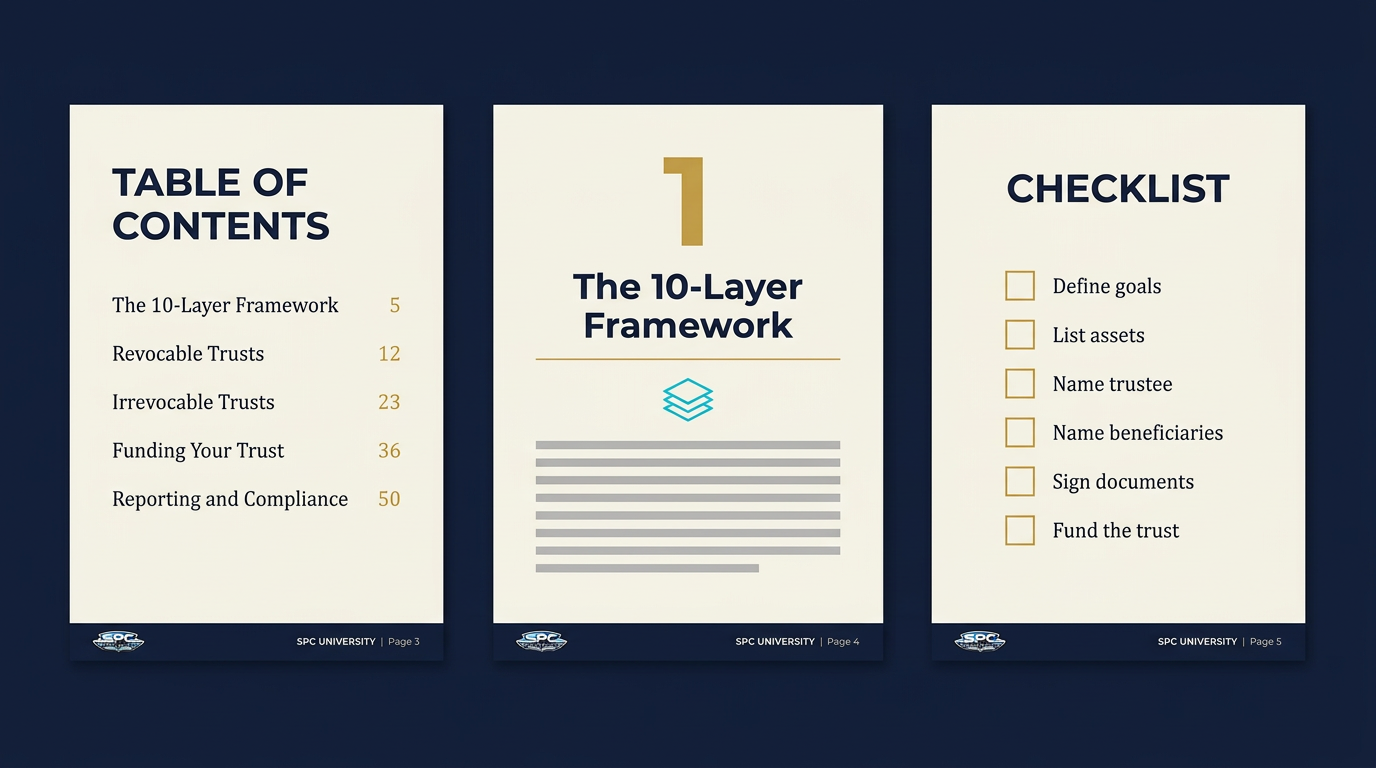
10-Layer Monolith Blueprint
Complete Visual Architectural Pillar System
FACULTY: Yusef El (Founder, SPC University)
PUBLISHER: SPC University Press
CATALOG ID: SPCU-LIB-003-TRUST
OFFICIAL PRICE: .00
JURISDICTION: Private Common Law / Pure Trust
Official Client & Buyer Deliverable
Licensed to the purchaser by SPC University . All legal instruments, affidavits, and fill-in templates below are verified and immediately operable.
✔ Operational Checklist & Milestones
NOW, THEREFORE, the Trustee hereby acknowledges receipt of the Trust Estate and agrees
to hold, manage, invest, reinvest, and distribute the same pursuant to the terms, conditions,
and trusts herein set forth. The formal name of this trust estate shall be:
" [NAME OF TRUST] "
Article II: Absolute Settlor Severance & Irrevocability
This Trust is irrevocable. The Settlor expressly, fully, and irrevocably relinquishes and renounces any and all right, power, title, interest, or reversionary privilege to alter, amend, revoke, terminate, or cancel this Indenture in whole or in part.
Under no circumstances shall any part of the principal or income of the Trust Estate revert
to the Settlor, nor shall the Settlor exercise any power of appointment, administrative power,
or managerial control over trust assets. The Settlor ceases to possess any legal or equitable
interest in the Trust Estate immediately upon execution of this Indenture.
Article III: Discretionary Spendthrift Protections
This Trust incorporates the maximum asset protection permitted under equity and statutory spendthrift doctrine pursuant to Restatement (Third) of Trusts § 56 and Uniform Trust Code § 502:
This Trust incorporates the maximum asset protection permitted under equity and statutory spendthrift doctrine pursuant to Restatement (Third) of Trusts § 56 and Uniform Trust Code § 502:
No interest of any Beneficiary in the principal or income of this Trust shall be subject to
anticipation, assignment, pledge, sale, attachment, execution, garnishment, sequestration, or
seizure by any creditor of any Beneficiary, whether civil, bankruptcy, or matrimonial.
No Beneficiary shall possess any vested property right or enforceable claim against the Trustee
for any distribution. Distributions of income or principal shall be made solely within the absolute,
uncontrolled, and unreviewable discretion of the Trustee. Any attempted assignment or levy by a
creditor shall be void ab initio, and the Trustee shall immediately withhold all distributions
to such Beneficiary until said claim is extinguished.
Article IV: Comprehensive Powers of the Trustee
The Trustee shall hold full legal title and plenary managerial authority over all Trust property,
including without limitation:
(a) To purchase, sell, exchange, mortgage, lease, and encumber real and personal property;
(b) To open, maintain, and disburse funds from commercial bank checking, savings, and brokerage accounts;
(c) To form, own, capitalize, and operate limited liability companies, private corporations,
and holding partnerships as subsidiary entities of the Trust;
(d) To execute promissory notes, security agreements, UCC-1 financing statements, and deeds;
(e) To institute, defend, settle, or arbitrate any legal or administrative action on behalf of the Trust;
(f) To employ attorneys, accountants, investment advisors, and agents at the expense of the Trust.
Article V: Trust Protector & Advisory Council Governance
The initial Trust Protector of this Trust shall be: [TRUST PROTECTOR NAME] .
The Trust Protector shall act in a fiduciary capacity for the sole purpose of ensuring the
faithful execution of this Indenture. The Trust Protector shall possess the unilateral power:
(a) To remove any Trustee with or without cause upon thirty (30) days written notice;
(b) To appoint a Successor Trustee to fill any vacancy;
(c) To change the governing jurisdiction and situs of this Trust to another sovereign state
or foreign jurisdiction if deemed necessary to protect trust assets from political or judicial duress.
Schedule B: Statutory Certificate of Trust (UTC § 1013)
The Certificate of Trust below is the official statutory instrument presented to banks, title companies, and government registries to verify the Trust without revealing private indenture terms or beneficiaries:
================================================================================
STATUTORY CERTIFICATE OF TRUST
(Pursuant to Uniform Trust Code § 1013 & Applicable State Law)
================================================================================
WHEREAS, the Settlor desires to create an Irrevocable Pure Common Law Trust Estate
for the preservation of family wealth, asset protection, and multi-generational succession; and
WHEREAS, the Settlor has contemporaneously transferred, assigned, and conveyed unto the Trustee
the initial sum of One Hundred Dollars ($100.00) in lawful money of the United States,
together with the property described in Exhibit A attached hereto (the "Trust Estate");
NOW, THEREFORE, the Trustee hereby acknowledges receipt of the Trust Estate and agrees
to hold, manage, invest, reinvest, and distribute the same pursuant to the terms, conditions,
and trusts herein set forth. The formal name of this trust estate shall be:
Article II: Absolute Settlor Severance & Irrevocability
(e) To institute, defend, settle, or arbitrate any legal or administrative action on behalf of the Trust;
(f) To employ attorneys, accountants, investment advisors, and agents at the expense of the Trust.
Article V: Trust Protector & Advisory Council Governance
The initial Trust Protector of this Trust shall be: [TRUST PROTECTOR NAME] .
The Trust Protector shall act in a fiduciary capacity for the sole purpose of ensuring the
faithful execution of this Indenture. The Trust Protector shall possess the unilateral power:
(a) To remove any Trustee with or without cause upon thirty (30) days written notice;
(b) To appoint a Successor Trustee to fill any vacancy;
(c) To change the governing jurisdiction and situs of this Trust to another sovereign state
or foreign jurisdiction if deemed necessary to protect trust assets from political or judicial duress.
SPC UNIVERSITY · SCHOOL OF PRIVATE CIVICS · LAW • COMMERCE • EMPOWERMENT
Official Unabridged Buyer & Student Edition (18,342 Words). Educational trust, estate, equity, and constitutional curriculum. Not personalized legal, tax, or investment advice.