Short answer:
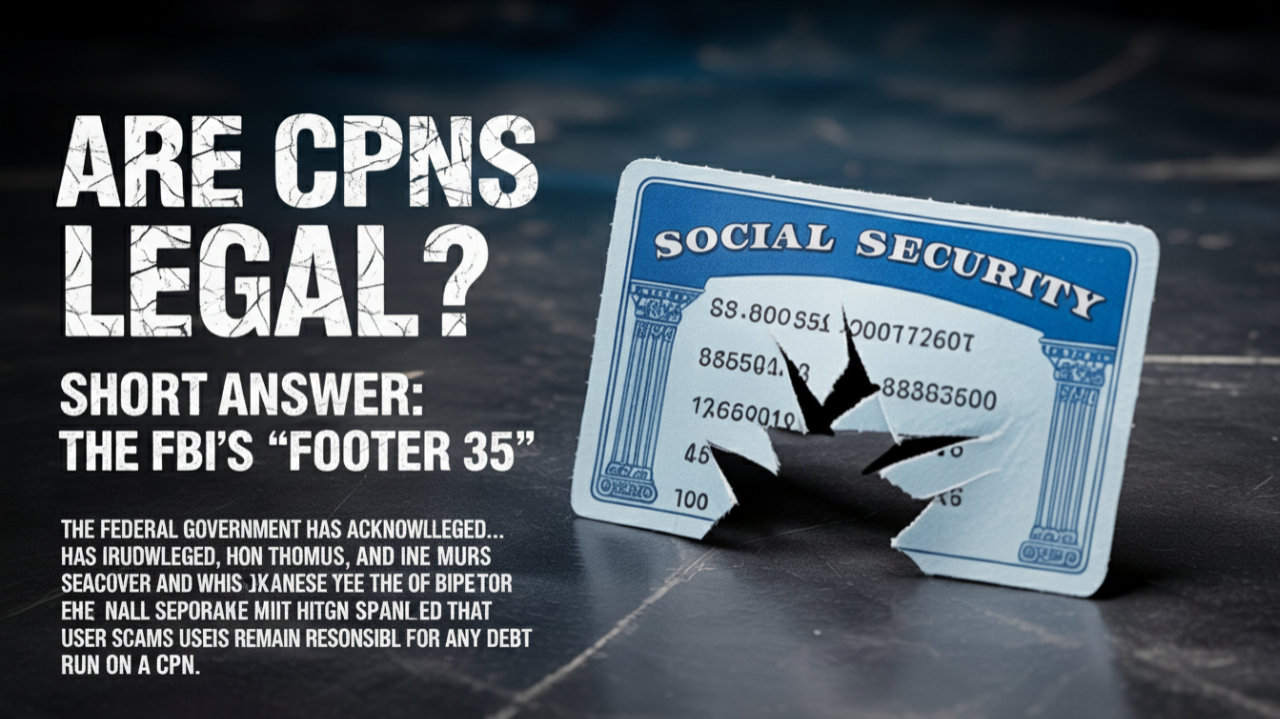
The federal government has acknowledged the existence and some lawful privacy uses of so-called Credit Privacy Numbers (CPNs), but that acknowledgement is narrow — and using a CPN to misrepresent your identity or to obtain credit by deception can be unlawful. The FBI mortgage-fraud report’s footnote 35 is a useful touchstone: it says CPNs are nine-digit file numbers used like Social Security Account Numbers for financial reporting and notes that “federal law allows individuals to legally use CPNs for financial reporting,” while also warning that paid-for CPN services are often scams and that users remain responsible for any debt run on a CPN.
Mortgage Fraud Report- Red Foot…
Below I explain what that means in plain English, what the legal limits are, and the practical risks.
1) What is a “CPN” (Credit Privacy Number)?
“CPN” is a market name for a nine-digit identifier that some people try to use in place of a Social Security number on credit or loan applications. Promotional materials and websites present CPNs as a privacy tool or a way to start a new credit file. The documents you supplied describe the privacy-law argument — that federal privacy rules limit when an SSN may be demanded and that private businesses do not always have a statutory right to require an SSN.
CPN (1)
2) What the FBI said in footer 35 (why the report is important)
The FBI’s 2008 Mortgage Fraud Report expressly mentions CPNs in a numbered footnote (footnote 35). That footnote states: https://spcuniversity.com/credit/
“Credit Privacy Numbers (CPNs) are nine-digit file numbers that follow the same algorithm as Social Security Account Numbers (SSANs). Currently, federal law allows individuals to legally use CPNs for financial reporting and protects those individuals who do not wish to disclose their SSAN. Individuals who acquire CPNs are completely responsible for any debt they incur using this number. Acquiring a CPN is supposed to be a free service; therefore, Web sites that offer CPNs for a fee are most likely scammers. Mortgage Fraud Report- Red Footer 35 https://spcuniversity.com/credit/
That passage does three things at once:
- It acknowledges CPNs exist and are used in the credit ecosystem. Mortgage Fraud Report- Red Foot…
- It recognizes a narrow privacy claim — that federal law protects some people who refuse to disclose an SSN in contexts where disclosure is not mandatory. CPN (1)
- It warns consumers about paid CPN services and stresses personal responsibility for debts run on a CPN.
Mortgage Fraud Report- Red Foot…
So: the FBI report does not issue a general “green light” to use CPNs to conceal identity or to obtain credit by misrepresentation. It records that CPNs are used and that paid sellers are often scams — and the agency treats CPNs as one feature of credit-enhancement schemes that can be abused in fraud schemes.
Mortgage Fraud Report- Red Foot…
3) Where CPNs can be lawful — and where they cross the line
Potentially lawful uses (limited):
- If a private business voluntarily accepts an alternate identifier and you honestly disclose that the identifier is a privacy ID (not an SSN), that transactional arrangement may not itself be a federal crime — the Privacy Act and related guidance limit government agencies’ ability to force SSN disclosure in many contexts. The CPN materials emphasize the narrow protection for refusing to disclose an SSN in non-mandatory settings.
CPN (1)
When use is likely illegal or risky:
- Misrepresentation to creditors or lenders. If you supply a CPN but represent it as your SSN (or conceal a material fact to obtain credit), that can be fraud, wire fraud, bank fraud, or identity-theft (and state statutes often criminalize similar conduct). The FBI report ties CPNs to “credit enhancement” schemes that facilitate mortgage fraud and other illicit activity.
Mortgage Fraud Report- Red Foot… - Using someone else’s SSN or a recycled SSN. Some paid CPN sellers supply numbers that are actually assigned to other people (including deceased persons) or stolen SSNs — using those numbers is identity theft and a federal crime. The FBI explicitly flags paid CPN services as likely scams. This is also the reason so many attorneys claim that using a CPN is identity theft. They are referencing the instances CPNs are used in this manner even though this is not the proper way CONS are to be created or used.
Attempting to evade statutory obligations. Using alternate paperwork to avoid tax reporting, subpoenas, or court processes can raise serious criminal and civil exposure. The “CPN as a shield” argument does not immunize you from taxes, judgments, or regulatory obligations.
CPN (1)
4) Civil consequences and enforcement
The FBI and other agencies investigate mortgage-fraud and credit-enhancement schemes; the Mortgage Fraud Report places CPNs in that broader enforcement context and warns of scams and abuse. Even where criminal charges are not filed, misuse of a CPN can produce civil liability (for fraud, for breach of loan documents), credit reporting disputes, and loss of access to mainstream lenders. The report also notes that individuals who use a CPN remain “completely responsible for any debt they incur using this number.”
Mortgage Fraud Report- Red Foot…
5) Bottom line — what “legal” actually means here
- Yes, the FBI report acknowledges narrow lawful uses and recognizes privacy protections that limit mandatory SSN disclosure in some contexts. That is the statement you asked me to use and quote (footer 35).
Mortgage Fraud Report- Red Footer 35: Download here: https://spcuniversity.com/credit/ - No, that acknowledgement is not a license to hide, to deceive, or to buy a number from an online “CPN vendor.” Buying a number, misrepresenting a CPN as an SSN, or using a CPN that is actually another person’s SSN is dangerous and commonly tied to mortgage-fraud and identity-theft schemes (the very abuses the FBI report discusses).
Mortgage Fraud Report- Red Footer 35 https://spcuniversity.com/credit/
6) Practical, safe advice (non-legal-advice)
- Don’t buy a “CPN” service that charges a fee — the FBI footnote warns those sellers are likely scammers. Mortgage Fraud Report- Red Foot…
- If you have privacy concerns about your SSN, use lawful privacy tools: credit freezes, fraud alerts, identity-protection services from reputable firms, and the statutory protections that restrict mandatory SSN disclosure in many contexts. See the Privacy Act and consumer protection guidance (the CPN materials refer to these statutory protections). CPN (1)
- If you’ve been offered a CPN confirm that the CPN has never been issued by going to an SSN VALIDATOR. This is a necessary step to insure you do not get accused of identity fraud. Mortgage Fraud Report- Red Foot…
Closing thought
Footnote 35 is important because it records a narrow, factual observation: CPNs exist, federal law recognizes limits on mandatory SSN disclosure in some contexts, and consumers remain liable for debts run on such numbers — and websites charging for CPNs are often scams. That combination explains why some attorneys warn strongly against CPNs: the legal space is narrow, the enforcement and fraud risks are real, and the practical upside is limited compared with safe, lawful privacy tools.
Mortgage Fraud Report- Red Foot…
CPN (1)
Sources (from your uploads): mortgage-fraud report (footnote 35) and the “CPN Tips” document. Download Both Here: https://spcuniversity.com/credit/