The Two Constitutions -The Subtle Shift: “For” vs. “Of” in the U.S. Constitution

by Yusef El
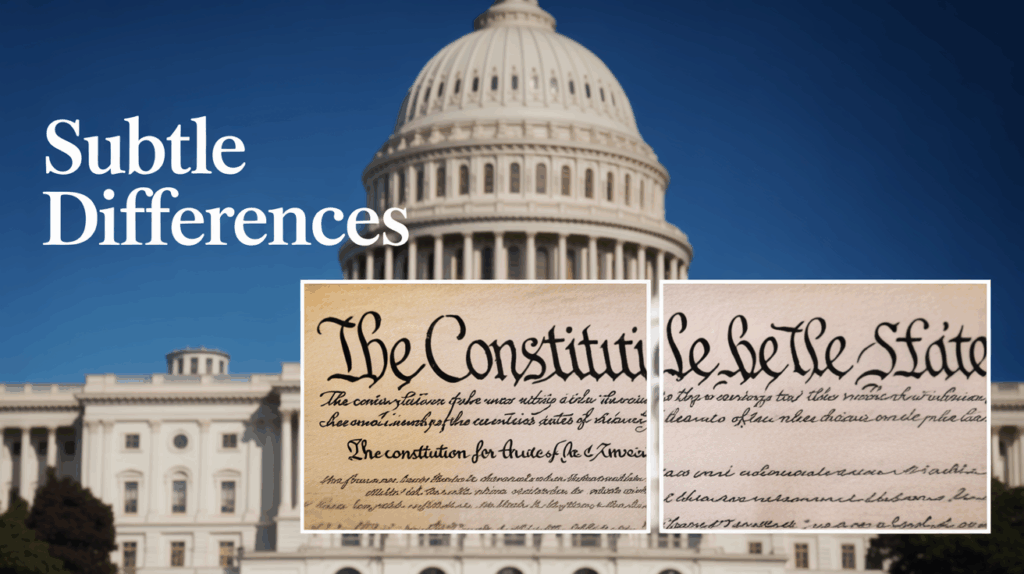
When you hear the phrase The Constitution of the United States, it likely calls to mind the nation’s founding document — the framework of government, the Bill of Rights, and the principles of liberty. But what if I told you there’s a small but significant difference between The Constitution for the United States of America and The Constitution of the United States?
At first glance, it may seem like a matter of semantics. In reality, the difference reflects a deeper story of political shifts, legal interpretations, and even structural changes to the U.S. government itself.
The Original Wording — “For the United States of America
When the Constitution was drafted in 1787 and ratified in 1789, its title read: “The Constitution for the United States of America.”
The choice of the word for was intentional. It positioned the Constitution as an instrument created for the benefit of the union of sovereign states and their people — not as the property of the federal government. The federal body was designed to be a service organization, exercising only the powers the states delegated to it.
In the early decades of the republic, official documents, archival reproductions, and communications largely kept this “for” phrasing intact.
Early Shifts and Interchangeable Use
As the 1800s progressed, both “for” and “of” began appearing in printings, often interchangeably. While most people — including lawmakers — saw no legal distinction, sovereignty-minded researchers note that “for” reflected the original servant-master relationship between the federal government and the states, while “of” hinted at ownership by the federal entity itself.
The Civil War Turning Point
The Civil War (1861–1865) marked a massive centralization of power in Washington. While the war didn’t officially rewrite the Constitution’s title, it set the stage for later structural changes — and for an evolving interpretation of federal authority over the states.
The 1871 Organic Act — Rise of “Of the United States”
In 1871, Congress passed the District of Columbia Organic Act, which incorporated the municipal government of D.C. as a corporate entity. This allowed the federal capital to operate much like a city corporation, managing its own debts and obligations.
Around this time, the “Constitution of the United States” wording became far more common in legal and administrative contexts. Sovereignty researchers argue this marks a symbolic — and possibly functional — shift from a service-oriented federal structure to a corporate-style governing body.
From the Late 1800s to Today
By the late 19th century, “of” dominated official government printings, court opinions, and textbooks. While “for” still appears in reproductions of the original parchment, the average citizen encounters “of” almost exclusively.
Mainstream legal thought treats the two phrases as interchangeable. But for those who examine governance through the lens of trust law, the difference is profound:
- For implies a fiduciary relationship where the federal government serves the states and people.
- Of suggests a charter belonging to, and operating for, the federal corporate entity itself.
Why This Matters Today
Whether you see the change as symbolic or substantive, it raises a key question: is the federal government still the servant of the states and people, or has it become an independent corporate entity with its own interests?
Understanding this subtle shift in language helps frame broader discussions about federal power, states’ rights, and the contractual relationship between the governed and their government.
Is there a difference between the US Constitution and the constitution for the united states of America?
Yes — and the difference is subtle but significant, depending on how you’re looking at it.
1. “The Constitution of the United States”
- This is the formal name of the foundational document ratified in 1788 and effective in 1789.
- It establishes the federal government, separates powers into three branches, and lays out the enumerated powers and limitations of that government.
- In legal usage, “of the United States” is often interpreted as a charter for the political entity called the United States — the federal corporation created to serve the states and the people.
2. “The Constitution for the United States of America”
- This phrasing emphasizes the idea of the Constitution as an instrument for the union of states, not as property of the federal entity.
- Some researchers, particularly in the sovereignty and legal reform communities, see this as the original intent — a trust-like document created for the benefit of the states and the people, rather than as an internal governing charter for a separate corporate government.
- In this view, the shift from for to of in later printings or interpretations is seen as symbolic of the shift from a service-oriented federal body to a self-contained authority.
3. Why the Distinction Matters
- Originalist perspective: “for” reflects that the federal government is the creation and servant of the states/people.
- Post-Civil War perspective: The corporate form of government, especially after the 1871 Organic Act, uses “of” to frame the Constitution as belonging to and governing the incorporated federal jurisdiction (Washington, D.C., and territories).
- In court, both phrases generally refer to the same legal document, but the political and philosophical implications are very different.