THE CONSTITUTION DOES NOT APPLY TO PRIVATE CITIZENS

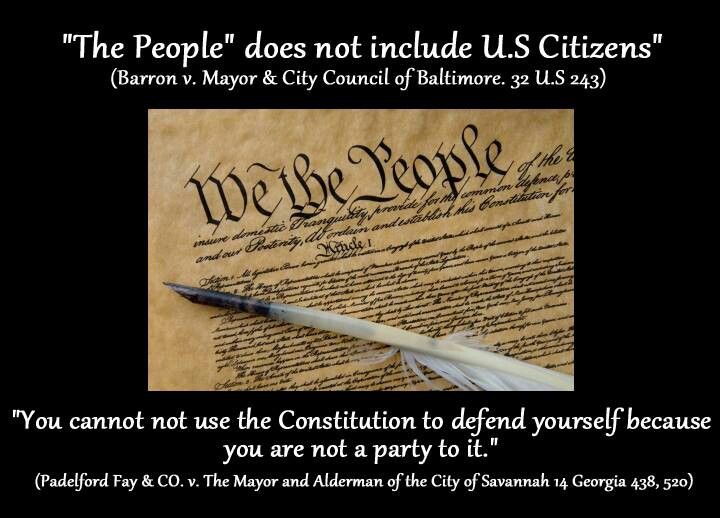
Barron v. Mayor & City Council of Baltimore, 32 U.S. 243 (1833)
https://supreme.justia.com/cases/federal/us/32/243/
Before reading, it’s important to recognize that this case predates the adoption of the 14th Amendment. To fully grasp its significance, you must understand how the Constitution was interpreted before the creation of federal citizenship. The 14th Amendment introduced a distinct class of citizenship—U.S. (federal) citizenship—which effectively bound individuals to the federal government and made them direct parties to the Constitution, altering the original relationship between the individual, the state, and the Union.
The term “Baron vs. Mayor & City Council of Baltimore” refers to a pivotal US Supreme Court case that shaped the relationship between individuals and local governments concerning constitutional rights
.Here’s a breakdown of the case and its implications:
Barron v. Mayor & City Council of Baltimore (1833)
- Parties involved: John Barron, a wharf owner in Baltimore (the “Barron”), and the Mayor and City Council of Baltimore.
- Background: Barron sued the city, claiming that alterations to local streams by the city diverted water flow and caused sediment to accumulate around his wharf, reducing its functionality and value.
- Barron’s Argument: He argued that the city’s actions constituted a taking of private property for public use without just compensation, violating the Fifth Amendment’s Takings Clause.
- Supreme Court Decision: In a unanimous ruling, the Supreme Court, led by Chief Justice John Marshall, determined that the Fifth Amendment, and indeed the entire Bill of Rights, only applied to the federal government, and did not restrict the actions of state or local governments.
- Impact: This decision significantly impacted the understanding of federalism in the US and the scope of the Bill of Rights. It established that individuals could not seek protection under the Bill of Rights in lawsuits against state or local governments.
Mayor and City Council of Baltimore today
- Current structure: Baltimore operates under a strong mayor-council government system.
- Mayor’s role: The Mayor serves as the chief executive, proposing budgets, signing legislation, appointing department heads, and overseeing day-to-day city operations.
- City Council’s role: The City Council is the legislative body, responsible for adopting the budget, approving mayoral appointees, levying taxes, and creating or amending city laws and policies.
- Interactions and power dynamics: The Mayor and City Council work collaboratively to govern Baltimore. However, recent developments, like a 2020 charter amendment, have expanded the City Council’s budgeting authority, allowing them to reallocate and modify the budget without needing mayoral approval, and even to override a mayoral veto with fewer votes.
There are ongoing discussions and proposals aimed at potentially reforming the Board of Estimates and reevaluating the Mayor’s power in financial matters.
In essence, while the historical case of Barron v. Mayor & City Council of Baltimore established limitations on the reach of the federal Bill of Rights to local actions, the relationship between the Mayor and City Council in Baltimore today reflects a system of checks and balances with evolving power dynamics. By Yusef EL
